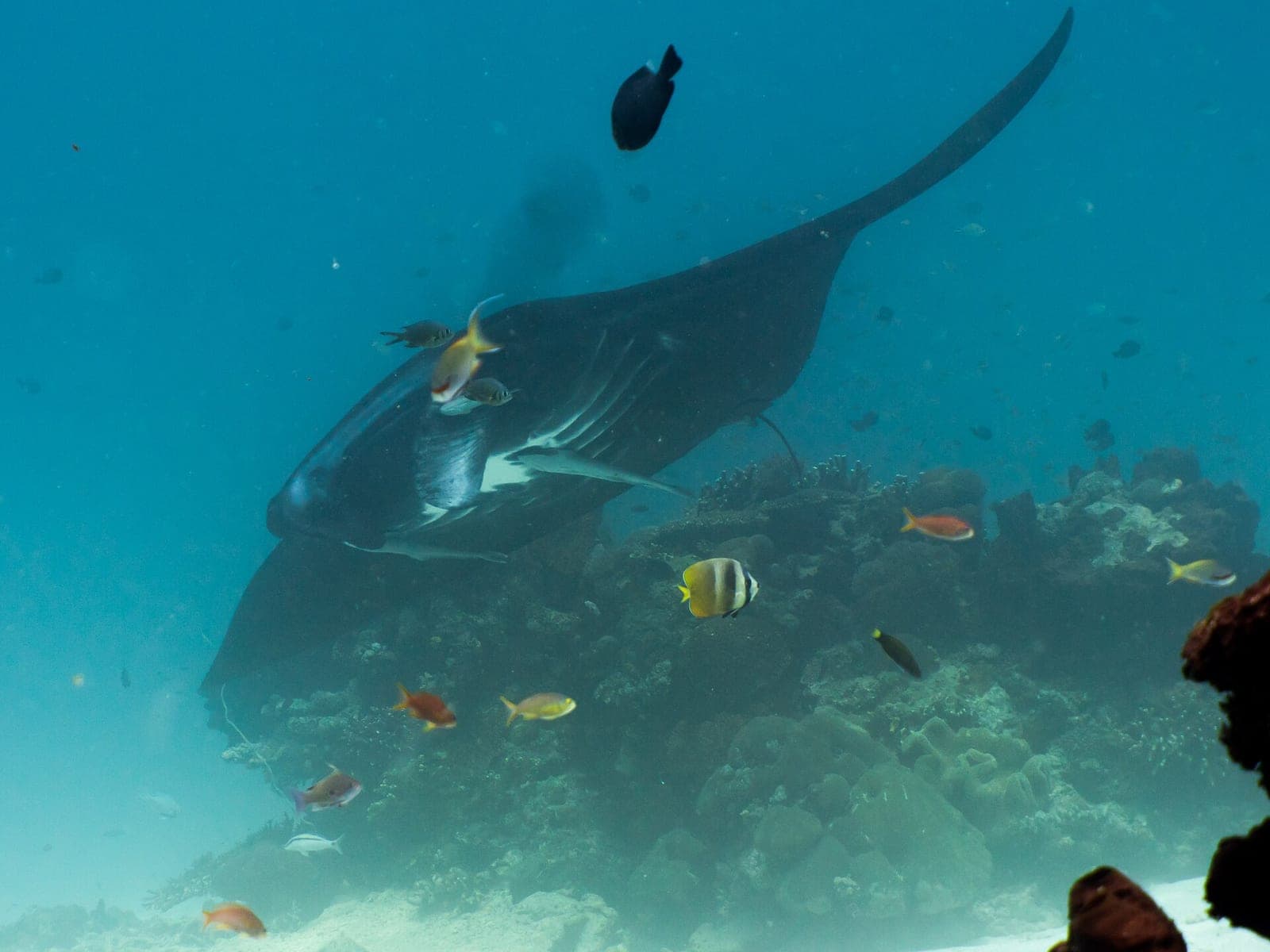
Manta Alley
A narrow channel cut through rock at the far south of Komodo, where mantas stack up in the current like planes waiting to land.
Manta Alley is the dive site that gives Komodo its manta reputation. Tucked into the southern tip of Komodo Island, inside the national park and open to the Savu Sea, it is a current-driven channel and cleaning station where reef mantas — and, on the right day, the big oceanic ones — gather to feed and be cleaned. It is remote, colder than the sites up north, and reached only by liveaboard, which is exactly why the encounters here can be so extraordinary. This is a diver's manta site, not a snorkel splash, and it rewards good buoyancy, patience and respect for the animals.
Quick answer: Manta Alley is a channel and cleaning-station dive around a partially submerged rocky outcrop in Komodo. Best season: Southern-Komodo manta window roughly October to March, with peak aggregations December to February. Level: Advanced recommended (strong, shifting currents). Depth: 5–25 m; cleaning stations around 20–22 m. Typical visibility: Variable — often 10–20 m, and can turn dark and plankton-rich at depth.
Facts verified September 2026
Why Manta Alley is Komodo's signature dive
Plenty of places in Komodo will show you a manta. Manta Alley shows you a squadron. The site sits at the far south of Komodo Island, where the national park meets the open Savu Sea, and its geography is the whole story: towering rocks break the swell, and a channel is hewn straight through the rock, funnelling nutrient-rich water into a corridor mantas seem to love.
On a good day this is one of the most reliable manta aggregation sites in Indonesia. Divers regularly count double figures, and on the best days up to around 40 mantas hang in the flow at once, layered in the current with barely a wingbeat. It is a genuinely different kind of manta dive from the gentle reef-manta cleaning stations further north — wilder, more exposed, and more weather-dependent, which is precisely what keeps the crowds thin and the animals relaxed.
What you'll see underwater
The headline act is the manta ray. Most of what you'll see are reef mantas (Mobula alfredi) using the site as a combined cleaning station, feeding zone and, as local guides put it, a gym — riding the current to hover in place while cleaner wrasse work them over. Manta Alley is also one of the more likely spots in the park to run into the larger oceanic manta (Mobula birostris) and the striking all-dark black-morph mantas, though neither is guaranteed on any single dive.
Beyond the mantas, the rocky outcrop and its sandy slope hold the usual rich Komodo supporting cast.
- Reef mantas in numbers — typically several to a few dozen, occasionally up to ~40
- Oceanic mantas and black-morph mantas on the right days (less predictable)
- Reef sharks patrolling the deeper water and channel edges
- Turtles, schooling reef fish and trevally hunting in the current
- A healthy hard-coral outcrop sloping to sand around 20 m
Conditions and who it's for
Be honest with yourself here: Manta Alley earns its advanced recommendation. Current is the defining feature. It can run strong and surging through the channel, and the topography demands careful positioning — you want to tuck out of the flow at the edges rather than fight it in the middle, both for your own gas and to avoid crowding the animals. There are calmer pockets on either side of the channel and quieter slack-tide windows, and a good guide will plan the dive around the tide to put you in the right place.
The water is noticeably cooler than northern Komodo — roughly 20–25°C thanks to upwelling from the south — so bring more exposure protection than the tropics might suggest; a 5mm and a hood are not overkill. Visibility is variable and can turn dark and green at depth when the plankton that draws the mantas is thick. None of this should scare off a competent diver, but it is not a first-open-water site. Solid buoyancy, comfort in current and a reef hook (used on rock, never on coral or an animal) make all the difference.
When to dive it
Manta Alley runs on a different clock from the famous northern sites. The southern part of the park is fed by cooler, plankton-heavy water, and the manta aggregations here build as that productivity peaks — broadly October through March, with the densest gatherings usually falling between December and February.
That timing is the opposite of Komodo's calm-water high season, which means the south can be exposed and the crossing rougher in those months, and access is firmly weather-and-tide dependent. Many liveaboard itineraries in the mid-year dry season still visit Manta Alley when conditions allow — you can absolutely score mantas outside peak — but if seeing the big aggregations is your single priority, aim for that late-year-into-early-year window and keep your expectations flexible.
How you actually dive it
The plan is usually a negative or prompt descent to get below the surface chop and into position before the current pushes you off the site. Guides drop divers near the channel or the cleaning station depending on the tide, and the technique is simple to say and harder to do: get low, get still, and stay put. Find a bare patch of rock or sand at the edge of the flow, hook or brace yourself, keep your fins down, and let the mantas come to you.
Do not chase them, do not swim over the top of a cleaning station, and do not block their path through the channel — mantas that feel crowded simply leave, taking the dive with them. Hold your position low and they will often cruise in close, sometimes peeling off into the blue and circling back within touching distance (look, don't touch). It is one of those dives where doing less gets you more.
Faneca dives Manta Alley on our Komodo liveaboard routes aboard the Blue Pearl and iLike, since the site's remote southern position means it's only realistically reachable by boat — and even then it's conditions-dependent, so we build the day around the tide and weather rather than promising it on a fixed schedule.
Manta Alley: common questions
What is the best season to dive Manta Alley?
Southern-Komodo manta window roughly October to March, with peak aggregations December to February
What experience level do I need for Manta Alley?
Advanced recommended (strong, shifting currents)
How deep is Manta Alley?
5–25 m; cleaning stations around 20–22 m
What marine life will I see at Manta Alley?
Reef mantas (often 10–40), occasional oceanic mantas and black-morph mantas, reef fish, sharks, turtles
