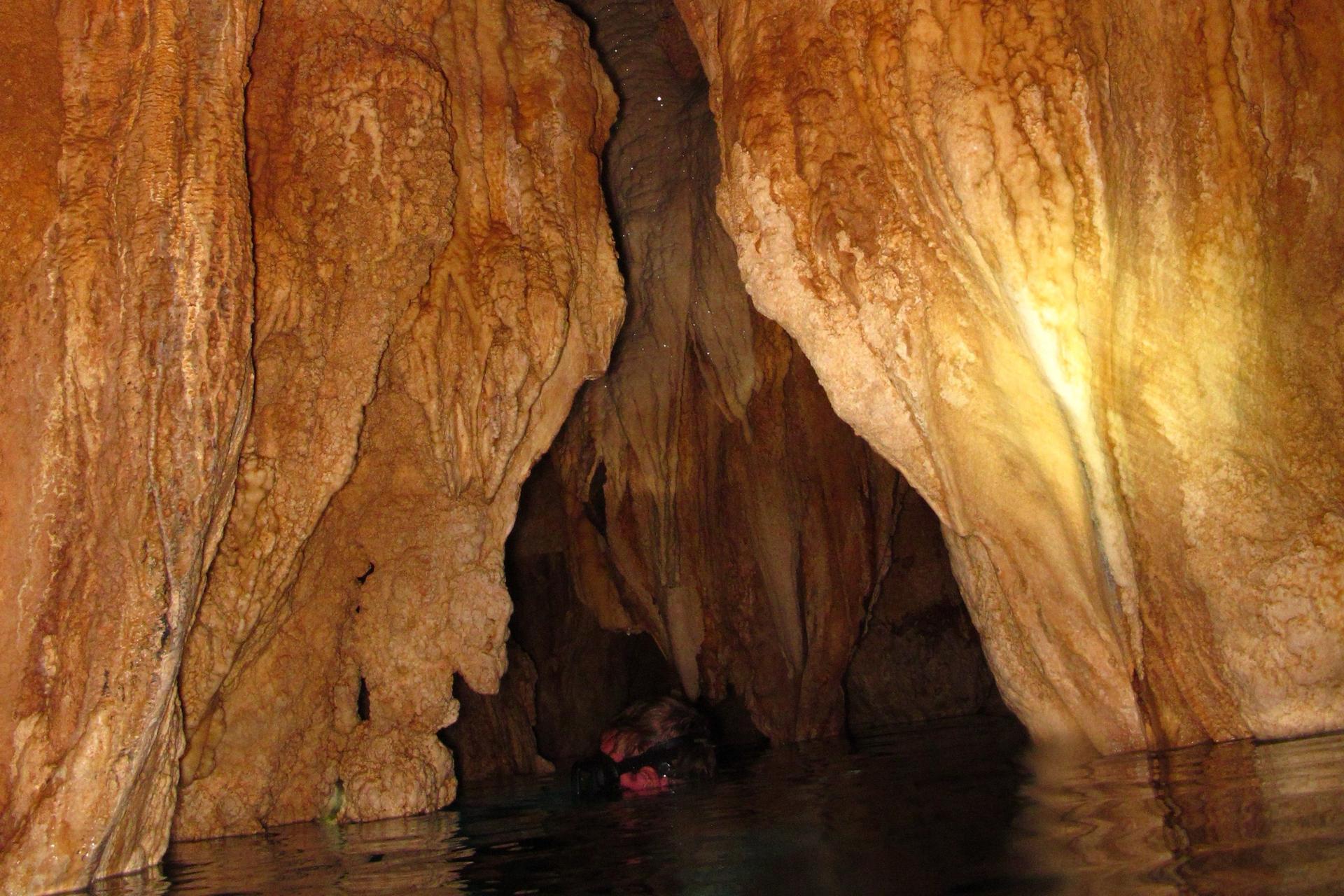
Chandelier Cave
Four flooded chambers under a rock island, with air pockets where you can surface among the stalactites.
Chandelier Cave is five minutes from the dive shops in Koror and nothing like the rest of Palau's diving. There is no current, no wall and no sharks. You swim through an opening a few metres below the surface of Malakal Harbour into a chain of flooded chambers under a limestone island, and in each one you can rise into an air pocket and look up at stalactites that formed when the cave was dry land. It is shallow and short, and it needs a torch and good buoyancy rather than a big logbook. Most divers come out grinning, and it is the dive people describe first when they get home.
Quick answer: Chandelier Cave is a shallow cavern dive with air chambers in Palau. Best season: Year-round; a sheltered harbour site that dives in almost any weather. Level: Guided cavern dive; Open Water with good buoyancy, not for anyone uneasy in the dark or in an overhead. Depth: Entrance about 4 m below the surface; maximum about 11 m. Typical visibility: Clear inside the chambers unless fins stir up the silt on the floor.
Facts verified November 2026
What Chandelier Cave is
The cave lies under a limestone island in Malakal Harbour, beside Koror and close to most of the town's dive centres. Its entrance is an opening about three metres wide, roughly four metres below the surface, at the foot of the island.
Inside are five connected chambers. Four are flooded, each with an air pocket at the top; the fifth is completely above water. The cave formed when sea level was much lower during the last ice age: rainwater seeping through the limestone built up the stalactites and stalagmites, and the rising sea flooded the cave afterwards. The formations that give it its name hang from the ceilings of the air pockets right down to the waterline.
What you'll see
The point of the dive is the cave itself, and it is best seen slowly, by torchlight, with time spent at the surface of each chamber looking up.
- Stalactites hanging to the waterline in the air pockets, and stalagmites rising from the floor below
- Four flooded chambers, each with room to surface, linked by short swim-throughs
- A halocline deeper inside, where fresh and salt water meet and the water shimmers
- Cardinalfish and soldierfish in the shade of the entrance
- Small shrimps and crabs on the sponges along the walls
- Mandarinfish around the entrance, if you are patient enough to find them
Conditions and who it's for
There is no current and the depth never gets beyond about 11 metres, so this is not a demanding dive physically. What it asks for is comfort in the dark and in an overhead, and buoyancy good enough to keep your fins off the floor. The floor is silty, and one careless kick can turn clear water into a cloud for everyone behind you. Divers who are claustrophobic or uneasy about darkness should skip it.
Always dive it with a guide who knows the cave, and carry a torch; the entrance is lit by daylight but the chambers further in are not. When you rise into an air pocket, go slowly with one hand above your head so you do not hit a stalactite, which hurts you and breaks a formation that took thousands of years to grow. Keep your regulator in unless your guide tells you otherwise. Beyond the last chamber, passages continue into the island over slippery mud; that is not part of the dive.
When to dive it
Any time. Chandelier Cave is a few minutes from the dock and sheltered inside the harbour, so weather and season make almost no difference to it, and it is often dived when wind or swell keeps boats off the outer reef. It is commonly the last dive of a day, or part of the first day's dives on a trip that leaves from Malakal Harbour.
If mandarinfish are on your list, ask about a late-afternoon dive: they are most active around dusk. For the outer-reef sites, where the season matters much more, see our Palau diving season guide.
How you actually dive it
The boat ties up beside the island and you descend a few metres to the entrance. The guide leads the group through the chambers one by one; in each, you rise slowly into the air pocket, take in the formations with your torch, then drop back down and follow the guide through to the next. The way back is visible from each chamber, and the whole dive is retraced to the same entrance.
It is a short dive by Palau standards and a gentle one. Use the time in the air pockets to look around properly, and keep your torch beam on the formations rather than in other divers' eyes.
Our Palau trips leave from Malakal Harbour, and Chandelier Cave is one of the harbour dives at the start or end of the week on the Best of Palau itinerary we sell, usually paired with the Iro wreck. Sites and order always depend on the weather and the tide.
Chandelier Cave: common questions
What is the best season to dive Chandelier Cave?
Year-round; a sheltered harbour site that dives in almost any weather
What experience level do I need for Chandelier Cave?
Guided cavern dive; Open Water with good buoyancy, not for anyone uneasy in the dark or in an overhead
How deep is Chandelier Cave?
Entrance about 4 m below the surface; maximum about 11 m
What marine life will I see at Chandelier Cave?
Cardinalfish and soldierfish at the entrance, small shrimps and crabs on the walls, mandarinfish around the entrance for patient divers; the stalactites and stalagmites are the real attraction