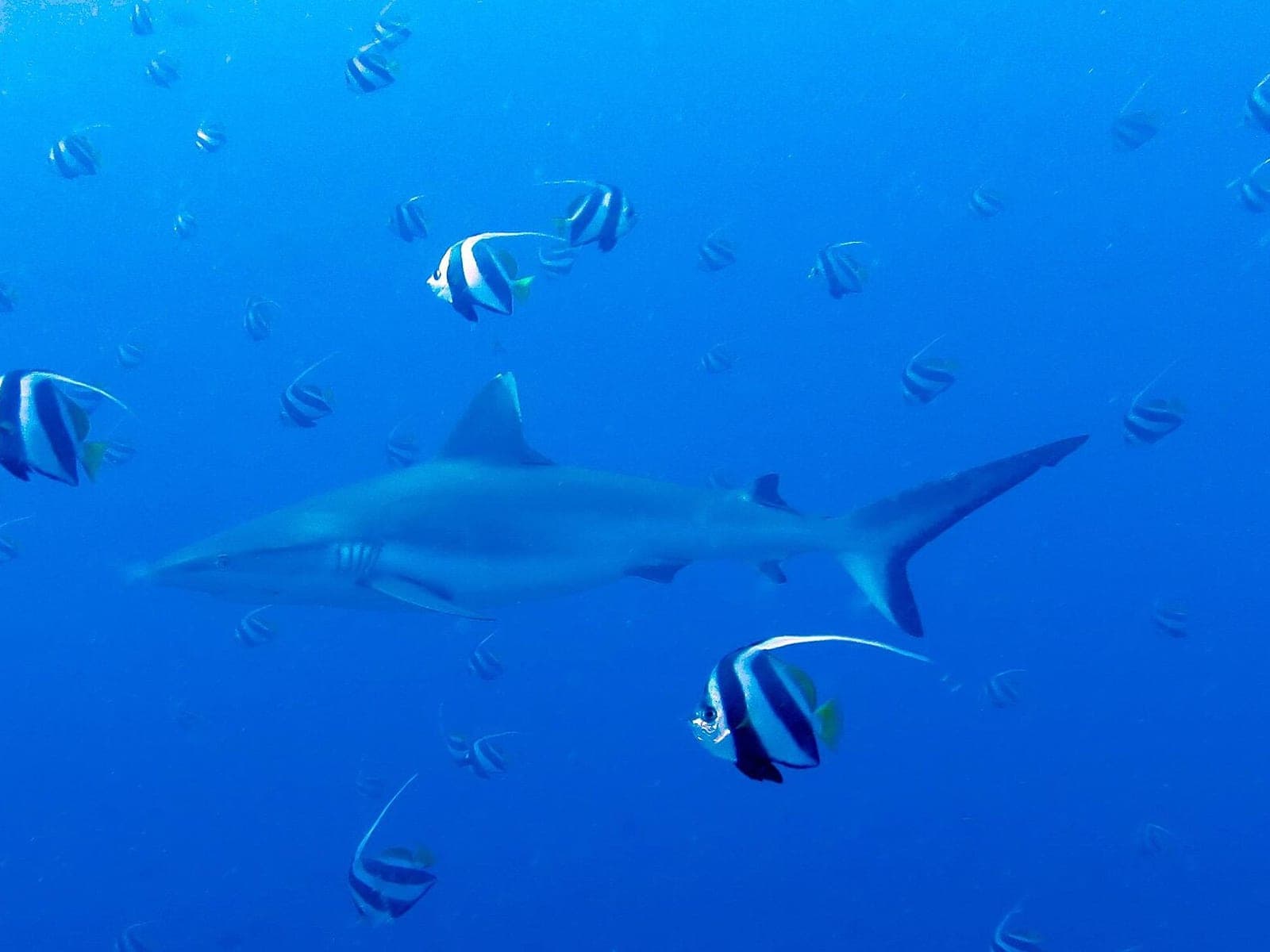
Twin Tunnels
Two lava chimneys, a dark descent, and a doorway that opens onto blue water and circling sharks.
Twin Tunnels is the signature swim-through dive of the Florida Islands and one of the most quietly thrilling sites in the Solomon Islands. A submerged seamount rises to within a dozen metres of the surface, and threaded through it are two vertical lava tubes that drop like elevator shafts into the reef. You enter from a sunlit coral garden, sink through a fan-lined chimney in near silence, and exit through a cavern mouth around 36 metres onto a sheer wall where fusiliers, jacks and reef sharks patrol the drop-off. It is geology and pelagic action in a single dive, and it dives beautifully from a Solomon Islands liveaboard.
Quick answer: Twin Tunnels is a seamount, two vertical lava tunnels into a cavern, then a wall dive in Solomon Islands. Best season: April to November (dry season) for the calmest seas and best access. Level: Advanced — depth plus a short overhead environment. Depth: 12m plateau top to ~36m at the cavern exit. Typical visibility: Typically 20–40m, often exceptional in the blue.
Facts verified September 2026
What makes Twin Tunnels special
Most swim-throughs are horizontal — you slip through an arch or a short cave and pop out the far side. Twin Tunnels does something rarer. The seamount top sits at around 12 metres, and set into it are two vertical shafts, ancient lava tubes formed when this whole channel was volcanically alive. You descend down them rather than through them, and that vertical geometry is what gives the dive its drama.
The tunnels are wide — comfortably big enough to fin down in a relaxed, upright posture with a camera — so this is not a tight technical cave. Light pours in from above and the walls are upholstered in gorgonian sea fans, whip corals and sponges. Around 34 to 36 metres the shaft turns and opens through a cavern mouth onto the outer wall of the seamount. That transition, from enclosed rock into sudden open blue, is the moment divers remember. It is one of the most photogenic exits in the Solomon Islands.
What you'll see
The dive gives you two distinct worlds. Inside the tunnels the mood is cathedral-quiet: fan corals, whip corals, and in the shadows the nocturnal crew — soldierfish, squirrelfish and bigeyes hanging in the gloom. Look closely on the larger gorgonians and your guide may point out pygmy seahorses rocking with the surge.
Then the cavern opens and the energy changes completely. The wall and the blue beyond it are where the pelagic traffic runs.
- Grey reef and whitetip reef sharks patrolling the wall and the blue off the exit
- Schooling fusiliers, plus trevally, kingfish and passing tuna hunting the baitfish
- Barracuda and midnight snapper schooling along the drop-off
- Gorgonian sea fans, whip corals and sponges lining both shafts
- Pygmy seahorses on the fans, octopus over the rubble, and dense anthias clouds on the plateau
Conditions and who it's for
This is an advanced dive, and it is worth being honest about why. The signature experience — descending the shafts and exiting the cavern — happens at 34 to 36 metres, so you are working at the deeper end of recreational limits with a short overhead section above you. You want solid buoyancy, comfort with depth, and ideally some experience in caverns or swim-throughs before you drop in.
The good news is that Twin Tunnels is forgiving by Solomons standards. Currents here are usually mild to moderate and rarely strong enough to need a reef hook, and visibility is typically 20 to 40 metres with warm 27–30°C water year-round. Because it sits so close to Honiara and Tulagi it can also be dived as a day trip with a Guadalcanal-based operator, but the relaxed, unhurried version — arriving early, diving it clean, then repeating it — is very much a liveaboard experience.
When to dive it
The Solomon Islands dive season runs broadly from April to November, the drier months, when seas are calmest and boat access to the Florida Islands is most reliable. Visibility in the Solomons does not follow a strong seasonal pattern — it tends to be excellent most of the year — but sea state and comfort of the crossing from Honiara do, which is why the dry season is the sweet spot.
Water temperature stays warm all year at roughly 27 to 30°C. A 3mm wetsuit suits most divers, though repetitive deep dives on a liveaboard week can leave you wanting 5mm by the third or fourth day.
How you actually dive it
You'll usually giant-stride onto the seamount top at around 12 metres and drop down the colourful plateau to locate the two tunnel entrances. Guides brief the route carefully: which shaft you'll take, where it turns, and where it opens onto the wall — orientation matters here because the exit is not visible from the entrance.
From there it's a straightforward plan. Descend a shaft, follow it down to the cavern mouth near 36 metres, exit onto the wall, and begin your slow, gradual ascent up the reef face back toward the plateau — logging the shark and fusilier action in the blue as you go. Watch your gas and no-deco time closely given the depth, and finish shallow on the seamount top, which is a fine safety-stop garden in its own right. A torch is worth carrying to light up the fans and the nocturnal fish inside the shafts, and a computer you trust is non-negotiable on a dive built around 36 metres.
Faneca dives Twin Tunnels on our Solomon Islands liveaboard trips aboard the Bilikiki and Solomons Master, which sail from Honiara and reach the Florida Islands early in the itinerary — so the site is a realistic, well-timed stop during the calmer April-to-November season rather than a hoped-for extra.
Twin Tunnels: common questions
What is the best season to dive Twin Tunnels?
April to November (dry season) for the calmest seas and best access
What experience level do I need for Twin Tunnels?
Advanced — depth plus a short overhead environment
How deep is Twin Tunnels?
12m plateau top to ~36m at the cavern exit
What marine life will I see at Twin Tunnels?
Grey reef and whitetip sharks, trevally, tuna, barracuda, fusiliers, gorgonian fans, pygmy seahorses
