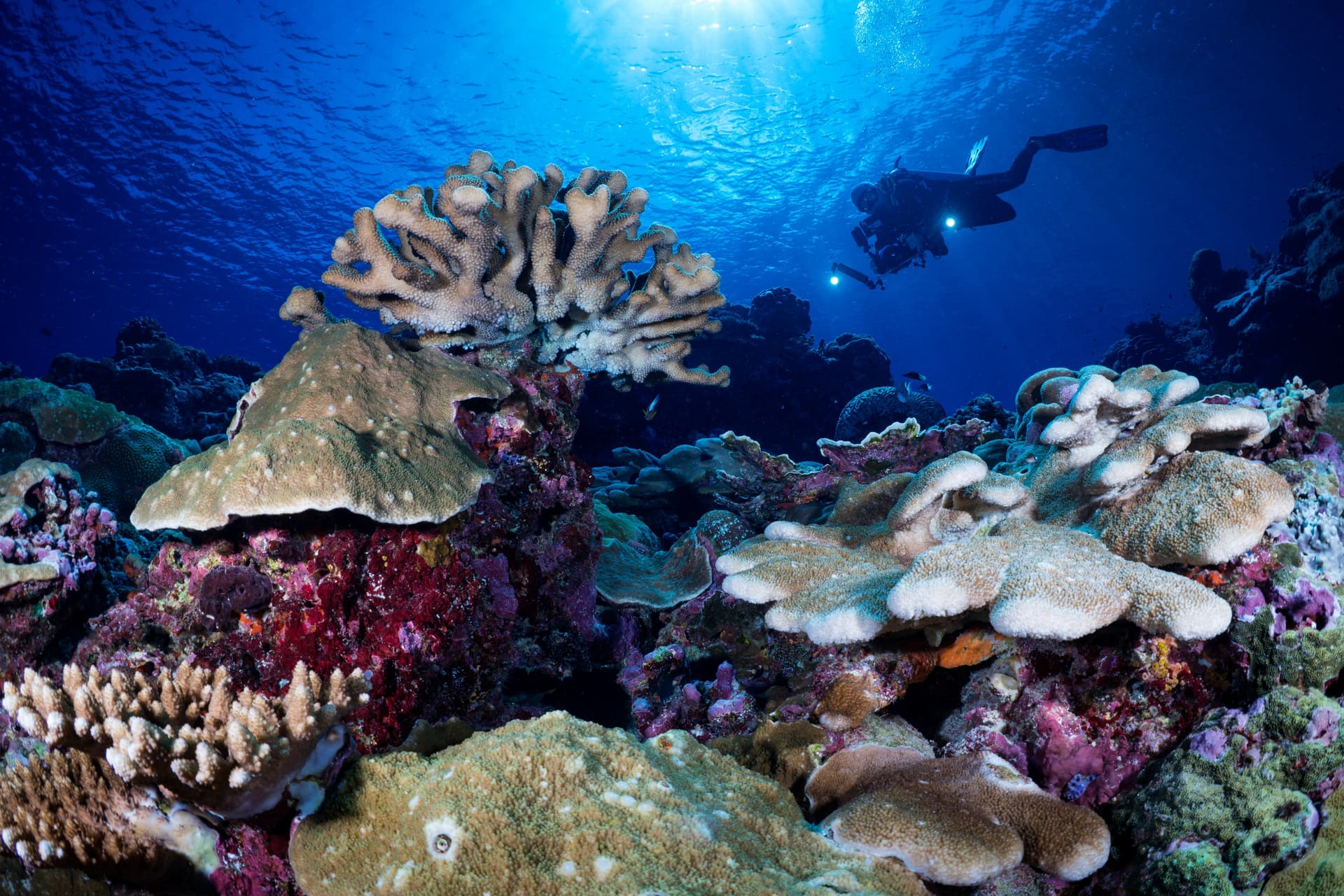
Grand Central Station
One reef. Nearly 280 fish species. This is why Grand Central Station is the busiest dive site in the Solomon Islands.
Off the tip of tiny Njari Island, about 15km northwest of Gizo, a single coral reef holds one of the highest fish counts ever recorded on the planet. Danny Kennedy of Dive Gizo named it Grand Central Station because the traffic underwater reminded him of rush hour in Manhattan, and the name has stuck for good reason. Fed by currents pushing between New Georgia Sound and the Solomon Sea through Wilson Strait, this is a dive where the water itself seems to be moving with fish. It is one of the signature stops of any serious Solomon Islands diving trip, whether you reach it by day boat from Gizo or aboard a liveaboard working the Western Province.
Quick answer: Grand Central Station is a boat dive; drift or multi-level reef dive depending on tide in Solomon Islands. Best season: Dry season April–November; May and October are the sweet spots. Level: Intermediate — variable current, but often gentle enough for less-experienced divers with a guide. Depth: Reef flat from ~5m sloping and walling to ~30m. Typical visibility: Typically 20m+, occasionally up to 30m.
Facts verified September 2026
What makes Grand Central Station special
Most reefs give you a species here, a school there. Grand Central Station gives you the whole cast at once. In 2004, a Rapid Ecological Assessment by The Nature Conservancy, led by the ichthyologist Dr. Gerry Allen, logged 279 fish species on this one site — at the time the fourth-highest single-site count anywhere in the world. Divers routinely tick off more than 200 species on a single tank here, which is a genuinely rare thing to be able to say about any dive site on Earth.
The reason is geography. Njari sits at a convergence, where nutrient-rich water funnels between New Georgia Sound and the Solomon Sea through nearby Wilson Strait. That moving water is the engine: it feeds the filter-feeders, draws in the plankton, and turns a pretty reef into a pulsing, high-traffic junction. Danny Kennedy, who discovered and named the site during his early explorations out of Gizo, chose the name for exactly that reason — the density and the constant motion read like a subway platform at rush hour.
What you'll see
The headline is the schooling action. When the current runs, the reef edge fills with fish in numbers that are genuinely hard to process on your first dive here.
Beyond the big schools, the smaller stuff is where that record species count actually lives — the wrasses, damsels, gobies, anthias and reef fish packed into every crevice of the coral. Take your time on the reef flat between the bigger encounters and you will understand how one site holds so many species.
- Schooling bigeye and other trevally (jacks), plus barracuda stacked in the blue
- Clouds of fusiliers and anthias hanging over the reef
- Snapper, batfish and reef fish in dense aggregations
- Grey reef sharks, whitetip and blacktip reef sharks patrolling the deeper slope
- Soft corals, sea fans (gorgonians), sponges and whip corals along the wall
- Excellent macro and reef-fish diversity for photographers working the shallows
Conditions and who it's for
Be honest with yourself about current before you splash. On a slack or gentle tide, Grand Central Station is a relaxed, forgiving reef dive that a competent Open Water diver can enjoy at an easy pace. On a running tide it becomes a real drift, and the schooling action is best precisely when the water is moving — so the trade-off is that the best conditions are also the busiest ones to dive.
We rate it intermediate for that reason. You want to be comfortable with buoyancy, with drifting, and with using a reef hook or hanging on the sand rather than the coral when you pause to watch the sharks. There is nothing technical about the depths — the reef flat starts around 5m and the slope carries you to about 30m — but a guide who knows the tide windows makes the difference between a good dive and an unforgettable one.
One thing worth knowing: this reef took heavy damage from the April 2007 tsunami that struck Ghizo Island, and Dive Gizo has run coral-restoration work at Njari in the years since. It may not be exactly what it was two decades ago, but it remains one of the most diverse and alive reefs in the whole of the Solomon Islands.
When to dive it
The dry season, roughly April to November, is the window. Seas are calmer, rainfall is lower and visibility is at its most reliable — commonly 20m or better, occasionally opening up toward 30m. Within that stretch, May and October tend to be the sweet spot: solid conditions with fewer travellers around.
January and February bring the heaviest rain, and many operators use that period for maintenance rather than diving. Water temperature barely changes through the year, sitting at a warm 27–30°C, so a 3mm suit is plenty and multi-dive days are comfortable.
How you actually dive it
Grand Central Station is, first and foremost, a boat dive off Njari Island. The most common way to dive it is as a day trip from Gizo with a land-based operator — a short 20–30 minute run out to the site, often paired with a second dive and a lunch stop on Njari's beach. If you are basing yourself in Gizo, this is the classic outing.
From a liveaboard, access is real but conditional. The main Solomon Islands liveaboard itineraries centre on the Russell, Florida and Mary Islands, and Njari sits well west of that core loop — it comes into range on longer Western Province voyages rather than a standard week. If diving Grand Central Station from a liveaboard is a priority for you, the itinerary and season need to be chosen deliberately, not assumed.
Faneca reaches Grand Central Station through our Solomon Islands liveaboards, the Bilikiki and Solomons Master — but honestly, Njari sits at the western edge of their range, so we build it in on the longer Western Province itineraries or pair a liveaboard week with a few land-based days out of Gizo to be sure you dive it in the right season.
Grand Central Station: common questions
What is the best season to dive Grand Central Station?
Dry season April–November; May and October are the sweet spots
What experience level do I need for Grand Central Station?
Intermediate — variable current, but often gentle enough for less-experienced divers with a guide
How deep is Grand Central Station?
Reef flat from ~5m sloping and walling to ~30m
What marine life will I see at Grand Central Station?
200+ fish species per dive — schooling jacks, barracuda, fusiliers, snapper, batfish, anthias; grey, whitetip and blacktip reef sharks
