Devil's Highway
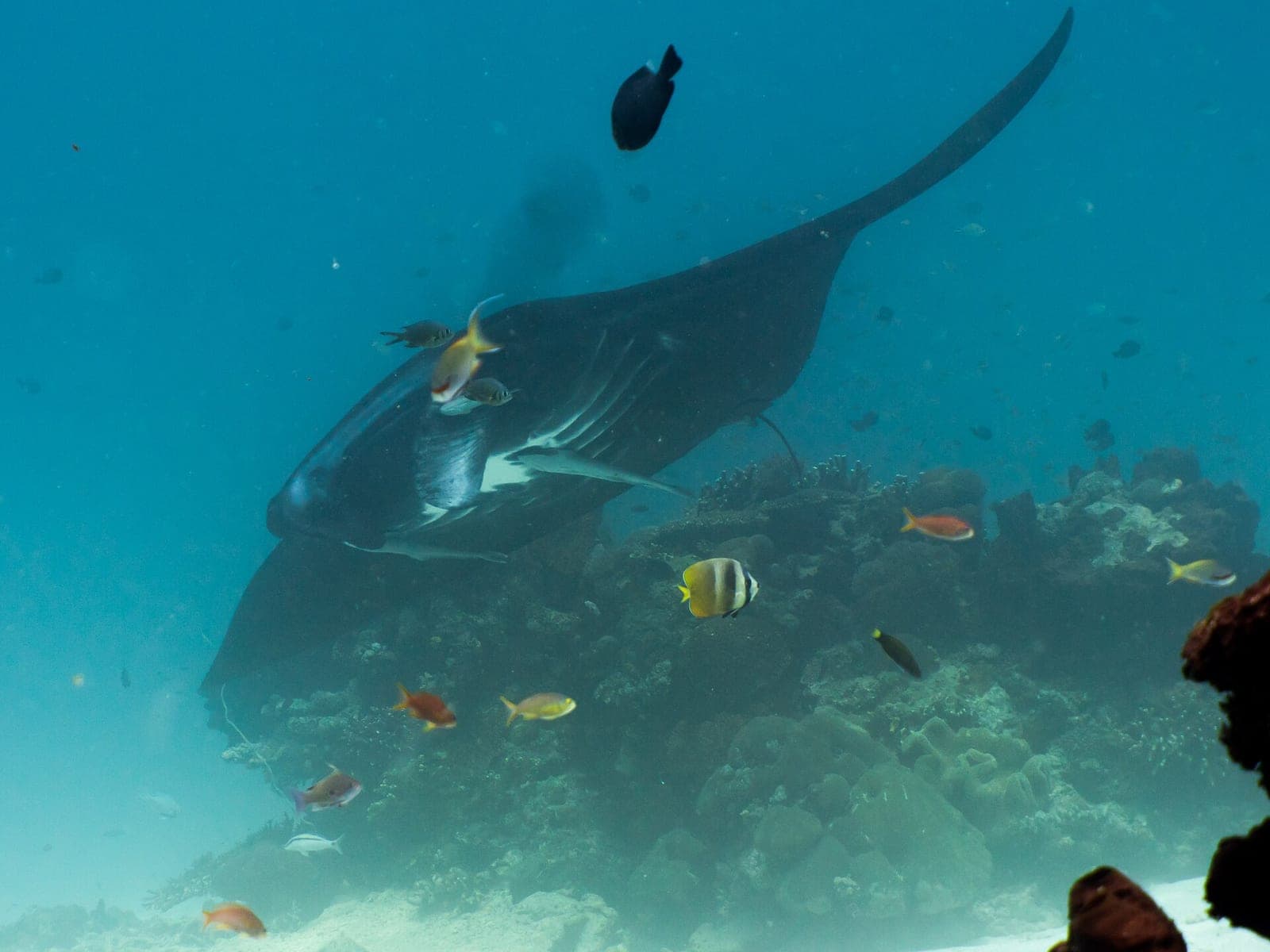
Hook onto the reef, hang in the current, and look up: a dozen reef mantas wheeling overhead in the blue.
Devil's Highway is the Solomon Islands' most famous manta dive, a current-swept channel in the Florida Islands where fast tidal water sweeps plankton over a shallow reef and draws in a resident colony of reef mantas. It is an advanced drift you reach by liveaboard, and when the tides line up it is one of the best big-animal encounters in the Pacific. This guide covers what makes Devil's Highway diving special, what you will actually see, the honest conditions, and how you dive it.
Quick answer: Devil's Highway is a current-swept channel drift / manta cleaning-and-feeding station, reef-hook dive in Solomon Islands. Best season: Around full and new moon for the biggest tides; liveaboard season broadly April–December. Level: Advanced — strong current and reef-hook skills required. Depth: Shallow action at 5–12m; the reef corner and channel wall run down past 20–25m. Typical visibility: Variable, roughly 10–25m — often greener in the nutrient-rich current the mantas come for.
Facts verified September 2026
What makes Devil's Highway diving special
Most manta encounters ask you to hover in calm water and wait. Devil's Highway is the opposite. This is a narrow channel between islands in the Florida (Nggela) group, and twice a day the tide forces a huge volume of water through the gap. That racing current does two things at once: it stacks up plankton over a shallow reef, and it summons a resident colony of reef mantas to feed and be cleaned in it. The name comes from the rays themselves — manta and mobula rays have long been called 'devil rays' for the horn-like cephalic fins that unfurl when they feed.
The result is a genuine spectacle. You settle onto the reef corner, tuck out of the worst of the flow, and watch the mantas work the current above you — banking, looping back, mouths open, cephalic fins scrolled forward like horns. On a good day you can have a dozen animals overhead at once, some with wingspans approaching five metres. It is the Solomon Islands' signature manta dive and, for many divers, the single image they carry home from a Solomons liveaboard.
What you'll see
The stars are reef mantas that treat the channel as both a cleaning station and a feeding station — cleaner wrasse work them over the reef while the current delivers their food. Numbers swing with the tide, from a handful to around a dozen on a strong day. Because they are feeding rather than passing through, encounters can be long and close.
The supporting cast is classic Solomons big-water fare:
- Reef mantas feeding and being cleaned overhead, close and unbothered when you stay low
- Grey reef sharks holding in the current off the channel mouth
- Schooling barracuda, jacks and big-eye trevally stacked in the flow
- Dense reef fish and healthy hard coral on the shallow reef top
- The occasional eagle ray or larger pelagic passing through the blue
Conditions and who it's for
Be honest with yourself here: Devil's Highway is an advanced dive and not a first-week-of-diving site. The current is strong and, at peak tidal flow, can be very strong — this is not a place to be finning against water or drifting without a plan. You need to be comfortable using a reef hook, controlling buoyancy while anchored in flow, and doing a mid-water drifting safety stop with an SMB when you unhook.
The trade-off for that difficulty is honesty about visibility. The nutrient-rich water that brings the mantas also carries plankton, so the channel is often greener and less clear than the gin-blue reefs elsewhere in the Solomons — expect something in the 10–25m range rather than postcard clarity. That murk is the whole point; clear water usually means no mantas. The dive is warm (water sits around 27–30°C year-round) and the shallow depth keeps it long, but the flow demands respect and a briefing you actually follow.
When to dive it
Devil's Highway is tide-driven, so timing is everything, and no operator can guarantee it. The biggest, most reliable currents run around the full and new moon spring tides, which is when the mantas are most likely to gather in numbers — that is the window every skipper hopes to hit. Between the tide state, moon phase, wind and swell all needing to line up, a little serendipity is part of the deal, and the site simply isn't run on every itinerary.
Across the year, the Solomon Islands liveaboard season broadly spans April to December, with the calmer, drier months generally giving the most workable conditions in the Florida Islands. If a manta encounter is the reason you are coming, plan a trip that overlaps a spring-tide window and treat any day it fires as the bonus it is.
How you actually dive it
You reach Devil's Highway by liveaboard, dropping in from a tender at the channel edge as the current runs. The pattern is straightforward but must be flown precisely: descend to the reef corner at around 5–12m, set your reef hook into dead coral or rubble (never live coral), pay out a little line, and hang low and streamlined while the mantas feed above you. Stay tucked, keep your bubbles from spooking them, and let them come to you — they will, repeatedly, as they circle back into the flow.
When you have had your fill, unhook cleanly, get neutral, and let the current carry you off the reef and back toward the shelter of the bay, where the tender collects you. Bring a reef hook, gloves for the hook-on (a rare Solomons exception to the usual reef-friendly no-gloves rule), an SMB and reel for the drifting ascent, and a wide lens — this is a scene, not a macro subject.
Faneca dives Devil's Highway on our Solomon Islands liveaboards aboard the Bilikiki and Solomons Master, which include the Florida Islands on their central Solomons itineraries — we time trips toward the spring-tide windows that give the site the best chance of firing, though the mantas and the current always keep the final say.
Devil's Highway: common questions
What is the best season to dive Devil's Highway?
Around full and new moon for the biggest tides; liveaboard season broadly April–December
What experience level do I need for Devil's Highway?
Advanced — strong current and reef-hook skills required
How deep is Devil's Highway?
Shallow action at 5–12m; the reef corner and channel wall run down past 20–25m
What marine life will I see at Devil's Highway?
Resident reef mantas (up to ~a dozen), grey reef sharks, schooling jacks and barracuda, reef fish
