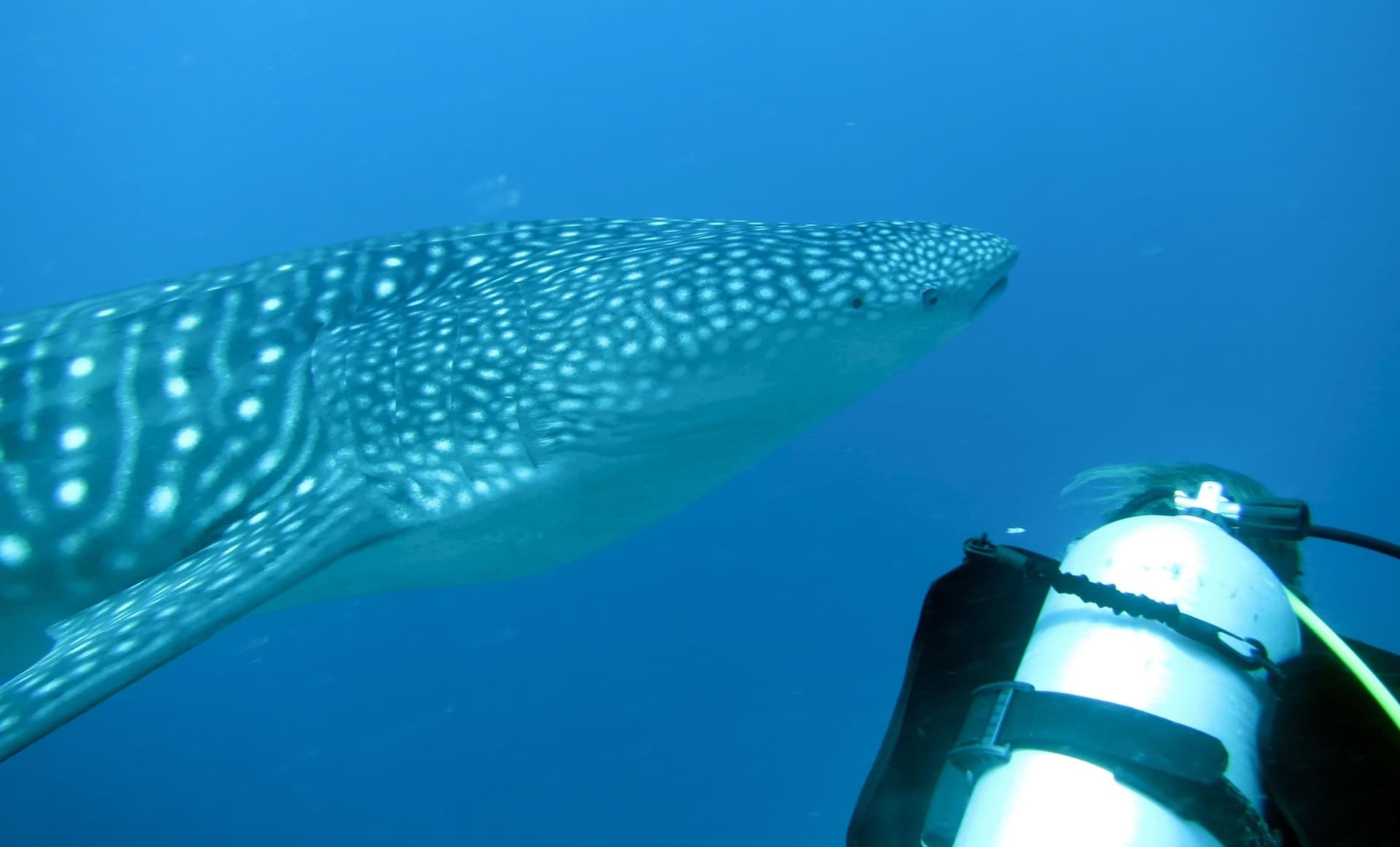
South Ari Whale Shark Area
A protected stretch of outer reef off Maamigili and Dhigurah where young whale sharks are seen in every month, mostly from the surface.
Along the southern edge of South Ari Atoll, whale sharks are recorded in every month of the year. They are mostly immature males, they cruise the outer reef between Rangali, Maamigili and Dhigurah, and many are seen again and again over several years. The reef has been a marine protected area since 2009. For visitors this is mainly a snorkel from the dhoni, run under a code of conduct that is now written into regulation, and it is often crowded. A sighting is never certain.
Quick answer: South Ari Whale Shark Area is a surface search by dhoni and snorkel along a protected outer reef, with reef dives on the same wall in Maldives. Best season: All year: whale sharks are recorded here in every month. December to April usually has the calmest sea for searching; no month guarantees a sighting. Level: The whale shark search is a snorkel and needs no certification: you should be a confident swimmer, comfortable getting in and out of a dhoni in open water. The reef dives on the same wall suit Open Water divers who stay above 18 m. Depth: Whale sharks are met at the surface and in the top few metres; the reef beside them slopes from about 3 m to beyond 30 m. Typical visibility: Variable: clear in settled northeast-monsoon weather, greener with plankton at other times.
Facts verified November 2026
What the area is
The South Ari Marine Protected Area, usually shortened to SAMPA, was declared in June 2009 to protect a whale shark aggregation. It covers the outer reef along the south of the atoll, from Rangali round past Maamigili to Dhigurah, and reaches about a kilometre out to sea from the reef crest. Its rangers are based on Maamigili.
This is a beyru, the ocean-facing outside of the atoll rim. It is neither a thila (a submerged pinnacle) nor a kandu (a channel through the rim). The reef slopes from a few metres down past 30, with deep water beyond. The sharks swim along that slope close to the surface, which is why they can be found from a boat.
What the research says
The Maldives Whale Shark Research Programme identifies the sharks here from photographs of their spot patterns. Published studies of that work describe an aggregation made up overwhelmingly of immature males, present all year, with individuals returning over several years.
Sightings are spread through the year. The northeast monsoon, roughly December to April, usually has calmer seas, which makes the search easier and more comfortable. We have found no research showing that the sharks themselves are more numerous then.
The same research is the source of the uncomfortable facts. A study published in Scientific Reports in 2021 found major injuries on about six in ten of the sharks surveyed and linked them mainly to boats. Tourist boats, carrying snorkellers and divers, are most of the traffic in the area.
The code of conduct
Whale shark encounters in the Maldives are covered by a national regulation announced in October 2024 (Regulation 2024/R-96, an amendment to the Protected Species Regulation), which revised the code of conduct first issued in 2009. These are its main points as published by the government.
- Stay at least 3 metres from the shark's body and 4 metres from its tail
- No touching, no holding on and no feeding
- Approach calmly from the side; do not chase the shark or swim into its path
- Flash photography, selfie sticks and bright lights are restricted
- Boats slow to 5 knots within a 250-metre contact zone around a shark, and to 2 knots within 50 metres
- The number of boats allowed inside the contact zone at one time is capped
Extra rules inside the protected area, and the crowding
Inside the protected area a management plan, in force since February 2025 and amended since, adds a speed limit of 10 knots throughout, registration of boats, and certified guides with no more than six guests each. Published reports of the plan give a limit of six boats in the contact zone, at most 60 people in the water at once and about 15 minutes in the water per group. Propeller guards are required, although the deadline has been moved more than once. Ask the crew for the current figures, because they have changed.
Crowding is a known problem. On a busy day many boats converge on one shark, and in 2026 a ranger told the Maldivian press that overcrowding around the sharks is long-standing and would not be fixed quickly. The rules help only if each group keeps them, so we ask our guests to keep them even when others do not.
Conditions and who it is for
The search is open to anyone on board who swims well. No certification is needed. You should be comfortable stepping from a dhoni into deep open water, swimming steadily with fins for a few minutes, and climbing back up a ladder in some swell.
Scuba diving is permitted in the protected area and divers do sometimes meet a whale shark on a reef dive here, but that is luck. The animals are usually near the surface, and a snorkeller keeps up with them more easily than a diver. The reef dives along the wall are undemanding when the current is light, and Open Water divers can join them if they stay above 18 metres. Water is about 27 to 31°C through the year.
How the search runs from a liveaboard
Many central-atolls weeks give part of a day to this reef. The dhoni runs slowly along the outside of the reef with the crew watching for a shape near the surface. When one is found the guide briefs the group again, the boat stops well clear of the shark, and you slip in quietly and swim beside it, never in front. The shark sets the pace and the length of the encounter. Often it lasts a few minutes before the animal goes deeper.
Some days the reef is empty, or the only shark is surrounded by boats and the right decision is to leave it alone. The usual plan then is to dive the reef, or the manta cleaning station off Rangali, and look again later.
A whale shark search off South Ari is part of many central-atolls weeks, and of some longer routes that pass through Ari Atoll, when the weather and the day allow. It is offered as a search, not a promise. If it is the reason for your trip, say so in your concierge brief and we will look at the weeks that give this reef more time. Our whale shark calendar and the Maldives month-by-month guide cover the seasons.
South Ari Whale Shark Area: common questions
What is the best season to dive South Ari Whale Shark Area?
All year: whale sharks are recorded here in every month. December to April usually has the calmest sea for searching; no month guarantees a sighting
What experience level do I need for South Ari Whale Shark Area?
The whale shark search is a snorkel and needs no certification: you should be a confident swimmer, comfortable getting in and out of a dhoni in open water. The reef dives on the same wall suit Open Water divers who stay above 18 m
How deep is South Ari Whale Shark Area?
Whale sharks are met at the surface and in the top few metres; the reef beside them slopes from about 3 m to beyond 30 m
What marine life will I see at South Ari Whale Shark Area?
Whale sharks (mostly immature males), reef manta rays at the cleaning station off Rangali, turtles, reef sharks and schooling reef fish on the wall