Sankisan Maru
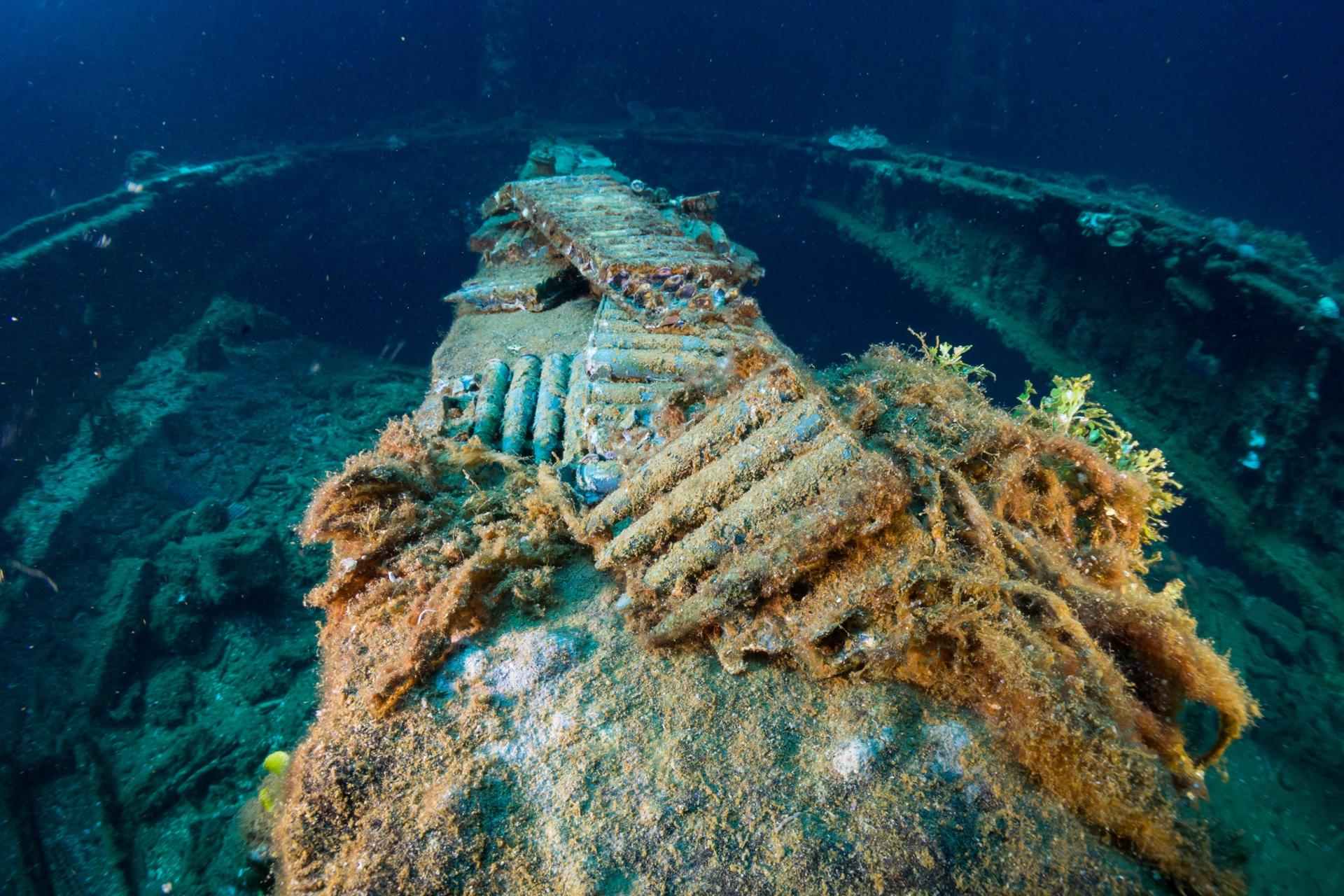
Half a cargo ship in shallow water, with her forward hold still stacked with machine-gun ammunition.
The Sankisan Maru reached Truk five days before the American raid of February 1944, loaded with war supplies, and never unloaded them. An explosion in her after hold destroyed the ship from the bridge back and threw the stern into deeper water, but the forward half settled upright off Uman with its cargo in place: small-arms rounds by the thousand, truck chassis, aircraft engines and medicine bottles. Her deck is around 15 metres, so she is one of the easiest cargo dives in the lagoon, and her masts and rails carry fine soft coral. This guide covers her story, what you will see, the conditions, when to go and how you dive her.
Quick answer: Sankisan Maru is a wwii shipwreck: forward half upright, stern blown off and lying apart in deeper water; open holds with cargo in Truk Lagoon. Best season: December to April (dry season) for the calmest seas and best visibility; diveable year-round. Level: Open Water with some experience for the deck; Advanced Open Water for the holds; the stern is a deep dive for divers trained for that depth. Depth: Masts rise to within a few metres of the surface; deck of the forward section around 15m; most dives on the bow section stay above about 27m; the detached stern lies in roughly 45–48m. Typical visibility: Often 20–30m in the dry season, less after heavy rain; the silt in the holds lifts at the slightest fin movement.
Facts verified November 2026
Why the Sankisan Maru is special
She was a freighter of about 4,750 gross tons and roughly 112 metres, taken over by the Japanese Navy in late 1943 as a transport. Accounts of her earlier career differ. She reached Truk on 12 February 1944 with a cargo of war supplies and anchored off the west side of Uman, in the southern part of the lagoon.
US carrier aircraft attacked her during Operation Hailstone on 17–18 February 1944. A hit aft set off the ordnance in her after hold, and the explosion destroyed the ship from the bridge to the stern, threw the stern section into deeper water and left a crater in the seabed. Japanese records of her sinking are thin, so the exact sequence of hits is not certain.
What survived is the forward half, upright and shallow. In 1974 a salvage crew lifted 284 depth charges and a number of shells out of her No. 1 hold to make the wreck safe for divers. Ten years later the National Park Service's survey of the lagoon already noted that she was visited often, and she still is.
What you'll see on the wreck
The forward holds are the dive, and most of what made her famous is still there under a thin layer of silt:
- Small-arms ammunition by the thousand in the forward hold, much of it still lying in the shapes of the wooden crates it was packed in
- Machine guns among the cargo
- Truck chassis and parts, with engines, radiators and frames, on deck and in the holds
- Aircraft parts in hold No. 2, including radial engines
- Small medicine bottles and ampoules, fewer than there once were
- Soft coral on the masts, kingposts and railings
- The detached stern, with its propeller and rudder, upright in about 45–48m and rarely visited
Look, don't take
Loose rounds lie everywhere in the forward hold, and over the years they have been picked up, moved and piled by visiting divers. Taking anything from the Truk wrecks is illegal under Chuuk law, and that includes a single cartridge. Leave the cargo where it lies, don't handle shells or anything that looks like ordnance, and treat what you see as live: the depth charges were removed, but this ship sank because her ammunition exploded.
Conditions and who it's for
The deck of the forward section sits around 15 metres and the holds open off it, so this is one of the most accessible cargo dives in Truk. An Advanced Open Water diver on nitrox can spend a long, unhurried dive moving between the deck and the holds, and confident Open Water divers can see a good deal from deck level. Going deeper into the holds means an overhead environment: take a torch and stay with your guide.
The silt is fine, and in a hold full of small objects one careless fin kick wipes out the view for everyone behind you. The stern is a separate proposition: it lies apart from the bow in about 45 to 48 metres and is a deep dive for divers trained and equipped for it, not a detour from the bow. Water is 28 to 30°C all year and current is usually mild.
When to dive it
Truk Lagoon is diveable all year. The drier months from about December to April usually bring the calmest surface and the clearest water; June to November is wetter, and August to November carries the most typhoon risk, though the barrier reef keeps the swell off the wrecks.
Because she is shallow, the Sankisan Maru works in any season and fits well as a second or third dive of the day after a deep wreck. Clear water helps most on the masts and rails, where the soft coral is at its best in good light.
How you dive the Sankisan Maru
Plan a long, shallow dive. Go to the forward hold first, while the silt is undisturbed, and look at the ammunition and truck parts by torchlight. Move on to hold No. 2 for the aircraft engines, then spend the second half of the dive on the deck, the rails and the masts, where the coral and the fish are.
Finish on the masts: they rise close to the surface, so you can do a slow ascent and a long safety stop with something to look at the whole way up.
We sell 8 to 10-night Truk Lagoon liveaboards that board off Weno, and the Sankisan Maru is one of the lagoon's regular stops. The day-by-day wreck plan is set on board around conditions and the group, so if she matters to you, tell us when you book. The bow section suits most certified divers; if you want to dive the detached stern or run decompression, tell us your training when you enquire.
Sankisan Maru: common questions
What is the best season to dive Sankisan Maru?
December to April (dry season) for the calmest seas and best visibility; diveable year-round
What experience level do I need for Sankisan Maru?
Open Water with some experience for the deck; Advanced Open Water for the holds; the stern is a deep dive for divers trained for that depth
How deep is Sankisan Maru?
Masts rise to within a few metres of the surface; deck of the forward section around 15m; most dives on the bow section stay above about 27m; the detached stern lies in roughly 45–48m
What marine life will I see at Sankisan Maru?
Soft corals and sponges on the masts, kingposts and rails, bubble coral and anemones, and reef fish around the upper structure