Rio de Janeiro Maru
A former South America liner on her side, with naval guns in her holds and crates of beer bottles still stacked.
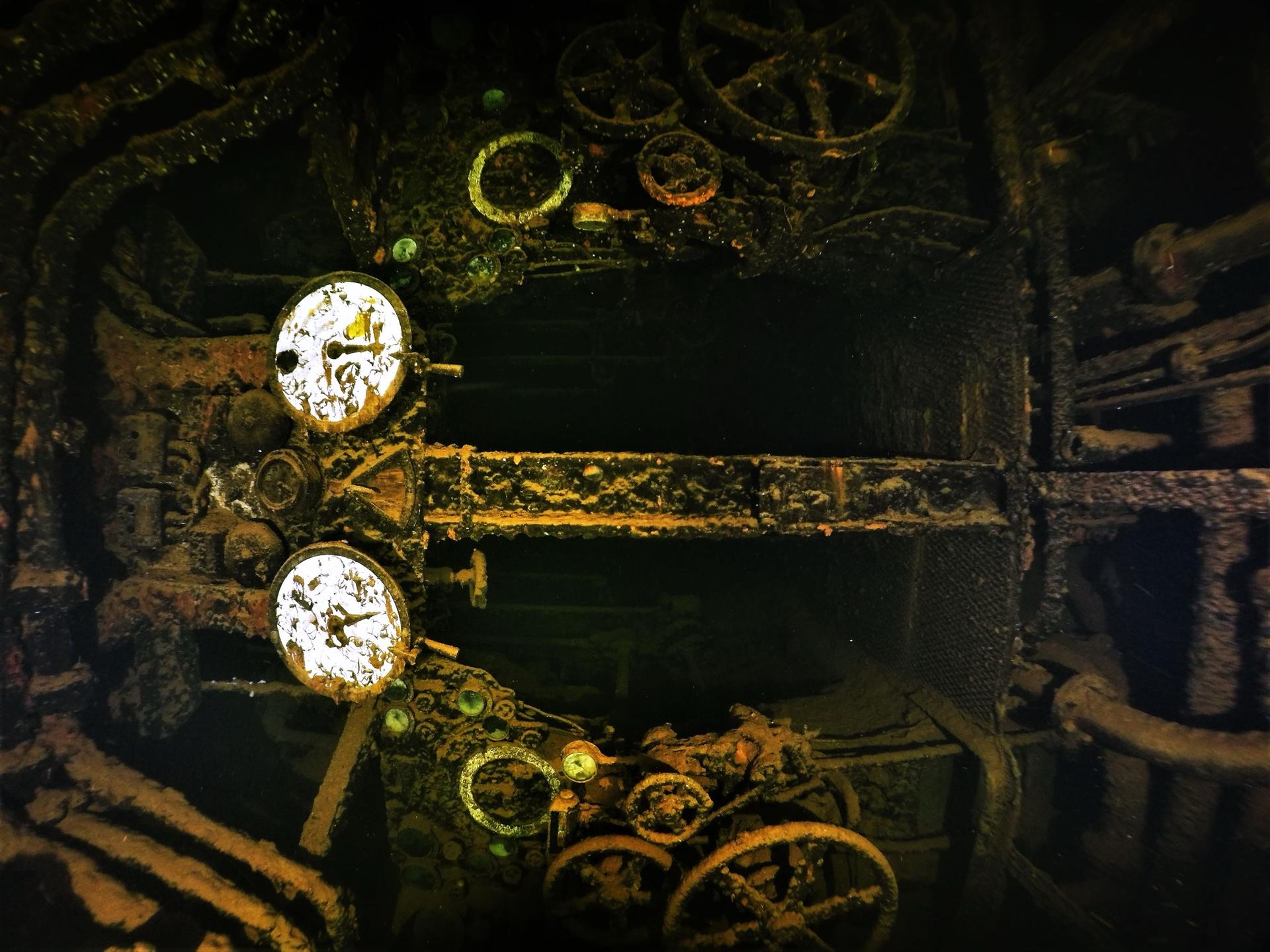
The Rio de Janeiro Maru carried passengers between Japan and South America before the navy turned her into a submarine tender and then a transport. She burned and sank in the February 1944 raid and now lies on her starboard side in the southern part of the old fleet anchorage, her upper side shallow enough for a twilight dive and the seabed at about 34 metres. Inside are old naval guns, coal, thousands of bottles and an engine room that many divers rank among the best in the lagoon. This guide covers what you will see, the conditions, when to go and how you dive her.
Quick answer: Rio de Janeiro Maru is a wwii shipwreck (former passenger liner) lying on her starboard side; exterior and penetration in Truk Lagoon. Best season: December to April (dry season) for the calmest seas and best visibility; diveable year-round. Level: Advanced Open Water for the exterior, stern and propellers; the holds are easy swim-throughs, while the engine room is penetration that needs wreck training. Depth: Upper (port) side about 9–12m; seabed about 33–35m; propellers and rudder in the 24–30m range. Typical visibility: Typically 15–30m, best in the dry season.
Facts verified November 2026
Why the Rio de Janeiro Maru is special
She was built by Mitsubishi at Nagasaki for the OSK line and entered service in 1930 on the route to South America, with berths for more than a thousand passengers, most of them in third class. The Imperial Japanese Navy requisitioned her in 1940 and converted her into a submarine tender and depot ship. In 1943 she was reclassified as a transport and based at Truk.
US carrier aircraft bombed her on 17 February 1944, the first day of Operation Hailstone. She burned for most of the day and sank by the stern just after midnight, early on the 18th. She is one of the bigger wrecks in the lagoon, at about 9,600 gross tons and roughly 140 metres long, and her size is what makes her: long holds you can swim through and a liner's worth of decks and passageways.
As a liner she had five holds, and for her passengers a smoking saloon, medical rooms and Japanese-style baths, with cabins of eight or twelve berths in third class. Very little of that fitting-out survives the conversions and eighty years on the seabed, but the scale of the ship does, and so does the layout: wide holds forward and aft of a long central superstructure.
What you'll see on the wreck
Divers usually work from the bow along the upturned port side to the stern, then into the holds or the engine room. The highlights:
- Her name, still readable on the side of the bow
- A 6-inch gun on the bow, its barrel pointing down, with blast damage from ammunition stored beneath it
- Old 6-inch naval guns in the holds, probably cargo meant for a shore battery
- Coal, and crates of beer and sake bottles, some still in their cases, in the aft holds
- A second gun on a platform at the stern
- Two large propellers and the rudder, a favourite with photographers
- The engine room, with electrical panels, gauges, machinery and tools still in place
- Heavy degaussing cables run around the hull, fitted as protection against magnetic mines
- China in the galley, and D-shaped portholes on the bridge, some still with their glass
Conditions and who it's for
The way she lies works in your favour. Her upper side sits at around 9 to 12 metres and the holds are wide and open, so an Advanced Open Water diver can see a great deal of her on a single no-stop dive, especially on nitrox. The upper side is shallow enough for a relaxed twilight or night dive. Water temperature is 28 to 30°C all year and current is rarely an issue.
The cautions are about the structure. The bow has been weakened by the fire and explosions of 1944 and has started to collapse, and some interior compartments are breaking down. Inside, a ship on her side is confusing, and the holds and passages hold silt that lifts easily. The engine room is the reason many divers come back for a second dive, and it is a penetration dive: go with wreck training, a primary and backup light, and a guide.
When to dive it
Truk Lagoon is diveable all year, with water at 28 to 30°C in every month. The drier months from about December to April usually bring the calmest seas and the best visibility. From June to November there is more rain and visibility varies more, and August to November carries the most typhoon risk, although the barrier reef keeps swell off the wrecks.
The Rio de Janeiro Maru is a good wreck in any season. If you want to photograph the propellers at their best, the clearer water of the dry season helps.
How you dive the Rio de Janeiro Maru
Like the rest of Truk, she is best dived from a liveaboard, which can moor near her and give you two dives at different times of day. A good pairing is a first dive on the exterior, from the bow gun along the upper side to the stern gun and the propellers, and a second, guided dive into the holds and the engine room.
The mooring is often at the bow, so if you linger at the stern and propellers, watch your gas and no-stop time for the swim back. Finish on the shallow upper side, then ascend from the hull for your safety stop at about 5 metres.
We sell 8 to 10-night Truk Lagoon liveaboards that board off Weno, and the Rio de Janeiro Maru is one of the lagoon's regular stops. The day-by-day wreck plan is set on board around conditions and the group, so if she matters to you, tell us when you book. Her engine room is a guided penetration dive; if you want to go further inside or run decompression, tell us your training when you enquire.
Rio de Janeiro Maru: common questions
What is the best season to dive Rio de Janeiro Maru?
December to April (dry season) for the calmest seas and best visibility; diveable year-round
What experience level do I need for Rio de Janeiro Maru?
Advanced Open Water for the exterior, stern and propellers; the holds are easy swim-throughs, while the engine room is penetration that needs wreck training
How deep is Rio de Janeiro Maru?
Upper (port) side about 9–12m; seabed about 33–35m; propellers and rudder in the 24–30m range
What marine life will I see at Rio de Janeiro Maru?
Coral and sponge growth over the hull and stern gun, reef fish around the upper side