Numidia
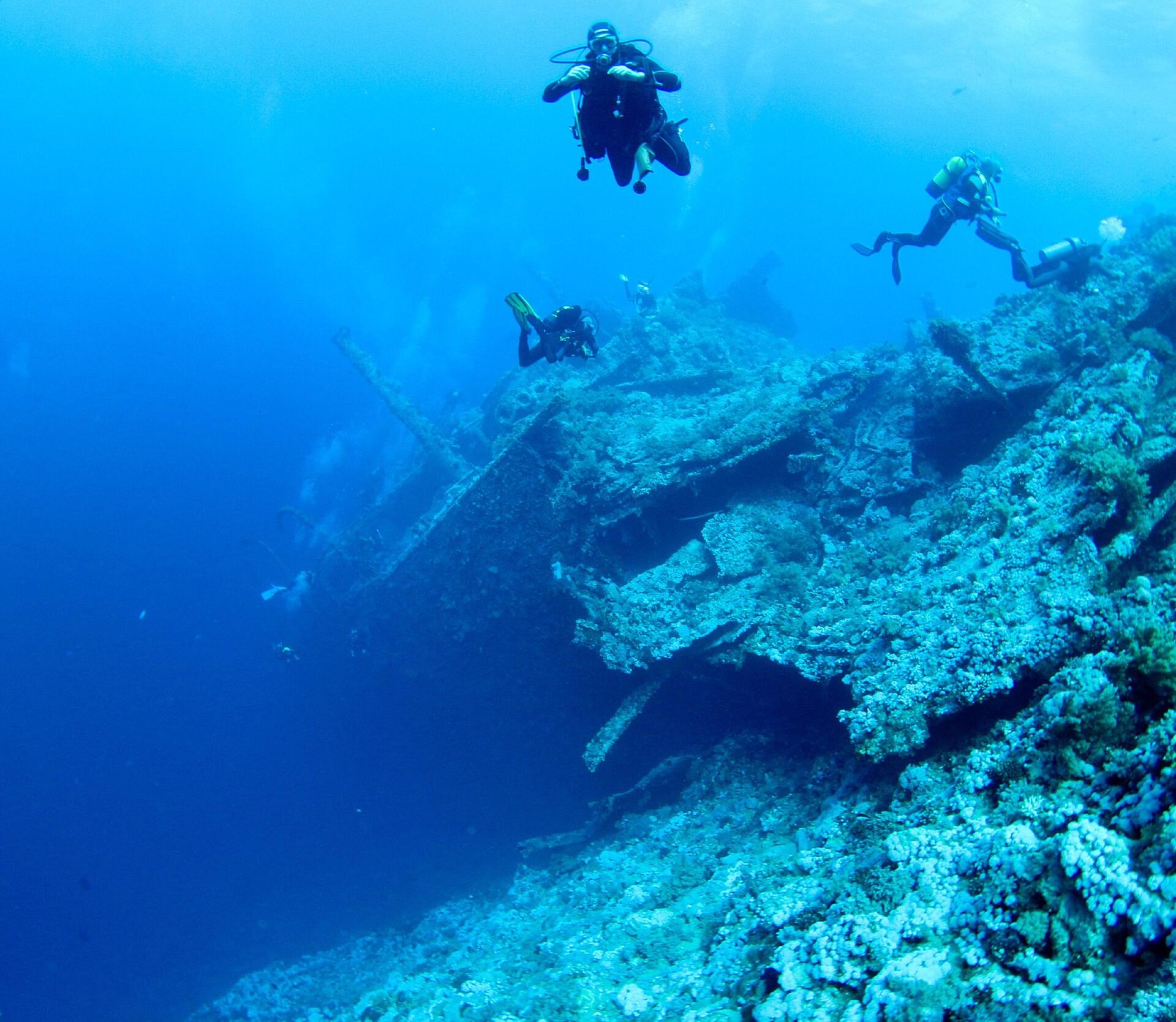
A 1901 steamer hanging down the north tip of Big Brother, from the reef top at 8 metres to her propeller at 80.
The Numidia is one of the great wrecks of the Red Sea and one of the easiest to dive badly. She ran onto the northern tip of Big Brother in 1901, broke her back, and now hangs down the reef slope from the shallows to around 80 metres, coral-covered and swept by whatever current is running past the island. You will see a lot of her within recreational limits, but the wreck keeps going long after your plan should stop. This guide covers her short life, how she lies, how to dive her well inside recreational limits, the current, and how she fits into a week at the offshore reefs.
Quick answer: Numidia is a wreck dive down a steep reef slope, usually from a rib, finishing as a drift along big brother's wall in Red Sea. Best season: Whenever the Brothers are dived: BDE weeks run most of the year, and late spring to autumn usually brings the kindest crossings and warmest water. Level: Advanced: Advanced Open Water, and operators typically ask for 30 to 50 logged dives; comfortable in current with an SMB. Depth: Broken bow, railway wheels and upper structure from about 8-12 m; stern mast about 40-50 m; stern and propeller around 80 m. Typical visibility: Typically 20-30 m, often more.
Facts verified November 2026
A new ship on her second voyage
The Numidia was built by D. & W. Henderson at their Meadowside yard in Glasgow for the Anchor Line and launched in February 1901. She was a cargo steamer of 6,399 gross tons with a triple-expansion engine. Her maiden voyage took her from Glasgow to Calcutta that spring.
On 6 July 1901 she left Liverpool on her second voyage to India with around 7,000 tons of general cargo, including railway equipment, and a crew of 97 under Captain John Craig. She came through the Suez Canal and down the Gulf of Suez, and by the evening of 19 July had passed Shadwan Island into the open Red Sea.
Aground in sight of the lighthouse
Late that evening, after a long spell on the bridge, Craig went below, leaving the second officer on watch with orders to call him when the Brothers light was abeam. He was never called. At about two in the morning on 20 July 1901 (some accounts give 19 July) the Numidia ran onto the northern tip of Big Brother, in plain sight of the island's lighthouse.
Attempts to back her off the reef failed, and the crew were taken off safely. Craig stayed on the island for about seven weeks while most of the cargo and the mail were removed. A Board of Trade inquiry concluded that the officer of the watch had probably fallen asleep, and suspended his certificate for nine months. The ship broke her back on the reef, and the after part of the hull slid down the slope to where she lies now.
How she lies
The north tip of Big Brother is narrow, and the Numidia lies down its steep slope, bow in the shallows and stern in the deep. The bow is broken up and embedded in the reef top at around 8 metres, and close by lie the two big railway wheels from her cargo that give her the nickname the railway wreck. The top of the bridge and accommodation sits at about 8 to 12 metres, and parts of the structure around midships have collapsed.
From there the hull runs down the slope, more or less upright, with the wooden decks gone and the steel frames open. The after holds gape open and the stern mast still stands, its base at around 40 to 50 metres. The stern itself, with the rudder and propeller, is at about 80 metres, far beyond recreational diving.
- Reef top, about 8 m: broken bow and the railway wheels
- About 8-12 m: top of the bridge and accommodation
- About 12-40 m: open hull, holds and engine-room area, the part most recreational divers see
- About 40-50 m: base of the stern mast, a sight to look down on, not a turn point
- About 80 m: stern, rudder and propeller, technical diving only
Diving her within recreational limits
The usual plan is a RIB drop just up-current of the north tip, a prompt descent along the hull to your planned maximum depth, and a slow climb back up the wreck. Go down first, because the deepest part of the dive should come at the start, and look down the slope to the stern mast rather than swimming to it. The open holds and the area around the engine room are full of light, and you can look into much of the ship without going inside. The enclosed spaces need wreck training and the right kit, and the middle of the ship has collapsed in places.
Work your way back up past the bridge to the railway wheels and the bow on the reef top, where the coral is thickest and the anthias are densest. From there the guide usually takes the group along the wall with the current, keeping an eye on the blue for grey reef sharks, before a safety stop under your own surface marker buoy and a pick-up by the RIB. The Aida, Big Brother's second wreck, is a separate dive and is covered in our Brothers Islands guide.
Depth and current: the honest part
Two things go wrong on the Numidia. The first is depth. The wreck pulls you down the slope, the water is clear, and the stern mast looks close. Decide your maximum depth on the boat, check your gas mix's limit if you dive nitrox, and remember that you are a long way from a recompression chamber at the Brothers. Decompression on a drift in current, far offshore, is not a plan.
The second is current. The north tip is the narrowest part of the island and takes the full force of the water moving past it. On a quiet day it is an easy wreck; on a bad day the current runs at several knots, can change direction during the dive, and will carry a diver off the reef into open water. Descend without hanging around on the surface, stay close to the wreck and the reef, and carry a surface marker buoy you can deploy from depth.
When to go and how it fits a BDE week
You can only dive the Numidia from a liveaboard, and the Brothers are a marine park with rules to match: under the current arrangement boats usually get one day at the islands, there are no night dives inside the park, and every diver needs a computer and an SMB. On that day the crew spreads the dives between the two islands, and the captain decides which sites go where, depending on the current.
BDE weeks run for most of the year. Late spring to autumn usually gives the calmest crossings and the warmest water, around 27 to 30°C in high summer, while from January to March the water drops to about 21 to 23°C and the overnight crossing can be rough. Grey reef sharks are around the island all year, and threshers turn up occasionally in the deeper water around the wreck. The hammerhead and oceanic whitetip seasons are covered in our Brothers Islands guide.
We dive the Numidia on our Brothers, Daedalus and Elphinstone (BDE) weeks and on the northern weeks that add a day at the Brothers. Current rules usually allow one day at the islands and the captain plans the dives around the current, so the Numidia is likely but never promised. These weeks generally ask for Advanced Open Water and around 50 logged dives.
Numidia: common questions
What is the best season to dive Numidia?
Whenever the Brothers are dived: BDE weeks run most of the year, and late spring to autumn usually brings the kindest crossings and warmest water
What experience level do I need for Numidia?
Advanced: Advanced Open Water, and operators typically ask for 30 to 50 logged dives; comfortable in current with an SMB
How deep is Numidia?
Broken bow, railway wheels and upper structure from about 8-12 m; stern mast about 40-50 m; stern and propeller around 80 m
What marine life will I see at Numidia?
Hard and soft coral over the whole hull, anthias, bigeye jacks, barracuda, Napoleon wrasse, turtles and morays; grey reef sharks, and the odd thresher at depth