Kiyosumi Maru
A former auxiliary cruiser lying on her side, still seeping fuel eighty years on.
The Kiyosumi Maru was a freighter turned auxiliary cruiser, torpedoed by an American submarine in January 1944 and towed into Truk for repairs, where carrier aircraft sank her seven weeks later. She lies on her port side in the old repair anchorage off Fefan, largely intact, with her upturned starboard side about 12 metres down. Locals have long called her the oil slick wreck because fuel still seeps out of her. Divers come for the variety: ship's lanterns in the bow, bicycles and spare propeller blades in the holds, a large hole torn in her side, and an engine room seen at an unusual angle. This guide covers her story, what you will see, the conditions, when to go and how you dive her.
Quick answer: Kiyosumi Maru is a wwii shipwreck lying on her port side; hold and engine-room penetration in Truk Lagoon. Best season: December to April (dry season) for the calmest seas and best visibility; diveable year-round. Level: Advanced Open Water for the exterior and the hold entrances; the connected holds and the engine room are penetration dives that need wreck training. Depth: Upturned starboard side about 12m; seabed about 30–36m; most of the dive is spent between 12 and 30m. Typical visibility: Variable: 20m or more on good days, murkier after rain because the anchorage lies close to Fefan; silt inside, and fuel seeping in places.
Facts verified November 2026
Why the Kiyosumi Maru is special
She was built by Kawasaki at Kobe and completed in 1934, a six-hold freighter of about 7,000 gross tons and 137 metres. The Imperial Japanese Navy took her over in 1941 and fitted her out as an auxiliary cruiser, with guns and torpedo tubes. Her armament was later removed and she went back to work as a transport, which is why the gun platforms on her after deck are empty.
On 1 January 1944 the US submarine Balao torpedoed her south of Truk. She stayed afloat and was towed into the lagoon, where she was moored for repairs in the anchorage between Dublon and Fefan. On 17 February, the first day of Operation Hailstone, aircraft from the carriers Yorktown and Enterprise hit her with several bombs, and she sank to rest on her port side.
The National Park Service's 1984 survey of the lagoon's sunken fleet already recorded her local name, the Oilslick Wreck. Fuel still seeps from her today, and you will notice it in places inside.
What you'll see on the wreck
Because she lies on her side, everything is turned through ninety degrees: decks become walls and hatches open sideways. Give yourself a moment at each entrance to work out which way is up. Then look for:
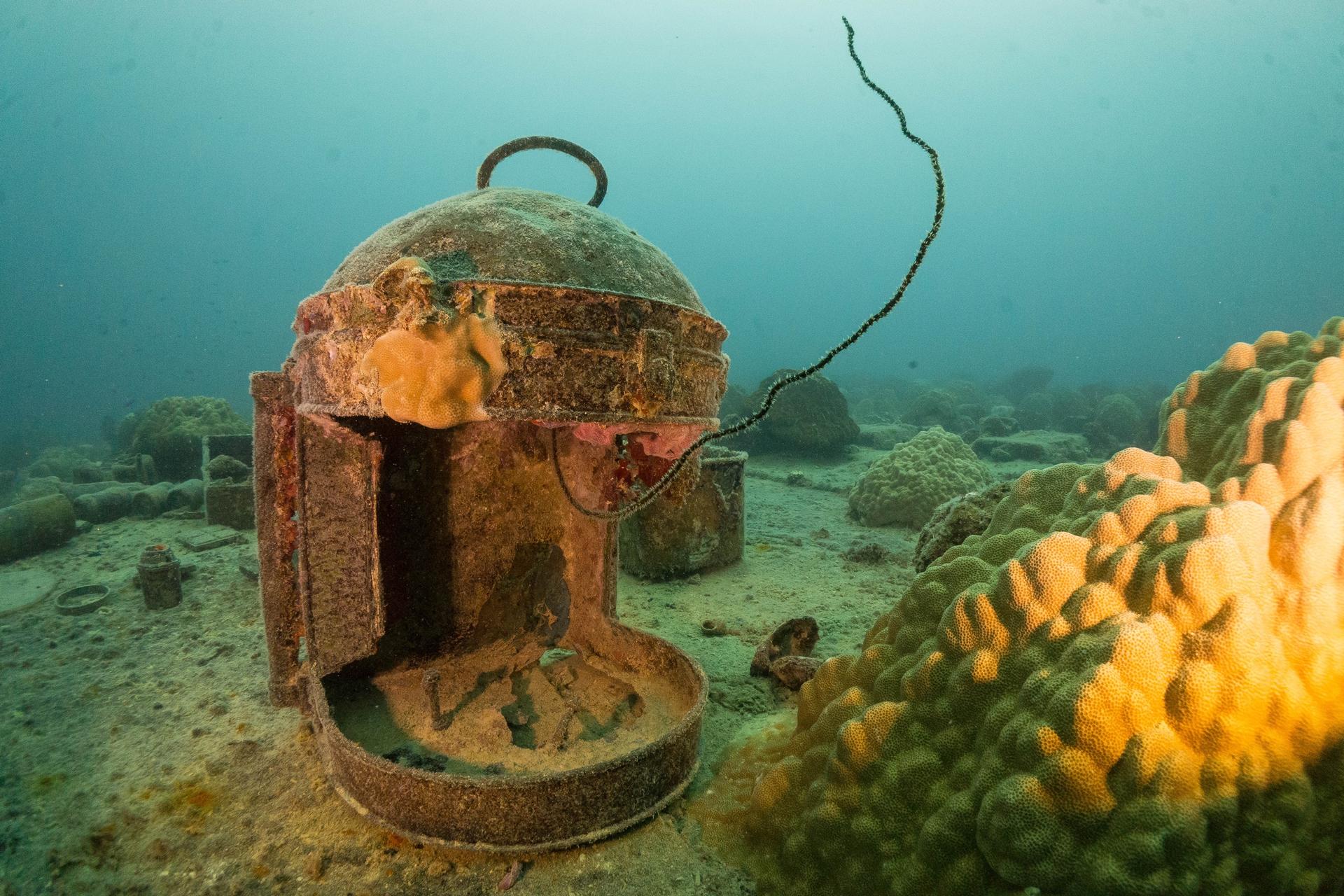
- Ship's lanterns in the forecastle, where they were stowed
- A large hole torn in the hull at the second hold
- Bicycles among the cargo
- Spare propeller blades in one of the holds
- Fuel drums in the holds
- The engine room, with its big diesel, gauges, switches and pipework, all seen from an unusual angle
- Empty gun platforms on the after deck, left from her time as an auxiliary cruiser
- Coral and sponge growth along the upturned starboard hull, the shallowest part of the wreck
Conditions and who it's for
Most of the Kiyosumi lies between 12 and 30 metres, with the seabed at roughly 30 to 36 metres, so the outside of the wreck and the hold entrances suit Advanced Open Water divers on nitrox. The holds connect with each other, and the engine room is reached through the inside of the ship. Both are overhead dives in a structure lying on its side, where your sense of direction works against you more than on an upright wreck. Penetration needs wreck training, a primary torch and a backup, and a guide.
The silt inside is fine and lifts easily. Fuel still seeps out in places; keep your head and your gear out of it. Water is 28 to 30°C year-round and current is usually mild.
Look, don't take
Human remains have been reported inside the Kiyosumi, and a Japanese recovery team brought up a set of remains from her as recently as June 2024. Treat her as a grave. Look, don't touch and take nothing: removing anything from the Truk wrecks is against Chuuk law, and if you come across remains, leave them exactly as they are.
When to dive it
Truk is diveable all year. The drier months from about December to April usually give the calmest surface and the best visibility; June to November is wetter and more variable, and August to November carries the most typhoon risk, although the lagoon keeps the swell off the wrecks.
The Kiyosumi sits close to Fefan, and wrecks near the main islands lose more visibility after heavy rain than those in the open lagoon. If the itinerary allows a choice, she is worth saving for a dry spell.
How you dive the Kiyosumi Maru
Make the first dive an outside tour. Start on the upturned starboard side, go forward to the forecastle for the lanterns, look at the hole in the hull at the second hold, then swim aft along the deck, which is now a vertical wall, to the empty gun platforms.
On a second dive, go inside with your guide: through the holds for the bicycles and the propeller blades, then into the engine room. Keep the dive short enough to come out with the visibility you went in with.
We sell 8 to 10-night Truk Lagoon liveaboards that board off Weno, and the Kiyosumi Maru is one of the lagoon's regular stops. The day-by-day wreck plan is set on board around conditions and the group, so if she matters to you, tell us when you book. The holds and engine room are penetration dives for trained divers; if you want to go inside or run decompression, tell us your training when you enquire.
Kiyosumi Maru: common questions
What is the best season to dive Kiyosumi Maru?
December to April (dry season) for the calmest seas and best visibility; diveable year-round
What experience level do I need for Kiyosumi Maru?
Advanced Open Water for the exterior and the hold entrances; the connected holds and the engine room are penetration dives that need wreck training
How deep is Kiyosumi Maru?
Upturned starboard side about 12m; seabed about 30–36m; most of the dive is spent between 12 and 30m
What marine life will I see at Kiyosumi Maru?
Some coral and sponge growth on the upturned starboard hull, and reef fish; growth is thinner than on many Truk wrecks