Kingston (Sarah H)
A Victorian coal steamer sitting upright against Shag Rock at 4 to 19 metres, a few miles from the Thistlegorm.
For years divers called her the Sarah H and nobody knew what she really was. She turned out to be the Kingston, an iron steamer that hit Shag Rock in February 1881 with a hold full of coal for Aden. She sits upright against the reef in shallow water, her decks gone and her iron frame covered in some of the healthiest hard coral in the Strait of Gubal. It is a short, easy-depth wreck dive that rewards a slow pace, and it often sits in the same day as the Thistlegorm. This guide covers her story, how she lies, how to dive her and what the current can do.
Quick answer: Kingston (Sarah H) is a shallow wreck dive on an iron steamer sitting upright against the reef, finishing on the reef in Red Sea. Best season: Year-round; March-May and September-November usually bring the calmest seas in the Strait of Gubal. Level: Open Water and up in calm conditions; current can make it more demanding, and the guide chooses where to drop. Depth: About 4-19 m; propeller and rudder around 17 m at the stern. Typical visibility: Usually good, often 20 m or more.
Facts verified November 2026
The wreck that had the wrong name
Dive boats had been visiting this wreck for years under the name Sarah H, or Sara H, a name divers had given her. Stories differ on who she was named after, and the name has stuck even on modern dive maps. In 1996 the British wreck diver Peter Collings pieced together enough evidence to identify her as the Kingston, and that is the name that belongs on her.
Coal for Aden
The Kingston was an iron screw steamer, rigged as a brigantine with two masts, built by the Oswald yard in Sunderland and launched on 16 February 1871. She was about 78 metres long and 1,449 tons.
In early 1881 she sailed from Cardiff for Aden, the coaling station at the southern end of the Red Sea, with a cargo of coal. Most accounts give Cardiff, although one says London. In February she struck Shag Rock. The crew fought to keep her afloat for a couple of days, but she settled by the stern and slid back off the reef until only her masts showed above the water. Everyone on board survived. The exact dates vary from one account to another, from the middle to the last week of February.
How she lies
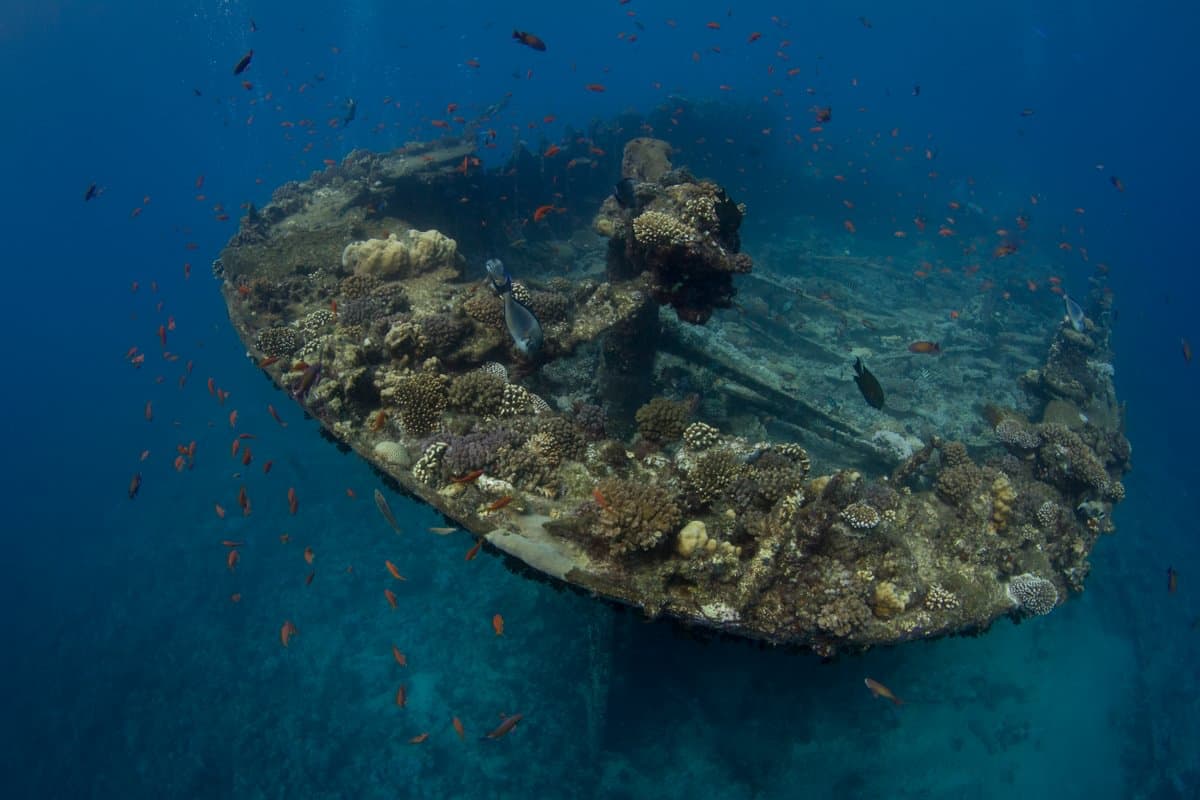
The Kingston sits upright, on an even keel, on the west side of Shag Rock. Her bow drove into the reef and is now broken and scattered across the coral slope. The stern half, from amidships aft, is fairly intact, although the superstructure is gone and the wooden decks have rotted away, leaving the iron beams and frames open to the light.
At the stern, the propeller and rudder are still in place at around 17 metres. Amidships you can make out the engine room and its two large boilers. A spare propeller lies among the beams, and the two masts lie fallen beside the hull. The whole ship is so thickly overgrown with hard coral that in places it is hard to say where the wreck ends and the reef begins.
- Stern, about 17 m: propeller and rudder
- Amidships: two boilers in the open engine room
- Along the deck: open iron beams and a spare propeller
- Bow: broken up against the reef, scattered across the coral slope at shallow depth
The dive
Most guides start at the stern, the deepest point, to see the propeller and rudder, then swim up and forward along the hull, looking down between the beams into the open holds and the engine room. Because the decks have gone there is little real penetration: the inside of the ship is open to the light, and you can see most of it without entering an enclosed space. Stay out of anything closed in unless you have wreck training.
From the boilers the route climbs to the broken bow and onto the reef itself, where the dive ends in a few metres of water over hard coral. The coral and the fish life are the reason photographers love this wreck: anthias over the stern, sohal surgeonfish along the reef edge, and nudibranchs on the hull if you slow down to look.
Conditions and who it suits
At 4 to 19 metres, the Kingston is within reach of Open Water divers, and on a calm day it is one of the most relaxed wreck dives in the north. The catch is the current. Shag Rock sits in the Strait of Gubal, the water moving past it can be strong, and the dive is only done when conditions are good. Experienced guides use the reef for shelter and plan the drop so the current carries the group along the wreck rather than against it.
Water runs from about 21 to 23°C in late winter to 28 to 30°C in August, so most divers wear a 5 mm suit and a 7 mm in the coolest months. With most of the dive in the top 15 metres, you get plenty of bottom time on air.
Where it fits in a northern Red Sea week
Shag Rock lies at the southern end of the Sha'ab Ali reef system, a few miles from the Thistlegorm, so northern wrecks weeks that include the Kingston usually dive it on or around the Thistlegorm day. She works well as the dive after the Thistlegorm: shallow, sheltered when the current allows, and a complete change from the war wreck's holds.
Not every northern week includes her. The crew picks the dives around the wind and the current, and the Kingston is one of the sites they choose between rather than a fixed stop, like the Ulysses on Gubal or the Dunraven at Ras Mohammed.
Some of our Northern Red Sea wrecks liveaboards from Hurghada dive the Kingston, usually on or around the Thistlegorm day. She is not on every itinerary and the crew decides around the current, so if she matters to you, tell us when you book and we will check the week's plan.
Kingston (Sarah H): common questions
What is the best season to dive Kingston (Sarah H)?
Year-round; March-May and September-November usually bring the calmest seas in the Strait of Gubal
What experience level do I need for Kingston (Sarah H)?
Open Water and up in calm conditions; current can make it more demanding, and the guide chooses where to drop
How deep is Kingston (Sarah H)?
About 4-19 m; propeller and rudder around 17 m at the stern
What marine life will I see at Kingston (Sarah H)?
Dense hard coral on the hull, anthias, sohal surgeonfish, parrotfish, sweetlips and nudibranchs; turtles sometimes on the surrounding reef