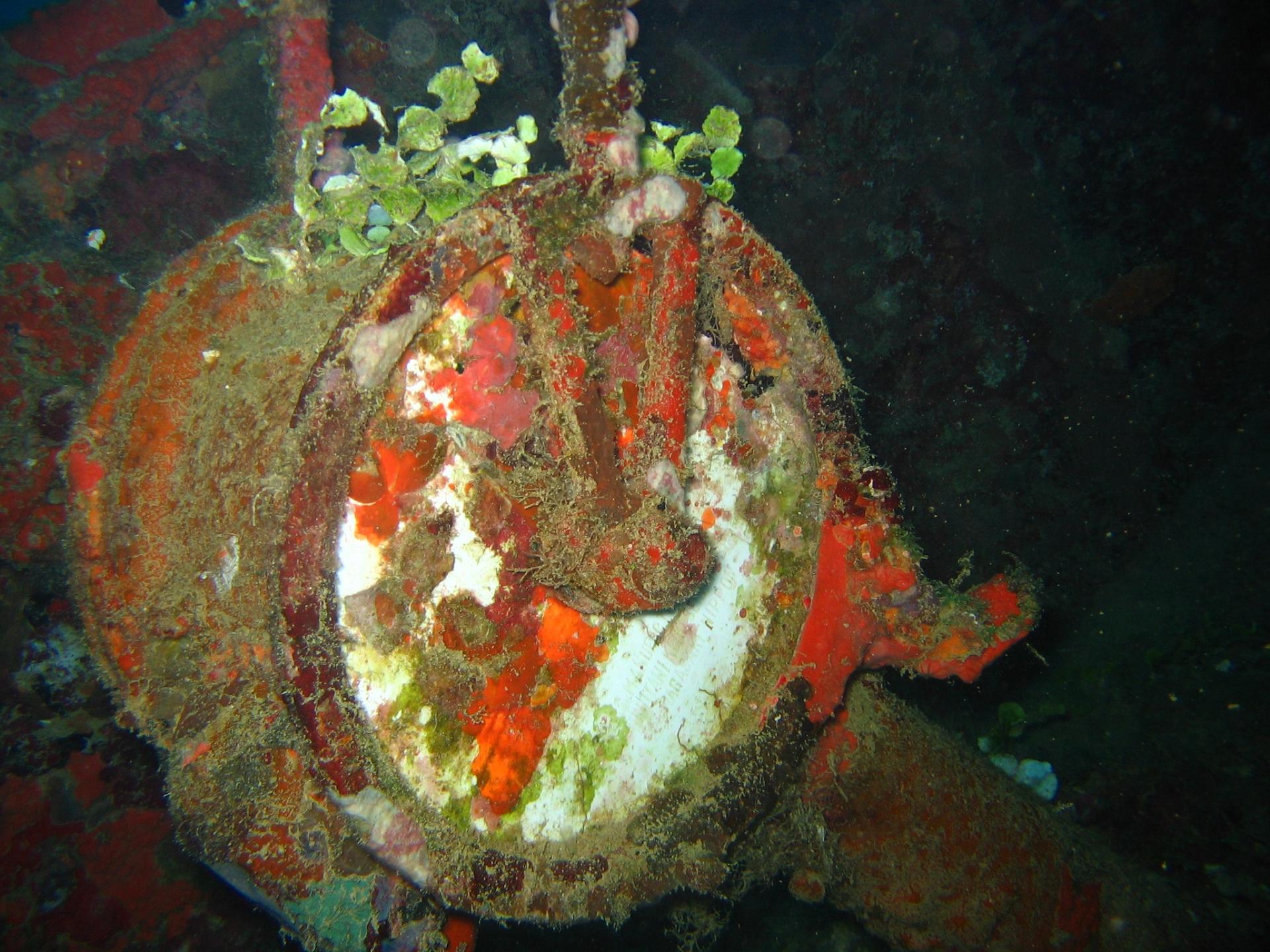
Kensho Maru
A cargo ship that went down under repair, and one of the finest engine rooms in Truk Lagoon.
The Kensho Maru was a mid-sized transport towed into Truk for repairs a few weeks before the American raid of February 1944, and she sank in the repair anchorage with the work unfinished. She sits upright with a list to port, mostly intact, and divers come for her engine room: tall, lit from above through a skylight, and full of machinery and tools. Her bridge still has its telegraph, her galley still has a pot on the stove, and her holds show the salvage gear of the crew who tried to save her. This guide covers what you will see, the conditions, when to go and how to dive her.
Quick answer: Kensho Maru is a wwii shipwreck sitting upright with a list to port; superstructure swim-throughs and engine-room penetration in Truk Lagoon. Best season: December to April (dry season) for the calmest seas and best visibility; diveable year-round. Level: Advanced Open Water for the bridge, deck and upper engine room; the lower engine room levels are tight penetration that needs wreck training. Depth: Shallowest structure about 12m; main deck around 24m; seabed from about 27m at the bow to about 40m at the stern; upper engine room to about 27m. Typical visibility: Typically 15–25m; the wreck is coated in fine sediment that clouds quickly, and the repair anchorage takes more runoff after rain.
Facts verified November 2026
Why the Kensho Maru is special
She was launched in 1938, a five-hold transport of about 4,860 gross tons and roughly 116 metres. The Imperial Japanese Navy requisitioned her in September 1940 to carry special cargo, and she worked the supply routes to its Pacific bases. By early 1944 she was out of action, and the transport Momokawa Maru towed her into Truk, where she was moored in the repair anchorage between Dublon and Fefan.
She went down during Operation Hailstone on 17–18 February 1944, still under repair. How exactly she sank is debated. American pilots reported hits on her, but wartime photographs show her low by the stern with an oil slick astern and no sign of fire, and one researcher who has studied the wreck argues for slow flooding that the crew could not pump out. Either way, she settled upright, and most of her is still intact.
Jacques Cousteau's 1969 expedition to the lagoon is credited with finding her, but she was effectively lost again until Klaus Lindemann relocated her in 1980. The US National Park Service's 1984 historic-landmark nomination of the lagoon already described her as one of the finest wrecks in Truk, and the reason is mostly what lies inside her superstructure.
What you'll see on the wreck
The engine room is the headline, and most divers plan at least one dive around it. The rest of the ship is worth the time too:
- The upper engine room: high and wide, lit through a large multi-panel skylight, with engines and boilers in good condition
- Tool racks with spanners and wrenches still mounted on the engine-room bulkheads
- The bridge, with its engine order telegraph and compass stand, and the radio room just below it
- The galley, with a pot still on the stove and a tiled floor, among the crew quarters around the engine casing
- Hold 4, with a salvage pump, gas bottles and welding gear, and a pump hose run through a cut in the bulkhead
- Oxygen and acetylene bottles and cutting torches on deck behind the superstructure, left from the repair work
Conditions and who it's for
The Kensho Maru suits a wide range of divers. The superstructure starts around 12 metres, the main deck is about 24 metres, and the upper engine room reaches roughly 27 metres, so an Advanced Open Water diver on nitrox can see the bridge, the galley and the top of the engine room without decompression. The list to port takes a minute to get used to, but she is upright and easy to read.
The lower engine room is tighter, deeper and darker, and that is where wreck training, redundant lights and a guide become essential. The whole wreck carries a layer of fine sediment that lifts easily, so trim and finning technique matter more here than on most Truk wrecks. Water is 28 to 30°C all year and current is rarely an issue.
When to dive it
Truk Lagoon is diveable year-round. The drier months from about December to April usually bring the calmest seas and best visibility; June to November is wetter, and August to November carries the most typhoon risk, although the barrier reef keeps swell off the wrecks.
The Kensho Maru lies in the repair anchorage close to Dublon and Fefan, which picks up more runoff after heavy rain than the outer lagoon. Inside the engine room, though, your own fins have far more effect on visibility than the season does.
How you dive the Kensho Maru
Plan two dives if the itinerary allows. Make the first an orientation dive along the deck to the bridge and galley, looking down into the engine room through the skylight. Make the second a guided engine-room dive on nitrox, starting with the upper level and going lower only if you have the training and the conditions are clear.
She also makes a good night dive. Anemones and their clownfish live on the upper structure, and the area around the pilot house is busy after dark.
We sell 8 to 10-night Truk Lagoon liveaboards that board off Weno, and the Kensho Maru is one of the lagoon's regular stops. The day-by-day wreck plan is set on board around conditions and the group, so if she matters to you, tell us when you book. The lower engine room is a penetration dive for trained divers; if you want to go there or run decompression, tell us your training when you enquire.
Kensho Maru: common questions
What is the best season to dive Kensho Maru?
December to April (dry season) for the calmest seas and best visibility; diveable year-round
What experience level do I need for Kensho Maru?
Advanced Open Water for the bridge, deck and upper engine room; the lower engine room levels are tight penetration that needs wreck training
How deep is Kensho Maru?
Shallowest structure about 12m; main deck around 24m; seabed from about 27m at the bow to about 40m at the stern; upper engine room to about 27m
What marine life will I see at Kensho Maru?
Anemones with clownfish on the upper structure, reef fish, and good night-dive life around the pilot house