Hoki Maru
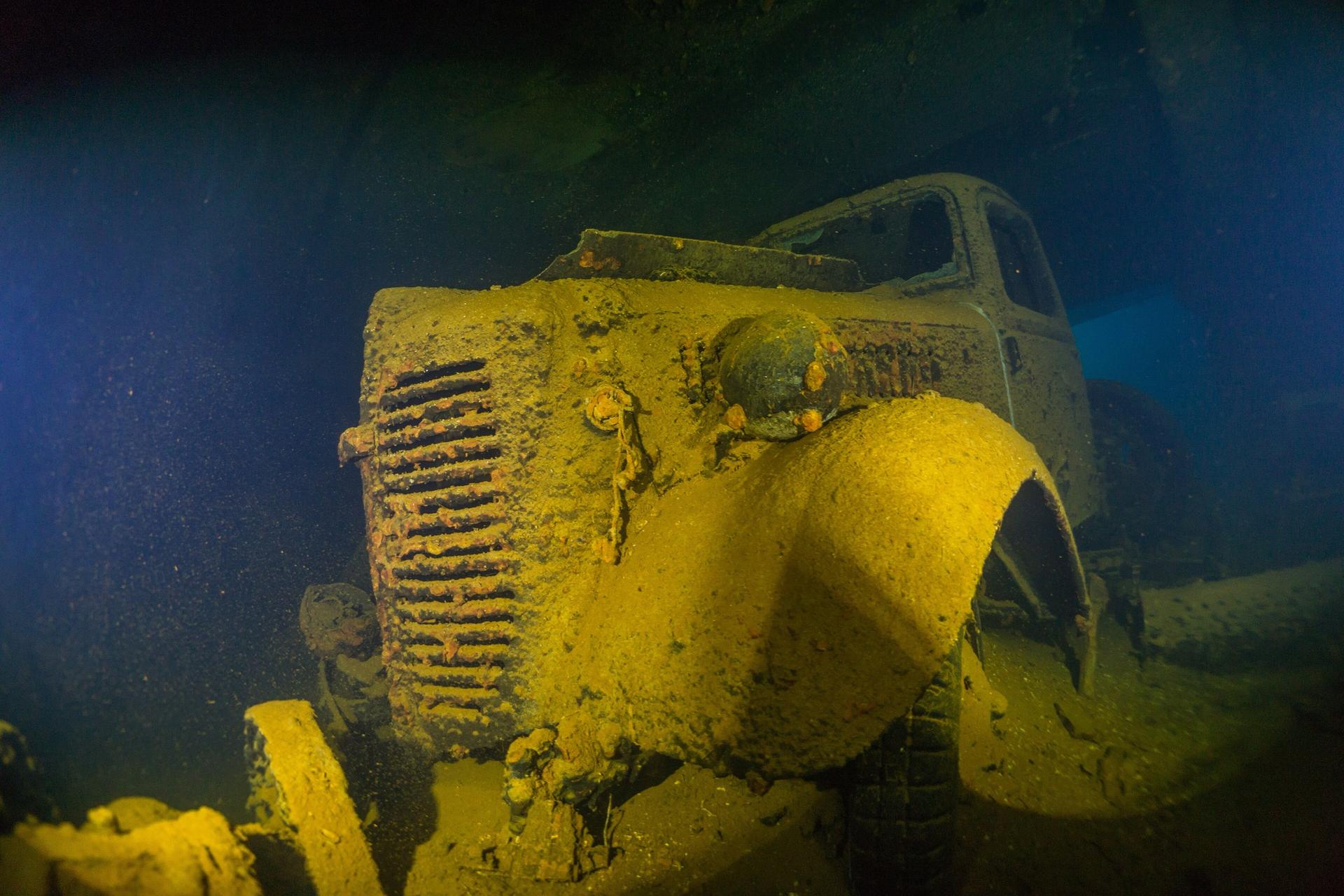
A New Zealand cargo ship captured at sea, with a hold still full of trucks and a bulldozer.
The Hoki Maru was built in Scotland as the Hauraki, sailed for a New Zealand line, was captured by Japanese raiders in 1942 and was sunk at Truk in 1944. Locals call her the bulldozer wreck, and the name is earned: one of her aft holds is packed with pickup trucks, dump trucks, a tractor, a steamroller and a bulldozer sagging on its beams. Her forward half was blown open when she sank, which makes the wreck deeper and more broken than the famous names. This guide covers her story, what you will see, the conditions, when to go and how you dive her.
Quick answer: Hoki Maru is a wwii shipwreck sitting upright, forward section blown open; deep exterior and hold penetration in Truk Lagoon. Best season: December to April (dry season) for the calmest seas and best visibility; diveable year-round. Level: Advanced, with deep-diving experience; the vehicle hold is a silty penetration dive that needs wreck training. Depth: Mast top about 12m; main deck roughly 24–37m; seabed reported between 36 and 50m; the vehicle hold lies below the main deck. Typical visibility: Typically 15–30m outside; silt in the vehicle hold can drop it to almost nothing.
Facts verified November 2026
Why the Hoki Maru is special
Her history is unusual for Truk. She was launched in 1921 by William Denny and Brothers at Dumbarton, Scotland, as the Hauraki, a cargo ship with room for twelve passengers, for the Union Steam Ship Company of New Zealand. On 12 July 1942, sailing in the Indian Ocean, she was stopped and seized by the Japanese armed merchant cruisers Aikoku Maru and Hokoku Maru. Her crew became prisoners of war: 23 of them, including engine-room crew, were kept aboard to take her to Japan and held in camps there, and several of her crew did not survive the war. Renamed Hoki Maru, she went into Japanese service as a transport and reached Truk early in 1944.
On 17 February 1944, the first day of Operation Hailstone, US carrier aircraft hit her. Bombs set off fuel in her forward holds and the explosion tore the front of the ship open. She went down with her cargo still aboard. The Aikoku Maru, one of the two raiders that captured her, also lies in the lagoon, sunk in the same raid.
What you'll see on the wreck
The stern half is largely intact and upright; the forward half is split open and spread across the seabed. The cargo is the reason to dive her:
- The vehicle hold aft of the mast: pickup trucks, dump trucks and a tractor, many with mudguards, headlights and tyres still on
- A bulldozer resting on the hold's middle level, its weight bending the beams beneath it
- A steamroller near the exit of the same hold
- Thousands of beer bottles in another hold, many from the Dainippon Brewery
- Crockery, rice bowls and other cargo debris around the holds
- A brass builder's plate amidships, British details on a ship sunk in Micronesia
- The tall mast, coated in growth, rising to within about 12m of the surface
- The forward half, opened up by the explosion, with hull plates bent outward and debris spread across the sand
Conditions and who it's for
This is a deeper dive than the Fujikawa Maru or Shinkoku Maru. The main deck sits at roughly 24 to 37 metres, the vehicle hold lies below it, and the seabed is reported between 36 and 50 metres depending on where you measure. Come with deep-diving experience and nitrox, and plan the dive around the hold rather than trying to see the whole ship.
The hold is cramped and silty. Exhaled bubbles knock particles off the ceiling, fins lift the floor, and the vehicles and bent beams leave little room to manoeuvre. Don't swim beneath the bulldozer or the steamroller: the beams holding them up have been weakening for eighty years. Penetration needs wreck training, a primary light and a backup, and a guide. Water is 28 to 30°C year-round and current is usually mild.
When to dive it
Truk is diveable all year. The drier months from about December to April usually give the calmest surface and the best visibility; June to November is wetter and more variable, and August to November carries the most typhoon risk, though the lagoon shelters the wrecks from swell.
Because the Hoki Maru is deep, good visibility pays off more here than on the shallow wrecks: you spend your limited bottom time looking at the cargo rather than searching for it.
How you dive the Hoki Maru
Dive her from a liveaboard, as part of a week with the shallower wrecks around her. Descend the mast, go straight to the vehicle hold while your gas and no-stop time are at their best, and spend the dive there with your guide. Then work up and forward along the deck, look at the blast damage from above, and come back to the mast for a slow ascent and safety stop.
If you want a second look, dive her again later in the trip with a different plan: the bottles and the bow wreckage on one dive, the trucks on the other.
We sell 8 to 10-night Truk Lagoon liveaboards that board off Weno, and the Hoki Maru is one of the lagoon's regular stops. The day-by-day wreck plan is set on board around conditions and the group, so if she matters to you, tell us when you book. She is a deep dive, so tell us your certification and how much deep diving you have done when you enquire; if you want to run decompression, ask us before you book.
Hoki Maru: common questions
What is the best season to dive Hoki Maru?
December to April (dry season) for the calmest seas and best visibility; diveable year-round
What experience level do I need for Hoki Maru?
Advanced, with deep-diving experience; the vehicle hold is a silty penetration dive that needs wreck training
How deep is Hoki Maru?
Mast top about 12m; main deck roughly 24–37m; seabed reported between 36 and 50m; the vehicle hold lies below the main deck
What marine life will I see at Hoki Maru?
Coral and sponge growth on the mast and upper structure, reef fish, and occasional grey reef sharks passing over the wreck