Heian Maru
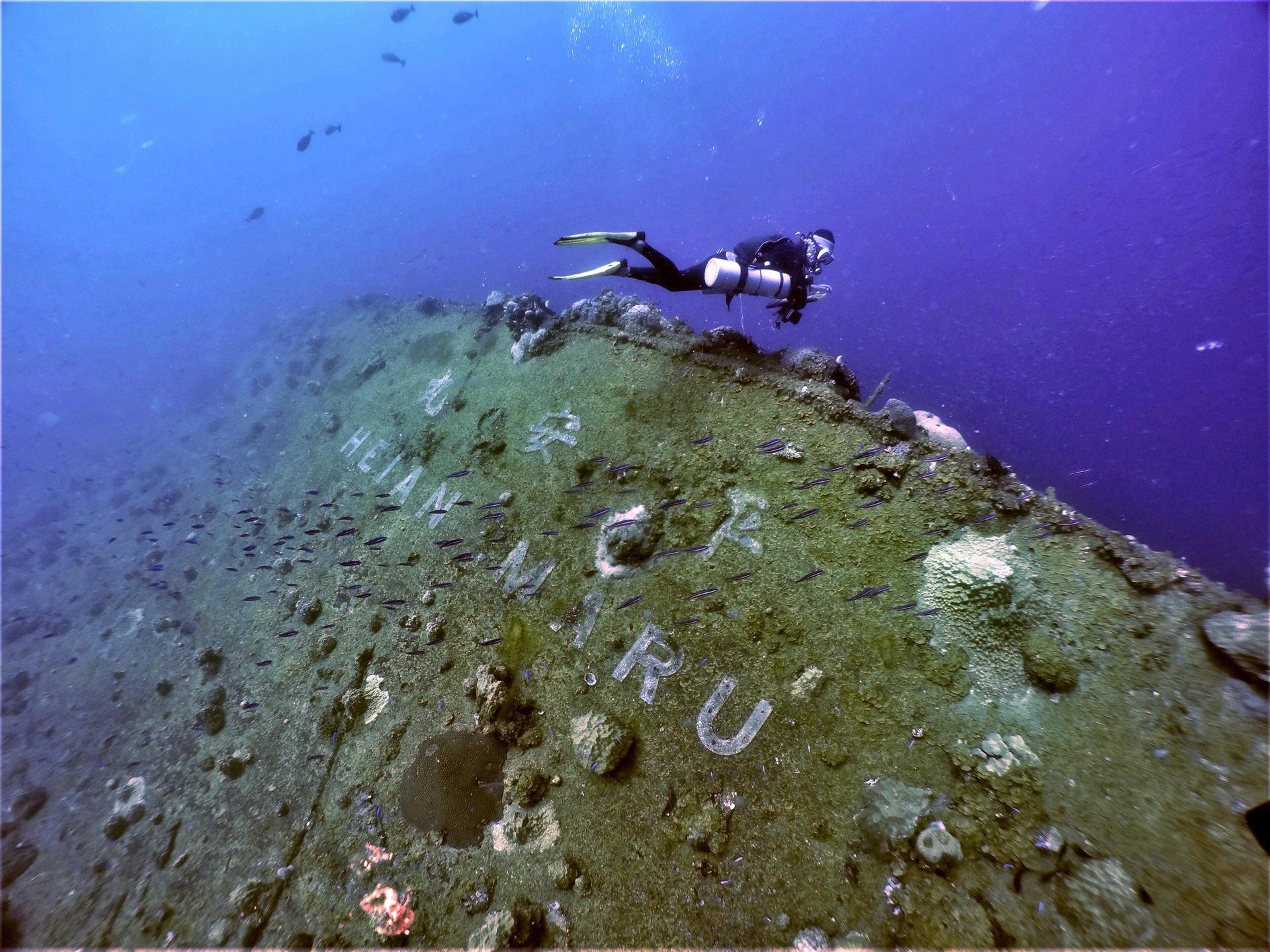
The largest ship left in Truk Lagoon lies on her side, her name still readable on the bow.
The Heian Maru started life as a passenger liner on the Pacific run to Seattle and ended it as a submarine tender, sunk in the American carrier raid of February 1944. She is the biggest wreck in the lagoon and lies on her port side, which puts her upper hull at easy recreational depth and turns her corridors, holds and engine room into a sideways world. Periscopes lie along her promenade deck and submarine torpedoes still sit in her forward hold. This guide covers her history, what you will see, the conditions, when to go and how you dive her from a Truk Lagoon liveaboard.
Quick answer: Heian Maru is a wwii shipwreck lying on her port side; exterior, swim-throughs and guided penetration in Truk Lagoon. Best season: December to April (dry season) for the calmest seas and best visibility; diveable year-round. Level: Advanced Open Water for the bow, hull and promenade deck; the holds and engine room are overhead penetration that needs wreck training. Depth: Upper (starboard) side about 9–12m; seabed roughly 33–41m (sources differ); most of the dive is spent between 12 and 30m. Typical visibility: Typically 15–25m; the anchorage sits between two islands and clouds up more after heavy rain than the outer wrecks.
Facts verified November 2026
Why the Heian Maru is special
She was built by Osaka Iron Works and completed in 1930 for NYK's transpacific service between Japan and Seattle, one of three sister liners. One of those sisters, the Hikawa Maru, survives as a museum ship in Yokohama; by several accounts she was also in Truk during the raid, marked as a hospital ship, and was not attacked. The Imperial Japanese Navy requisitioned the Heian Maru in October 1941 and converted her into a submarine tender, supplying the 6th Fleet's submarines with torpedoes, stores, spare parts and crew. At about 11,600 gross tons she is the largest ship still lying in the lagoon.
Before the war she was a working liner. She sailed on her maiden voyage to Seattle in December 1930 and spent the 1930s carrying passengers and cargo across the North Pacific, later on the Osaka and Kobe to Seattle run. The navy stripped out her passenger fittings to make room for workshops, torpedo and fuel stowage and extra crew, and armed her with deck guns. Look closely inside and you can still see where one kind of ship was turned into the other.
Operation Hailstone caught her at anchor. Near misses damaged her on 17 February 1944, more bombs set her bridge on fire before dawn on the 18th, and later that day an aerial torpedo from US carrier aircraft hit her amidships. She rolled onto her port side and sank. Eighteen of her crew were killed.
What you'll see on the wreck
Most dives start at the bow and work aft along the upturned starboard side, dropping into the ship where the guide knows the way. The features divers come for:
- Her name in Roman letters and kanji on the bow, and again at the stern above the propellers
- Submarine periscopes lying along the promenade deck corridor
- Submarine torpedoes in the forward hold, with shells nearby
- Long passenger corridors and a cavernous superstructure, all turned through 90 degrees
- The engine room, on its side, with two large diesels and much of the pipework, valves and gauges still in place
- The rudder and propellers at the stern
- From inside the hull, the hole torn in her port side by the torpedo that sank her
A war grave
Men died on this ship, and Japan regards the wreck as a war grave. Removing anything from the Truk wrecks is illegal, and the etiquette is the same as the law: look, photograph, and leave every object exactly where it lies. Don't pick things up to photograph them, and don't move them for the next diver.
Conditions and who it's for
Because she lies on her side, a lot of the Heian Maru is shallow. Her starboard hull sits around 9 to 12 metres, the bow lettering and promenade deck are well inside recreational limits, and an Advanced Open Water diver with good buoyancy gets a full, satisfying dive without going near the seabed. The water is 28 to 30°C all year and current is rarely a factor.
Inside is a different matter. A ship on her side is disorienting: corridors run the wrong way, doors open into the floor or the ceiling, and the silt that has settled on every flat surface lifts the moment a fin moves. The holds and engine room are overhead environments that need wreck training, a primary light and a backup, and a guide who knows the route. Nitrox helps you get more time in the 18 to 30 metre range where the holds are.
When to dive it
Truk Lagoon is diveable all year. The drier months from about December to April usually bring the calmest surface conditions and the most reliable visibility. June to November is wetter, with more variable visibility, and August to November carries the most typhoon risk, although direct hits are rare and the lagoon shelters the wrecks from swell.
The Heian Maru lies close to Dublon and Fefan, so heavy rain affects her visibility more than the wrecks out in the open lagoon. If clear water for wide-angle photography matters, the dry season is the better bet.
How you dive the Heian Maru
Truk is a liveaboard destination: the boat moors near the wreck and you dive her more than once without long rides across the lagoon. A sensible plan is two dives. The first follows the bow, the hull and the promenade deck to the periscopes, staying shallow and getting your bearings. The second goes inside, into the forward hold for the torpedoes or into the engine room, with a guide and on nitrox.
Agree a turn point before you go in, keep well off the silt, and save the shallow starboard hull for the end of the dive, where you can ascend slowly over coral before your safety stop at about 5 metres.
We sell 8 to 10-night Truk Lagoon liveaboards that board off Weno, and the Heian Maru is one of the lagoon's regular stops. The day-by-day wreck plan is set on board around conditions and the group, so if she matters to you, tell us when you book. Her holds and engine room are guided penetration dives; if you want to go further inside or run decompression, tell us your training when you enquire.
Heian Maru: common questions
What is the best season to dive Heian Maru?
December to April (dry season) for the calmest seas and best visibility; diveable year-round
What experience level do I need for Heian Maru?
Advanced Open Water for the bow, hull and promenade deck; the holds and engine room are overhead penetration that needs wreck training
How deep is Heian Maru?
Upper (starboard) side about 9–12m; seabed roughly 33–41m (sources differ); most of the dive is spent between 12 and 30m
What marine life will I see at Heian Maru?
Hard and soft coral on the exposed starboard hull, reef fish and baitfish around the superstructure