Gordo Banks
A deep blue-water seamount off Baja where scalloped hammerheads school over open ocean.
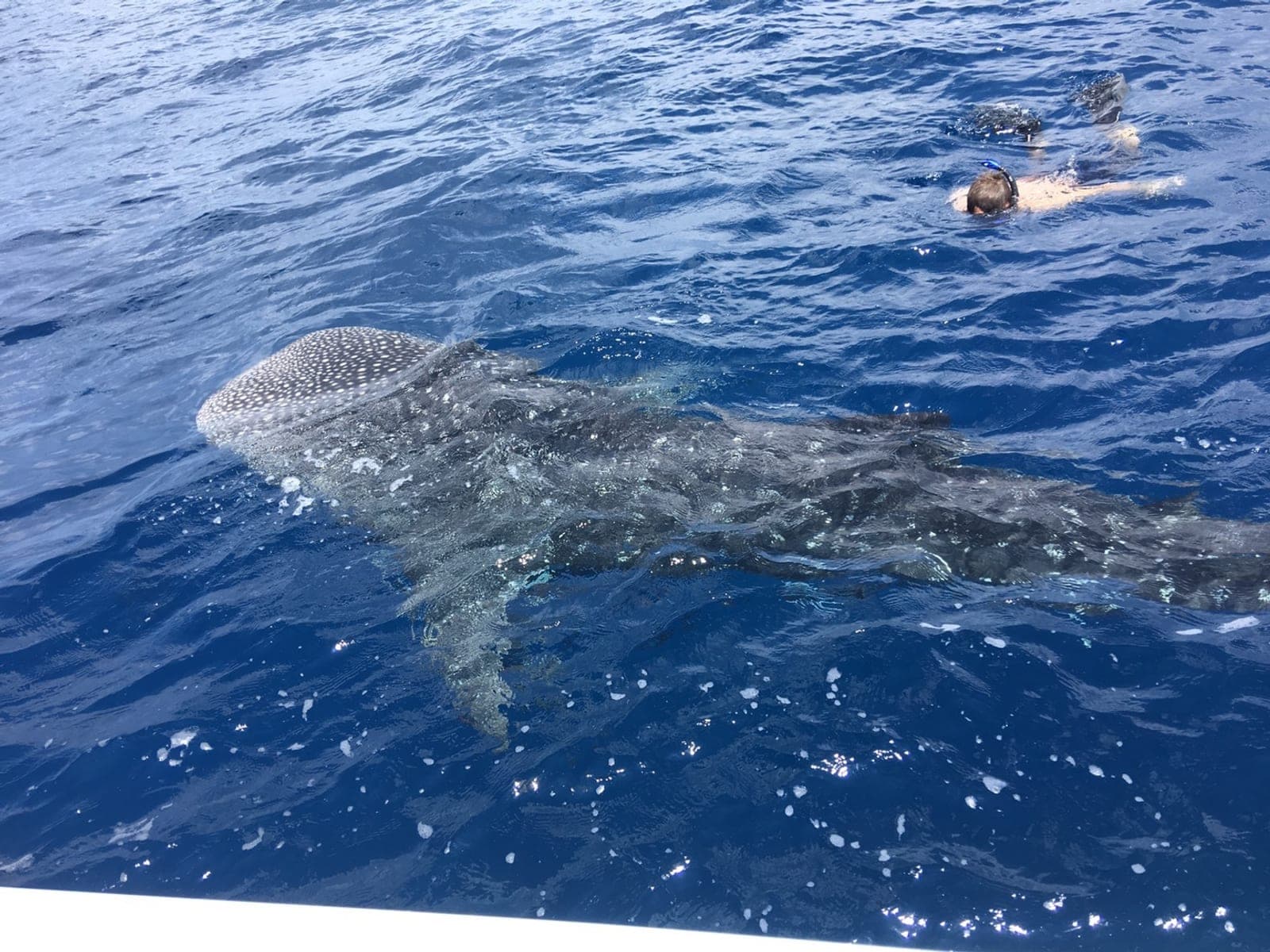
Gordo Banks is one of the Sea of Cortez's most serious dives: an offshore seamount rising toward the surface from very deep water, about seven miles off San Jose del Cabo. There is no reef to hold your hand here. You drop into blue water over a rocky pinnacle, hang in the current, and wait for the ocean to bring you scalloped hammerheads, silkies, tuna and the occasional whale shark. It is deep, exposed and genuinely advanced, and for divers who want big pelagics without a cage, it is one of the best shots in Mexico.
Quick answer: Gordo Banks is a deep offshore seamount, blue-water hang; often a negative entry in Sea of Cortez. Best season: Late August to January for hammerheads; September to December for the best all-round conditions. Level: Advanced — deep, blue-water diving; AOW plus a check dive typically required. Depth: Inner bank pinnacle tops out around 31-35 m (102-115 ft); the outer bank is deeper, 40 m+. Typical visibility: Variable, roughly 12-30 m (40-100 ft); best in autumn.
Facts verified September 2026
What makes Gordo Banks special
Most Sea of Cortez diving happens on sheltered walls, sea-lion colonies and shallow reefs. Gordo Banks is a different animal. It is a submerged seamount — two of them, in fact, the shallower inner bank and the deeper outer bank — rising out of very deep water well offshore. That geography is the whole point: the banks interrupt open-ocean currents and push nutrient-rich water upward, and that upwelling is what pulls big animals in from the blue.
What you are really diving here is the water column, not a wreck or a coral garden. The rocky pinnacle, dressed in black and wire coral, is your reference point and your shelter from the current, but the show happens out in the blue around and above you. On the right day that means a slow-moving school of scalloped hammerheads sliding past below, or a wall of tuna, or a lone whale shark materialising out of the haze. It is one of the few places in the Sea of Cortez where hammerhead schooling behaviour has been studied, and where you have a realistic chance of seeing it for yourself.
What you'll see
Gordo Banks is a pelagic dive, so nothing is guaranteed and everything is possible. Patience and good positioning in the current do more for you than chasing anything. The headline act is the scalloped hammerhead, which schools here seasonally, but the supporting cast is what makes even a quiet day worthwhile.
- Scalloped hammerheads — the signature species, schooling from late summer into winter, usually seen deep and in the blue
- Silky sharks and tope (dogfish) sharks working the water column
- Big schools of tuna, jacks, snapper and the occasional wahoo or marlin
- Mobula rays, sometimes in large squadrons, with peaks around June-August and again November-December
- Whale sharks passing through, plus seasonal humpback whales (roughly winter into spring) often heard before they are seen
Conditions and who it's for
Be honest with yourself about this one. Gordo Banks is an advanced dive and operators treat it that way. The pinnacle sits deep — the inner bank tops out around 31-35 m and the outer bank is deeper still — so you are diving near recreational limits with real bottom-time and gas-planning consequences. Reputable operators require an Advanced Open Water certification (or equivalent) and will usually run a check dive at a local site first to see your buoyancy and air consumption before they take you offshore.
Currents can be moderate to strong and are rarely predictable, thermoclines can appear without warning, and entries are frequently negative — you deflate and go down immediately so the group stays together and doesn't get swept off the bank. There is no bottom to fall back to, so comfort hanging in open blue water, solid buoyancy and calm gas management are non-negotiable. If deep, current-swept, blue-water diving is new to you, build up to Gordo rather than making it your first offshore seamount.
When to dive Gordo Banks
Timing matters more here than at almost any other site in the region. For hammerheads, late August through January is the window, with the sharks most reliable in the autumn months. September to December tends to offer the best overall package: warmer water, the clearest visibility and the most active pelagic schools.
The season to be wary of is roughly February to May. North winds and storm activity churn the southern Sea of Cortez, dropping the water temperature, cutting visibility and often making the offshore run uncomfortable or unrunnable. Water ranges from about 16 C (61 F) in spring to a balmy 30 C (86 F) in autumn, so your exposure protection and your expectations should both shift with the calendar. If hammerheads are the goal, plan for autumn and keep the itinerary flexible.
How you actually dive it
In practice Gordo Banks is almost always run as a day trip, not a classic reef dive off the back of a moored boat. Operators head out from the San Jose del Cabo or Cabo San Lucas marinas in a fast panga or RIB, and it is roughly a 40-minute to two-hour run offshore depending on sea state and which bank you are diving. It is typically a two-tank day, with the whole outing running six to seven hours door to door.
Expect a briefed negative entry, a descent straight down the line or into the blue toward the pinnacle, and a dive spent working the current close to the structure while watching the water column for movement. Because the site is deep and exposed, dives are short by design and surface intervals matter. A computer you trust, a surface marker buoy and a reliable buddy team are standard kit, and a good guide who reads the current and the sharks' behaviour is worth their weight in gold.
Faneca folds Gordo Banks into our Sea of Cortez (Baja California) liveaboard season as a marquee pelagic dive, though in practice this deep offshore seamount is usually reached by fast day boat from San Jose del Cabo rather than dived off the liveaboard itself — so we plan it for the autumn hammerhead window and pair it with the region's sea-lion colonies and reefs for a fuller trip.
Gordo Banks: common questions
What is the best season to dive Gordo Banks?
Late August to January for hammerheads; September to December for the best all-round conditions
What experience level do I need for Gordo Banks?
Advanced — deep, blue-water diving; AOW plus a check dive typically required
How deep is Gordo Banks?
Inner bank pinnacle tops out around 31-35 m (102-115 ft); the outer bank is deeper, 40 m+
What marine life will I see at Gordo Banks?
Scalloped hammerheads, silky and tope sharks, tuna, jacks, wahoo, marlin, mobulas, whale sharks, seasonal humpbacks
