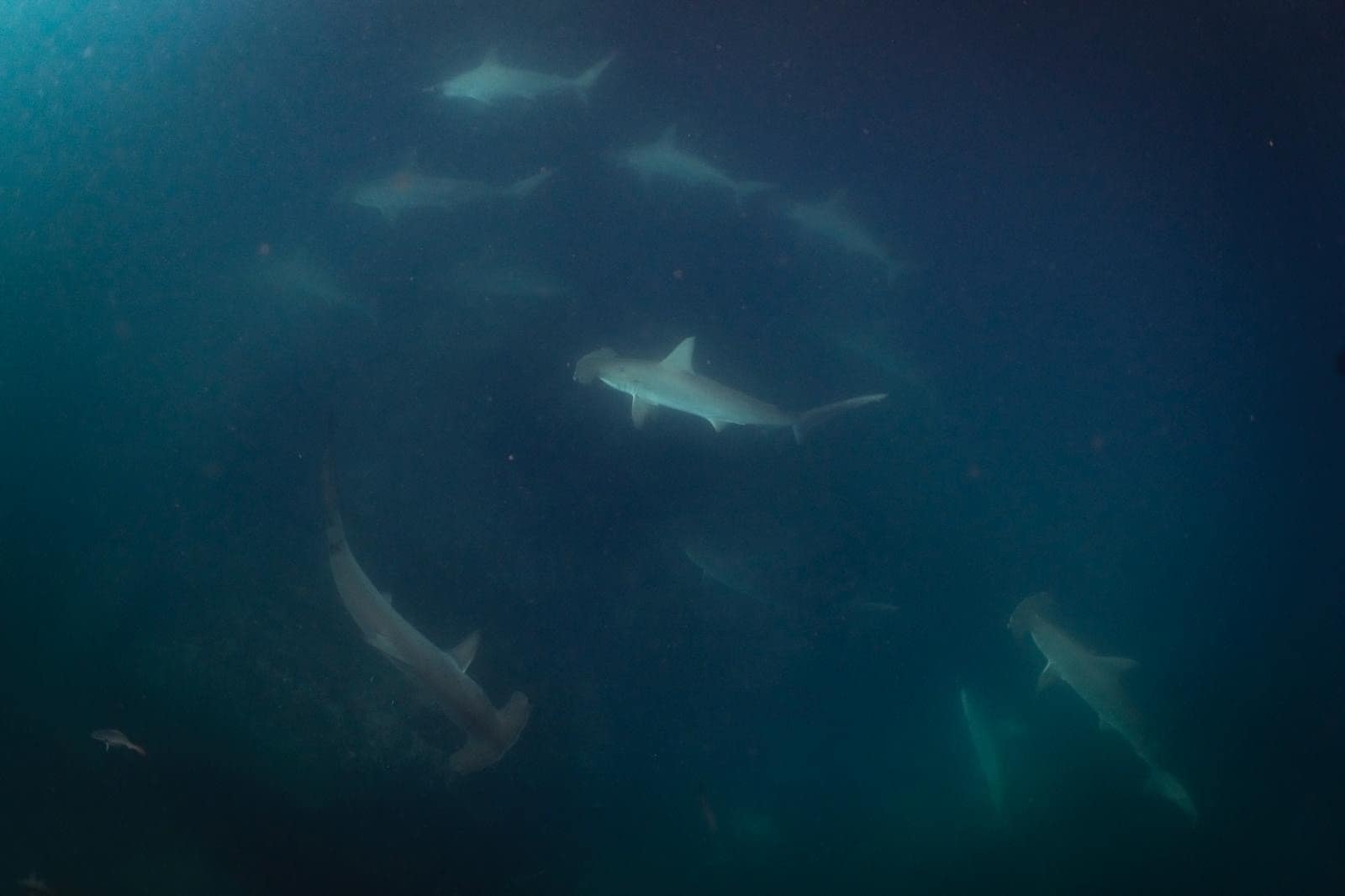
El Bajo Seamount
The seamount that made schooling hammerheads famous, and still runs blue water thick with pelagics when the season lines up.
El Bajo Seamount, off La Paz in the Sea of Cortez, is one of the most storied advanced dives on the planet. Three submerged pinnacles rise out of the blue eight nautical miles from land, and in late summer and autumn scalloped hammerheads still gather here to ride the current. It is offshore, exposed and current-swept, best reached on a Sea of Cortez liveaboard, and it rewards divers who come prepared and patient.
Quick answer: El Bajo Seamount is an offshore seamount / blue-water drift, boat access only in Sea of Cortez. Best season: August to November for pelagics and hammerheads; July–December clearest water. Level: Advanced to expert — strong open-ocean current and offshore exposure. Depth: Peaks at 16–25m (52–83ft); working dives 18–40m with deep water falling away below. Typical visibility: 15–30m (45–90ft), best from late summer into early winter.
Facts verified September 2026
Why El Bajo Seamount is diving history
El Bajo, known on charts as the Marisla Seamount, is where the modern hammerheads-and-seamounts story began. In the 1970s biologist Dr. Peter Klimley started studying the schools here, and early-1980s footage by Stan Waterman and Howard Hall put El Bajo on every serious diver's list. For a time it was talked about as the premier place on Earth to watch scalloped hammerheads school, ranked among the top handful of dives anywhere.
Structurally it is three separate peaks strung along roughly a 300-yard line rather than a single pinnacle. The central peak tops out shallowest at about 16m, the southern at around 21m, and the northern at about 25m, with the seabed dropping steeply into deep water all around. That geometry is the whole point: the seamount interrupts open-ocean current, deep water is forced up its flanks, and the resulting upwelling concentrates life in the blue.
Honesty matters here. Heavy fishing through the 1980s and 90s hammered the hammerhead population, and by the mid-90s the big schools had thinned dramatically. The La Paz bay nursery is slowly recovering and sightings are becoming more regular again, but this is no longer a guaranteed wall of a hundred sharks on every dive. Come for a genuinely wild offshore seamount, and treat a big school as the bonus it is.
What you'll see at El Bajo
El Bajo is a pelagic magnet, and the cast changes with the season and the current. The headline act is the scalloped hammerhead, which gathers over the peaks and turns in that slow, characteristic clockwise circling. But even on a quiet shark day the seamount is rarely empty — the blue water and the reef itself both stay busy.
- Scalloped hammerheads — seasonal, best August to November, in loose groups of a few to occasionally many dozens
- Mobula rays — summer schools flickering through the blue, sometimes in their hundreds
- Giant oceanic mantas and whale sharks — plankton feeders that make surprise appearances in the shallows
- Schooling and hunting fish — big aggregations of amberjack and tuna, with wahoo and dorado chasing baitballs
- Panamic green morays — a resident colony living in the seamount's cracks and small canyon
- Sea lions, dolphins and, on rare and memorable days, orcas passing through
Conditions and who El Bajo is for
This is an advanced-to-expert dive and operators are right to gate it. El Bajo sits well offshore with no shelter, so you are diving open ocean over a submerged structure with nothing to hide behind. Current is the defining factor: it can be gentle one day and run hard the next, and it can shift direction and strength during a single dive as the tide turns.
You need to be comfortable with blue-water descents, negative or fast entries when the crew calls for them, staying in a tight group, and holding position over a peak in current without silting or crashing the reef. Good buoyancy and air consumption count for a lot, because the action often happens deep enough that bottom time is short and you may need to work against flow.
Water is warm but stratified — surface can sit near 29°C in autumn while a sharp thermocline drops you into markedly cooler water down where the sharks hang, so plan exposure protection for the cold layer, not the boat deck. Visibility is generally good at 15–30m and best from late summer into early winter, though upwelling and plankton that draw the big animals can also cut clarity. If you are newly certified or shaky in current, build experience on La Paz's calmer sites first and come back for El Bajo.
When to dive El Bajo Seamount
Timing is everything on a seamount like this. The prime window for pelagic action and the best odds on hammerheads runs from roughly August through November, when the water is warmest, biodiversity peaks and the schools move into more accessible depths. September and October are the classic hammerhead months.
The broader Sea of Cortez season leans warm and clear from July into December, so even at the edges of the window you get good visibility and a strong supporting cast of mantas, mobulas and schooling fish. Winter brings its own spectacle to the wider region — the vast mobula aggregations Baja is famous for peak in the cooler months — but El Bajo itself is at its best in that late-summer-to-autumn sweet spot. Whichever week you pick, expect the schedule to flex: this is an exposed offshore site and trips are genuinely weather-dependent.
How you actually dive El Bajo
El Bajo is boat-access only — there is no shore option and no shortcut. Day boats run out from La Paz in good conditions, but the site sits far enough offshore, and its window is short enough, that a Sea of Cortez liveaboard is the more reliable way to reach it. A liveaboard puts you on the seamount early, lets the crew read the current before you splash, and gives you multiple attempts across a trip rather than one roll of the dice.
Expect a briefed drift-and-hold profile: descend fast into the blue along the reference the crew gives you, gather over or near a peak, and let the animals come to you rather than chasing them across the current. Nitrox is worth having for the repeated deeper time, and a surface marker and audible signal are sensible on a site where you can drift off the structure into open water. Follow the divemaster's line on entries and depth — on a good El Bajo day the current, the depth and the sharks all demand your full attention at once.
Faneca dives El Bajo on our Sea of Cortez (Baja California) liveaboards, which time their itineraries to the late-summer and autumn pelagic window and carry the offshore range to reach the seamount when day boats can't; we'll be straight with you that hammerheads are seasonal and never guaranteed, but this is the best-odds way to try for them.
El Bajo Seamount: common questions
What is the best season to dive El Bajo Seamount?
August to November for pelagics and hammerheads; July–December clearest water
What experience level do I need for El Bajo Seamount?
Advanced to expert — strong open-ocean current and offshore exposure
How deep is El Bajo Seamount?
Peaks at 16–25m (52–83ft); working dives 18–40m with deep water falling away below
What marine life will I see at El Bajo Seamount?
Scalloped hammerheads (seasonal), mobula rays, giant oceanic mantas, whale sharks, tuna, amberjack, wahoo, dorado, Panamic green morays
