Giannis D
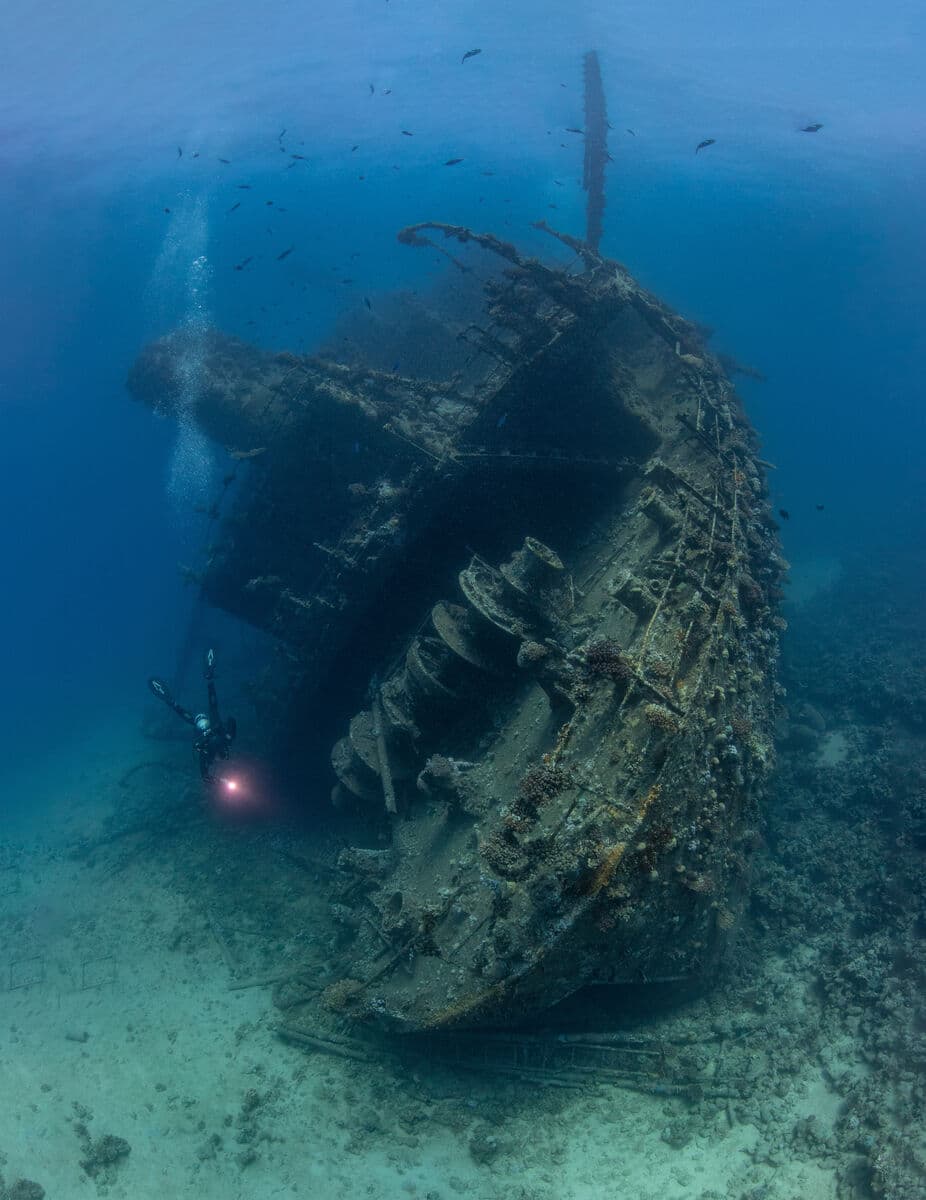
A Japanese-built freighter broken in three on Abu Nuhas, with a stern section you swim through at 45 degrees.
The Giannis D is the wreck most divers remember from Abu Nuhas, and the reason is her stern. It sits on the sand canted hard over to port, bridge and funnel intact, so the inside of the ship is tilted at an angle your inner ear never quite accepts. She is a 1960s cargo ship rather than a war wreck, nobody died when she was lost, and she lies in clear water at depths most divers can handle. This guide covers how she sank, how the three sections lie, the route of a good dive, what to expect inside, and where she fits in a northern Red Sea week.
Quick answer: Giannis D is a wreck dive on a 99.5 m cargo ship lying in three sections along the base of the reef: exterior, bridge and engine room in Red Sea. Best season: Year-round; March-May and September-November usually give the calmest surface for mooring on this exposed reef. Level: Open Water and up for the outside in calm weather; the bridge and engine room are overhead penetration for wreck-trained divers or a guided, well-briefed group. Depth: Top of the stern's A-frame mast about 4 m; stern seabed about 24-27 m (sources differ); most of the dive between 10 and 24 m. Typical visibility: Typically 20-30 m, less when the wind stirs up the windward side.
Facts verified November 2026
From Shoyo Maru to Giannis D
She was built in 1969 by the Kurushima Dock Company at Imabari in Japan as the Shoyo Maru, a 99.5-metre general cargo ship of 2,932 gross tons with two holds forward and her bridge and engine room aft. She was sold and renamed Markos in 1975, and in 1980 Dumarc Shipping and Trading of Piraeus bought her, renamed her Giannis D and painted the large D on her funnel that divers still look for today.
In April 1983 she loaded sawn softwood at Rijeka, in what was then Yugoslavia, for Jeddah in Saudi Arabia and Hodeidah in Yemen. She came through the Suez Canal, ran down the Gulf of Suez, and on 19 April 1983, heading for the Strait of Gubal at full speed, she left her course and drove onto the north-west corner of Abu Nuhas. The crew were taken off safely and no one died. Within weeks she had broken up on the reef and slid down its side; accounts differ on exactly how long it took.
How the wreck lies
The Giannis D lies in three sections on sand at the foot of the reef, roughly parallel to it: stern, midships and bow. Most of the dive happens on the stern, which is the most intact part and the deepest. It rests canted about 45 degrees to port, with the propeller and rudder on the sand at around 24 to 27 metres depending on whose figures you read.
Above the stern rise the bridge deck, the funnel with its D, and the A-frame cargo mast, whose top comes to within about 4 metres of the surface. Midships is the most broken section, a field of hull plates, booms and the second mast lying across the sand. The bow rests on its port side further along the reef, its mast lying flat, parallel to the seabed and covered in coral.
- Stern section: propeller and rudder on the sand at about 24-27 m, tilted bridge deck, funnel and engine room
- A-frame mast: rises to about 4 m and is the natural place to finish
- Midships: the most broken part, scattered plates, booms and a fallen mast
- Bow: on its port side, with its coral-covered mast lying flat along the sand
The route of a good dive
Boats moor on the reef or drop you by RIB, and you descend straight onto the stern. Start at the bottom, at the propeller and rudder, and give yourself a minute a few metres off the wreck to take in the whole tilted section. The sight of the bridge and funnel leaning over the sand is the picture of this wreck.
From there, trained divers or a guided group usually go into the bridge, a large open room with several entry points and plenty of light, and then down into the engine room. Afterwards the route runs east with the reef on your right, across the debris of the midships to the bow, before turning back along the reef to finish on the upper stern and the A-frame. In good conditions there is time for all three sections on one dive; in a chop, most guides keep the group on the stern.
Inside the bridge and engine room
The engine room is the reason many divers dive the Giannis D twice. The six-cylinder diesel and much of its machinery are still in place, and clouds of glassfish hang in the shafts of light. Access is through a skylight near the funnel and other openings in the stern.
The tilt is what catches people out. Every deck slopes at about 45 degrees, doorways open at odd angles, and some divers feel genuinely dizzy for the first few minutes. The lower parts of the engine room narrow into tight passages that are no place for a recreational diver. Stay in the areas where you can see daylight, follow a guide who knows the route, and carry a torch even at midday. In the late afternoon the light inside drops off quickly.
Conditions and who it suits
The wreck lies on the windward, northern side of Abu Nuhas, and that shapes the dive more than the depth does. The surface is often choppy, mooring can be difficult, and in a strong northerly the crew may not tie in at all. Current on the wreck itself is usually modest, but it can pick up, and some divers report water moving through the inside of the hull in rough weather.
On a calm day the outside of the Giannis D suits Open Water divers who are steady in the water, because the bridge deck, funnel and A-frame are all well inside 18 metres. The propeller and the lower stern need Advanced certification or a deep adventure dive. Going inside is overhead diving and needs wreck training or, at the least, a guide, good trim and a light. Water runs from about 21 to 23°C in late winter to 28 to 30°C in August, so a 5 mm suit covers most of the year and a 7 mm is welcome in February.
Where it fits in a northern Red Sea week
Abu Nuhas is a few hours north of Hurghada by boat, so it often comes early in a northern wrecks week, sometimes as the first full day of diving. Boats usually pair the Giannis D with the Carnatic, which lies close by on the same reef, and dive the deeper Chrisoula K or Kimon M when the sea allows. Our Abu Nuhas guide covers all four.
The same week normally takes in the Thistlegorm across the strait and the reefs of Ras Mohammed. If you only get one dive on the Giannis D, spend it on the stern and its engine room; if the itinerary gives you two, use the second for the midships and bow, which most groups skip.
We dive the Giannis D on our Northern Red Sea wrecks liveaboards from Hurghada, usually with the Carnatic and the other Abu Nuhas wrecks early in the week. Which wrecks the crew chooses on the day depends on the wind on this exposed reef. If you want to go inside the stern, tell us your wreck training when you enquire.
Giannis D: common questions
What is the best season to dive Giannis D?
Year-round; March-May and September-November usually give the calmest surface for mooring on this exposed reef
What experience level do I need for Giannis D?
Open Water and up for the outside in calm weather; the bridge and engine room are overhead penetration for wreck-trained divers or a guided, well-briefed group
How deep is Giannis D?
Top of the stern's A-frame mast about 4 m; stern seabed about 24-27 m (sources differ); most of the dive between 10 and 24 m
What marine life will I see at Giannis D?
Glassfish in the engine room, crocodilefish, lionfish and large morays in the broken midships, schooling reef fish over the wreck, and hard coral on the hull