Fish Head
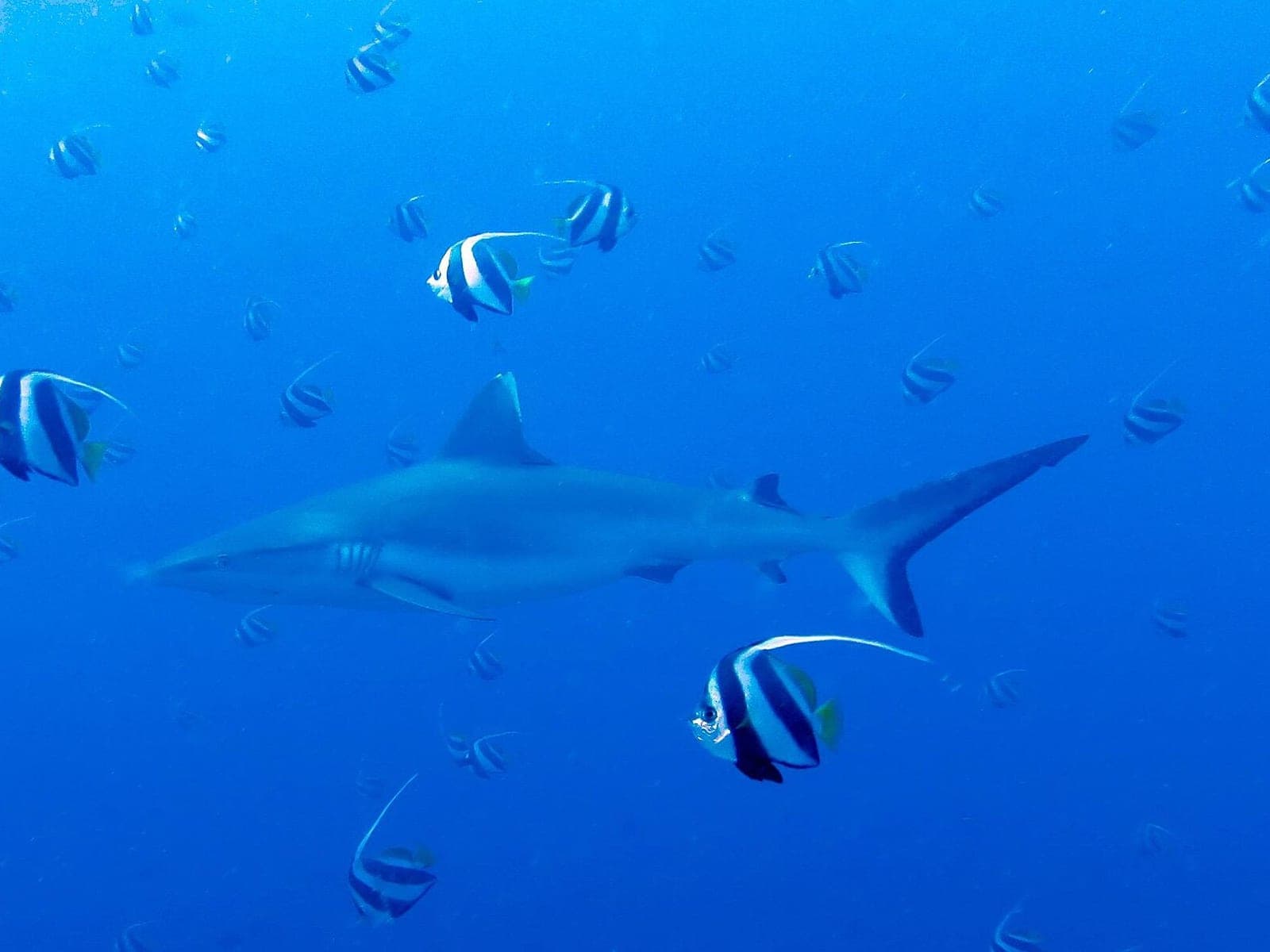
A protected pinnacle inside Ari Atoll where grey reef sharks hold in the current above a wall of overhangs, black coral and fusiliers.
Fish Head is the divers' name for Mushimasmingili Thila, a pinnacle inside North Ari Atoll and one of the longest-established shark dives in the Maldives. A government fisheries review in 1993 described it as the country's most outstanding shark-watching site and recommended protecting it, and it was listed as a protected marine area in 1995. The grey reef sharks are still the reason to come, along with dense schools of fusiliers, overhangs hung with black coral and the tuna and trevally that hunt along the edge. The sharks usually sit deeper than an Open Water diver should go, and the current decides how good the dive is.
Quick answer: Fish Head is a submerged pinnacle (thila) dived along its up-current edge, with caves and overhangs in Maldives. Best season: All year: the grey reef sharks are resident. December to April (northeast monsoon) usually has the clearest water and the calmest sea. Level: Boats typically ask for Open Water to Advanced Open Water and about 20 to 50 logged dives on central-atolls weeks. The sharks usually sit below 18 m, so the dive really calls for Advanced Open Water or a 30 m certification; Open Water divers stay on the upper reef. Depth: Reef top at about 10 m (sources give 8 to 14 m); walls fall to sand at 35 to 40 m or more; dives are planned to 30 m at most. Typical visibility: About 20 to 30 m in the northeast monsoon, sometimes more; lower in plankton, and the fish schools themselves can fill the view.
Facts verified November 2026
What Fish Head is
Fish Head is a thila: a pinnacle whose top stays under water at low tide. It stands inside the atoll, which sets it apart from a kandu, a channel through the atoll rim. It is an oval roughly 80 to 100 metres long, with a top at about 10 metres and sides that fall steeply to sand at 35 to 40 metres or more.
The walls are cut with caves and overhangs. Black coral bushes and sea fans grow under them, most thickly on the north and west sides, and the top is covered in fusiliers and bluestripe snappers. The current strikes one end of the oval and divides around it, and that up-current end is where the dive happens.
The feeding history, and what happens now
Fish Head was once a shark-feeding site. Dive instructors fed the grey reef sharks, which brought normally shy animals close to divers. By 1993 a review for the Ministry of Fisheries and Agriculture and the FAO already wrote of instructors feeding sharks as something done mainly in the past. The same review estimated that a grey reef shark at Fish Head was worth far more to the country alive than caught, and recommended a ban on fishing around the reef. Protection followed in 1995.
Feeding stopped long ago and does not happen now. Nobody baits or feeds on this dive. The sharks you see are there for the current.
What you will see
Grey reef sharks hold in the current off the up-current end, mostly in the deeper half of the dive. Recent dive guides speak of ten to twenty on a good dive. On a slack tide you may see two or three, or none close. Whitetip reef sharks rest under the overhangs by day.
The 1993 review noted that the sharks left the site for a few weeks each year, at some point between February and May, and then came back. We have not found a recent source that repeats this, but it is a fair reminder that resident sharks are not a promise.
- Grey reef sharks off the up-current end
- Whitetip reef sharks, often resting under overhangs
- Fusiliers in dense schools over the top, with tuna and trevally hunting through them
- Bluestripe snappers, bannerfish and great barracuda
- Napoleon wrasse, long associated with the site, though not seen on every dive
- Hawksbill turtles and the occasional eagle ray
- Black coral and sea fans under the overhangs
Conditions and who it is for
Current is moderate to strong on most dives and it is the point of the site: little current means clearer water but fewer sharks at the edge. You need to descend promptly, hold a position without holding on to coral, and manage your gas at depth.
Boats on central-atolls weeks typically ask for Open Water to Advanced Open Water and about 20 to 50 logged dives. At this site the certificate matters more than usual. The sharks are normally below 18 metres, the limit of Open Water training, so an Open Water diver stays on the top and the upper wall, among the fusiliers, snappers and turtles, and watches the sharks from above. Recreational dives in the Maldives are limited to 30 metres for everyone and the sand around the base is deeper than that, so watch your depth on the wall. Water is about 27 to 31°C through the year.
When it is dived
The site is dived all year. The northeast monsoon, roughly December to April, usually gives the clearest water and the calmest sea. From May to November visibility is lower and the weather less settled, but the sharks are still there.
In either season the tide matters more than the month. Small to medium currents give the best visibility, and guides time the dive for them where they can.
How the dive runs
The guide checks the current from the dhoni and drops the group up-current of the pinnacle. When the current is running the entry is negative: you leave the surface at once and descend to the up-current edge before the water carries you past it. The group settles there, at the depth set in the briefing, to watch the sharks, then works up the wall through the overhangs and finishes on the top among the fusiliers.
The top is at about 10 metres, too deep for a safety stop. The stop is made at about 5 metres in open water, drifting away from the pinnacle under a surface marker buoy, and the dhoni picks you up where you surface. Every diver should carry a buoy and be able to send it up from depth.
Fish Head is on the usual list for central-atolls weeks that cross North Ari Atoll, often within a day of Maaya Thila. Which sites a week dives depends on the current and the weather, so say in your concierge brief if grey reef sharks are a priority and we will match the week, and your certification, to it. See also our Maldives liveaboards page.
Fish Head: common questions
What is the best season to dive Fish Head?
All year: the grey reef sharks are resident. December to April (northeast monsoon) usually has the clearest water and the calmest sea
What experience level do I need for Fish Head?
Boats typically ask for Open Water to Advanced Open Water and about 20 to 50 logged dives on central-atolls weeks. The sharks usually sit below 18 m, so the dive really calls for Advanced Open Water or a 30 m certification; Open Water divers stay on the upper reef
How deep is Fish Head?
Reef top at about 10 m (sources give 8 to 14 m); walls fall to sand at 35 to 40 m or more; dives are planned to 30 m at most
What marine life will I see at Fish Head?
Grey reef sharks, whitetip reef sharks, fusiliers, bluestripe snappers, tuna, giant trevally, great barracuda, Napoleon wrasse, hawksbill turtles, eagle rays, black coral and sea fans