SS Carnatic
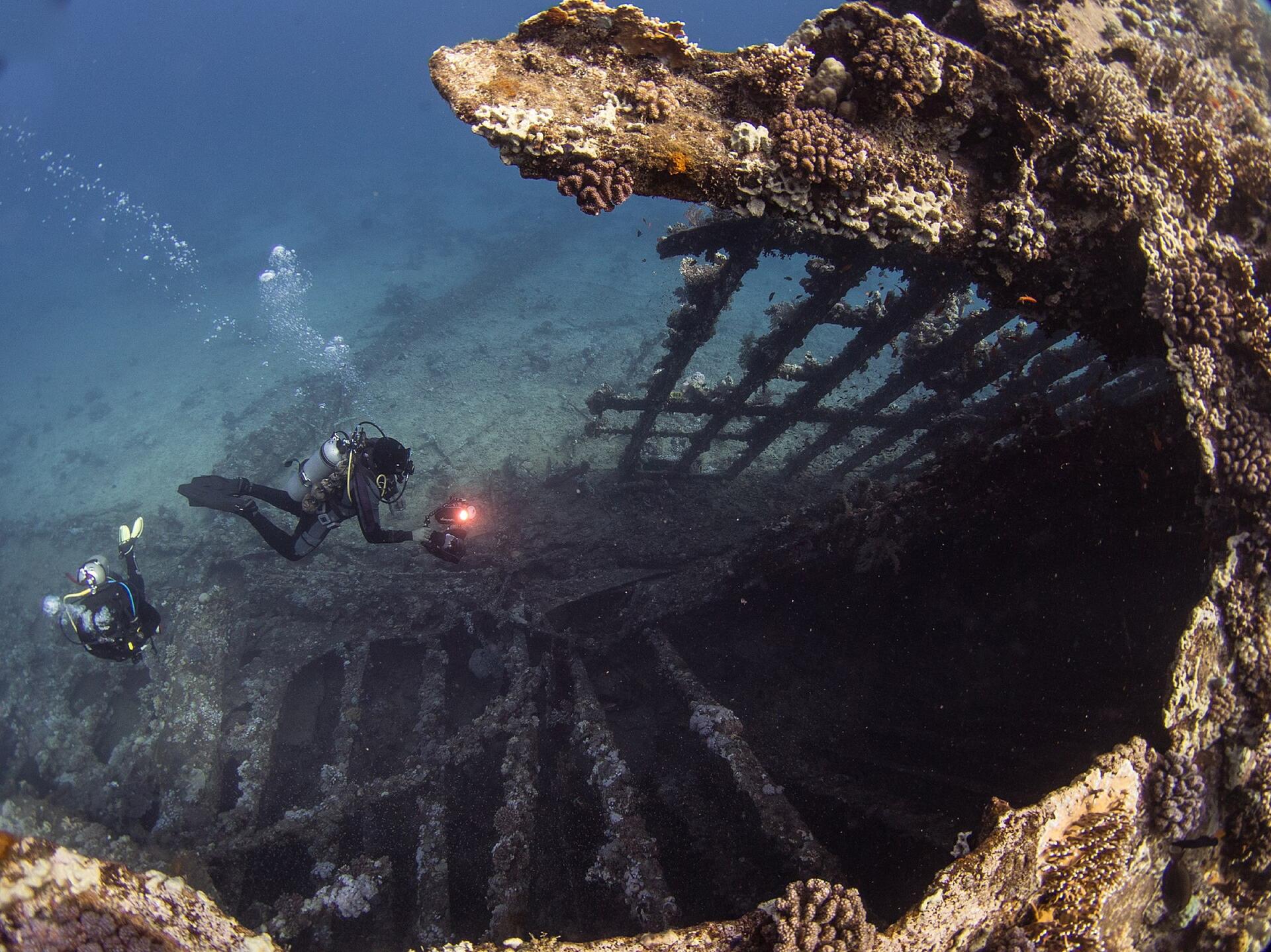
A Victorian P&O steamer on her side at Abu Nuhas, her planking long gone and her iron frames full of glassfish.
The Carnatic is the oldest of the Abu Nuhas wrecks and, for many divers, the most beautiful. She was a P&O mail steamer on the run to Bombay, lost in 1869 with gold in her strongroom and wine in her hold. Her wooden planking rotted away long ago, leaving the iron frames of the hull open like a rib cage, and light pours through them onto glassfish, groupers and coral. She lies a little deeper than her neighbour the Giannis D, almost all of her below 17 metres. Here is her story, how she lies, how to dive her and how she fits into a northern Red Sea week.
Quick answer: SS Carnatic is a wreck dive on a composite steam-and-sail liner lying on her port side, with swim-throughs between the iron frames in Red Sea. Best season: Year-round; March-May and September-November usually give the calmest surface for mooring on this exposed reef. Level: Advanced Open Water or a deep adventure dive recommended, since nearly the whole wreck lies below 18 m; the open frames make easy, well-lit swim-throughs. Depth: Shallowest parts about 17-18 m; seabed about 25-28 m (sources differ). Typical visibility: Typically 20-30 m.
Facts verified November 2026
A P&O liner on the Bombay run
The Carnatic was built by Samuda Brothers on the Isle of Dogs in London and launched in December 1862 for the Peninsular and Oriental Steam Navigation Company. She was a composite ship, with an iron frame planked in wood, about 90 metres long and 1,776 tons, driven by a compound steam engine with square-rigged sails as well. She carried passengers, mail and cargo between Suez and Bombay.
In September 1869 the Suez Canal was still two months from opening, and the Carnatic worked the Suez to Bombay leg of the route to India. She sailed on 12 September with 34 passengers and 176 crew, the Royal Mail, cotton, copper and £40,000 in specie for the mint in Bombay.
Thirty-four hours on the reef
In the early hours of 13 September she ran onto Abu Nuhas. Her master, Captain P. B. Jones, judged that she was holding and safe, and kept everyone on board rather than putting them in the boats. Through the next day the water rose until it reached the boilers and she lost power and light. On 14 September, about 34 hours after she struck, Jones ordered the ship abandoned, and as the first people took their places in the boats she broke in two.
Thirty-one people died in most accounts; P&O's official return gave 30. The survivors rowed to Shadwan Island and were picked up the next day by another P&O ship, the Sumatra. A salvage team recovered the specie within weeks, and the official record says all of it was found, although stories of missing gold have never quite gone away.
How she lies
Divers rediscovered the Carnatic in the mid-1980s and found her hold scattered with glass bottles, which is why she is still called the wine wreck or bottle wreck. She lies on her port side along the foot of the reef, parallel to it, in three parts. The stern and bow are largely intact; the middle, where the engine room was, has collapsed into a pile of wreckage with boilers and fallen masts on the sand.
The details that make her are Victorian. At the stern a single row of seven square windows faces aft above a big rudder and the propeller, both resting on the sand. At the bow you can still see the ring that held the bowsprit and the curved support below it where the figurehead once was. Lifeboat davits stand out from the hull, and along the upper side, now the starboard side, rows of square portholes run the length of the ship.
- Stern: seven square windows, rudder and propeller on the sand, the deepest part of the dive
- Midships: collapsed engine room, boilers and masts on the seabed
- Bow: bowsprit ring and figurehead support, open frames you can swim between
- Along the upper side: davits and square portholes
The dive, stern to bow
Boats moor in the lee of the reef and send you over the wreck by RIB, or you swim across from the mooring. Most guides start at the stern because it is the deepest point. Hang a few metres off it first: the windows, rudder and the shape of the counter only make sense from outside. Then go in. With the planking gone, the stern is a frame of iron beams with daylight on every side, and it is full of glassfish that part around you as you swim through.
Carry on forward through the mid-section, past the boilers and the fallen masts, to the bow, which is again open enough to enter between the frames. Finish by coming back along the upper side of the hull, which is the shallowest part of the wreck, past the davits and portholes, then move onto the reef for your safety stop.
Conditions and who it suits
The Carnatic is not difficult, but it is not shallow. Almost every part of the wreck is between 17 and 27 metres, so Advanced Open Water or a deep adventure dive is the sensible minimum, and your no-decompression time is the real limit on the dive. The penetration here is gentle by wreck standards, because the open frames let in light and you are never far from a way out, but stay out of anything enclosed unless you are trained for it.
Like everything on the north side of Abu Nuhas, she sits on the windward side of the reef. A chop makes the RIB pick-up the hardest part of the dive, and a strong northerly can stop boats mooring at all. Current on the wreck is usually mild. Water ranges from about 21 to 23°C in late winter to 28 to 30°C in August.
Where it fits in a northern Red Sea week
The Carnatic and the Giannis D lie close together, so northern wrecks weeks usually dive them on the same day, one after the other. Do the Carnatic first if you can: she is the deeper of the two, and the shallower Giannis D makes a better second dive.
She is one of four wrecks on the north side of Abu Nuhas, all covered in our Abu Nuhas guide, and the same week normally takes in the Thistlegorm and Ras Mohammed. Abu Nuhas is a few hours north of Hurghada by boat, so it often comes early in the trip.
We dive the Carnatic on our Northern Red Sea wrecks liveaboards from Hurghada, usually on the same day as the Giannis D. The order of the Abu Nuhas wrecks depends on the wind on this exposed reef, and the crew decides it on the day.
SS Carnatic: common questions
What is the best season to dive SS Carnatic?
Year-round; March-May and September-November usually give the calmest surface for mooring on this exposed reef
What experience level do I need for SS Carnatic?
Advanced Open Water or a deep adventure dive recommended, since nearly the whole wreck lies below 18 m; the open frames make easy, well-lit swim-throughs
How deep is SS Carnatic?
Shallowest parts about 17-18 m; seabed about 25-28 m (sources differ)
What marine life will I see at SS Carnatic?
Glassfish and groupers living inside the hull, lionfish, crocodilefish, morays, octopus and nudibranchs, with hard and soft coral on the frames