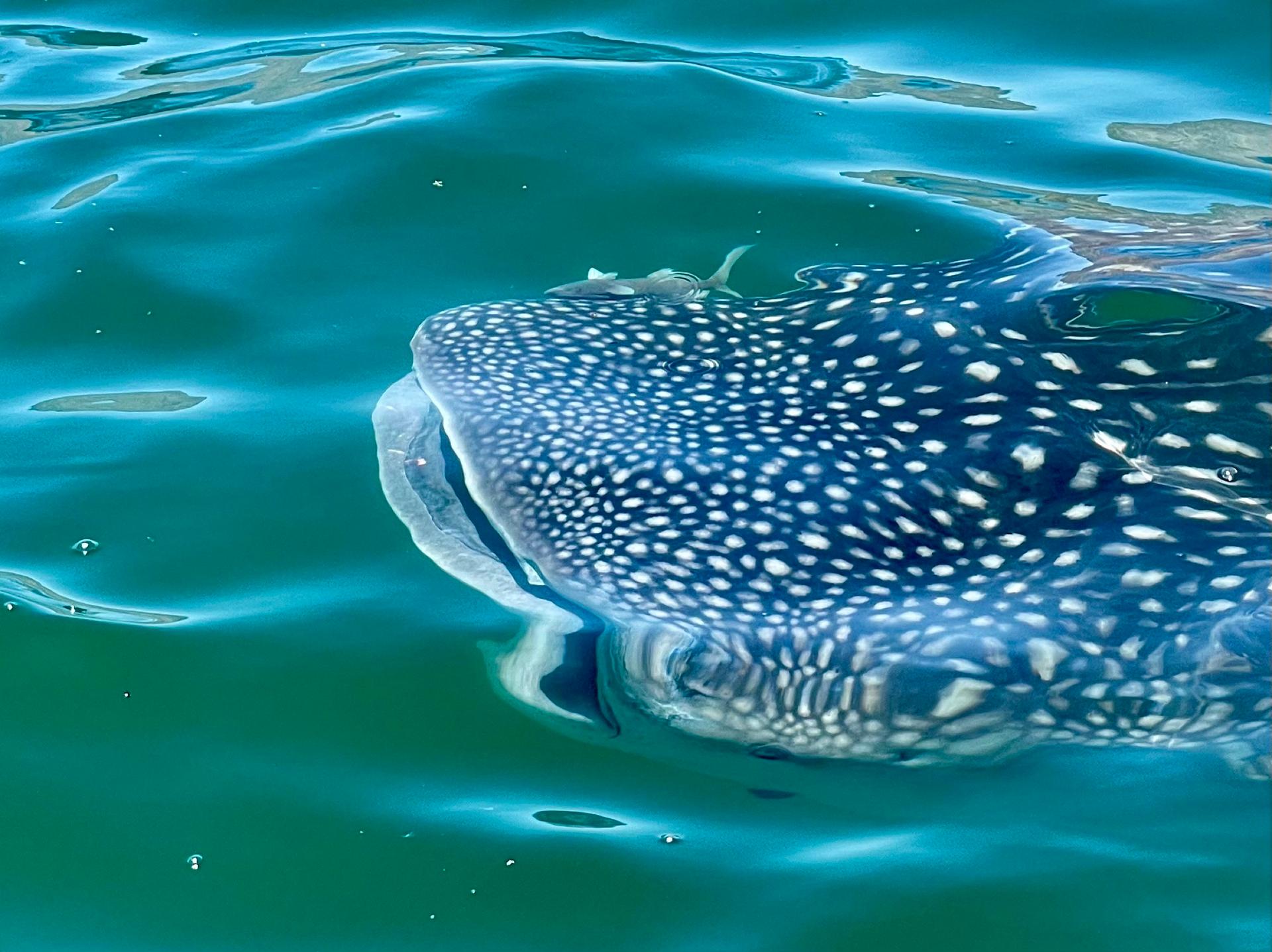
Bahía de los Ángeles (whale sharks)
A shallow desert bay where young whale sharks feed on plankton through the summer, a few metres under the surface.
Bahía de los Ángeles is a shallow bay on the Baja side of the Midriff, sheltered by a chain of islands and backed by bare desert mountains. Every summer juvenile whale sharks move in to feed on the plankton that blooms in its water, and on the last diving day of our Midriff week the boat stops here so you can snorkel with them. This guide covers when the sharks are there, the rules that govern the encounter, what the water is like and how the day is run.
Quick answer: Bahía de los Ángeles (whale sharks) is a guided snorkel from small boats, plus two scuba dives elsewhere in the bay the same day in Sea of Cortez. Best season: Sharks are seen from about June to November; the authorised season runs 1 June to 15 December. Level: Snorkellers of any level who swim comfortably; no scuba with the sharks. Depth: Snorkel at the surface; sharks feed in the top few metres; the bay is mostly under 40 m deep. Typical visibility: Often poor: the plankton the sharks feed on can cut it to a metre or two.
Facts verified September 2026
Why whale sharks come to Bahía de los Ángeles
The bay is shallow, mostly under 40 m and around 50 m in the channels that open onto the Canal de Ballenas, and the tides that sweep through the Midriff mix it so hard that it behaves like a place with constant upwelling. Through the summer that turns into dense swarms of zooplankton, mainly small copepods, and whale sharks come in to feed on them. Researchers have been photographing the sharks here for more than two decades and have identified several hundred individuals by their spot patterns, many of which return in later years.
Almost all of them are young. Studies of the bay's sharks find more than 90% are immature, mostly between about 2.5 and 8 m long, and males outnumber females by between two and three to one. Some of the same animals turn up in Bahía de La Paz, 600 km to the south, in other seasons. The whale shark is a protected species in Mexico, and since 2007 the bay has sat inside the Bahía de los Ángeles, Canales de Ballenas y Salsipuedes Biosphere Reserve, which runs a dedicated whale shark zone in the south of the bay.
What you'll see
Expect a young shark the size of a minibus rather than a giant, feeding slowly with its mouth wide open, often right at the surface. On a good day several are working the same patch of plankton. Numbers vary a lot from year to year and week to week, so no honest operator promises a set count.
- Juvenile whale sharks, usually 2.5–8 m, feeding at or just under the surface
- Remoras riding on the sharks' heads and backs
- From the boat: the sharks' dorsal and tail fins cutting the surface, which is how the guides find them
- On the scuba dives around the bay's islands: sea lions, rays, jawfish, reef fish and invertebrates
- Pelicans, boobies and frigatebirds over the bay, and sometimes dolphins on the way in
The rules in the water
Swimming with the sharks is regulated by the reserve and only allowed with authorised local providers and a certified guide. It is not guaranteed even in season: if five or fewer sharks are found in the bay, the rules allow viewing from the boat only. When swimming is open, the 2026 rules allow up to four people in the water per shark with the guide, at least 2 m from the head and sides and 3 m from the tail, for a maximum of 30 minutes with any one shark or group.
No touching or riding, no flash or artificial light in the water, no drones or selfie sticks, and use only biodegradable sunscreen. Boats keep at least 5 m from a shark, one boat per animal, with others waiting 50 m back. Slip in quietly, stay to the side, and let the shark pass rather than swimming at its head. An experimental study in the bay found that boat and swimmer approaches can make the sharks stop feeding and turn away or dive, so a calm group gets the longer encounter.
Conditions and who it's for
This is a snorkel, not a dive, and it suits anyone who is comfortable swimming in open water with a mask and fins; non-diving partners enjoy it as much as divers. Summer water in the bay runs about 24–29°C, so a rash guard or thin wetsuit is enough, and a wetsuit also gives you buoyancy if you're tired.
The catch is visibility. The plankton that brings the sharks also clouds the water, and on a thick day you may see only a metre or two; one diver on a September trip saw about ten sharks in two hours with visibility around 1.5 m. The sharks can appear out of the green at close range, so keep your distance markers in mind and watch where the guide points. Some of the best views come from the boat, looking down onto a shark feeding under the hull.
How the day is run
On our Midriff itinerary, day seven is Bahía de los Ángeles: two scuba dives around the bay and the whale shark snorkel, then the boat heads back north overnight to Puerto Peñasco, where you disembark at 7:30 the next morning. The operator schedules the snorkel to suit the conditions and the reserve's rules, and the guides spot the sharks from the boats before anyone gets in.
Your last scuba dives are on day seven, the day before you disembark, so check your no-fly interval against your flight: the operator advises flights home from Phoenix from 2 pm, and the usual guidance is to wait 18 to 24 hours after several days of diving. If the weather has shuffled the week, the captain can move the bay stop, but it is part of every Midriff departure we sell.
Every one of our 7-night Midriff liveaboards from Puerto Peñasco, July to mid-September, stops in Bahía de los Ángeles to snorkel with the whale sharks, after two days each at Ángel de la Guarda and San Pedro Mártir and a day at Salsipuedes and Las Ánimas. It is a good trip for non-diving partners too.
Bahía de los Ángeles (whale sharks): common questions
What is the best season to dive Bahía de los Ángeles (whale sharks)?
Sharks are seen from about June to November; the authorised season runs 1 June to 15 December
What experience level do I need for Bahía de los Ángeles (whale sharks)?
Snorkellers of any level who swim comfortably; no scuba with the sharks
How deep is Bahía de los Ángeles (whale sharks)?
Snorkel at the surface; sharks feed in the top few metres; the bay is mostly under 40 m deep
What marine life will I see at Bahía de los Ángeles (whale sharks)?
Juvenile whale sharks (about 2.5–8 m), with remoras; sea lions, rays and reef fish on the bay's dives