Aikoku Maru
A former commerce raider whose bow vanished in a single explosion, and a war grave for hundreds of men.
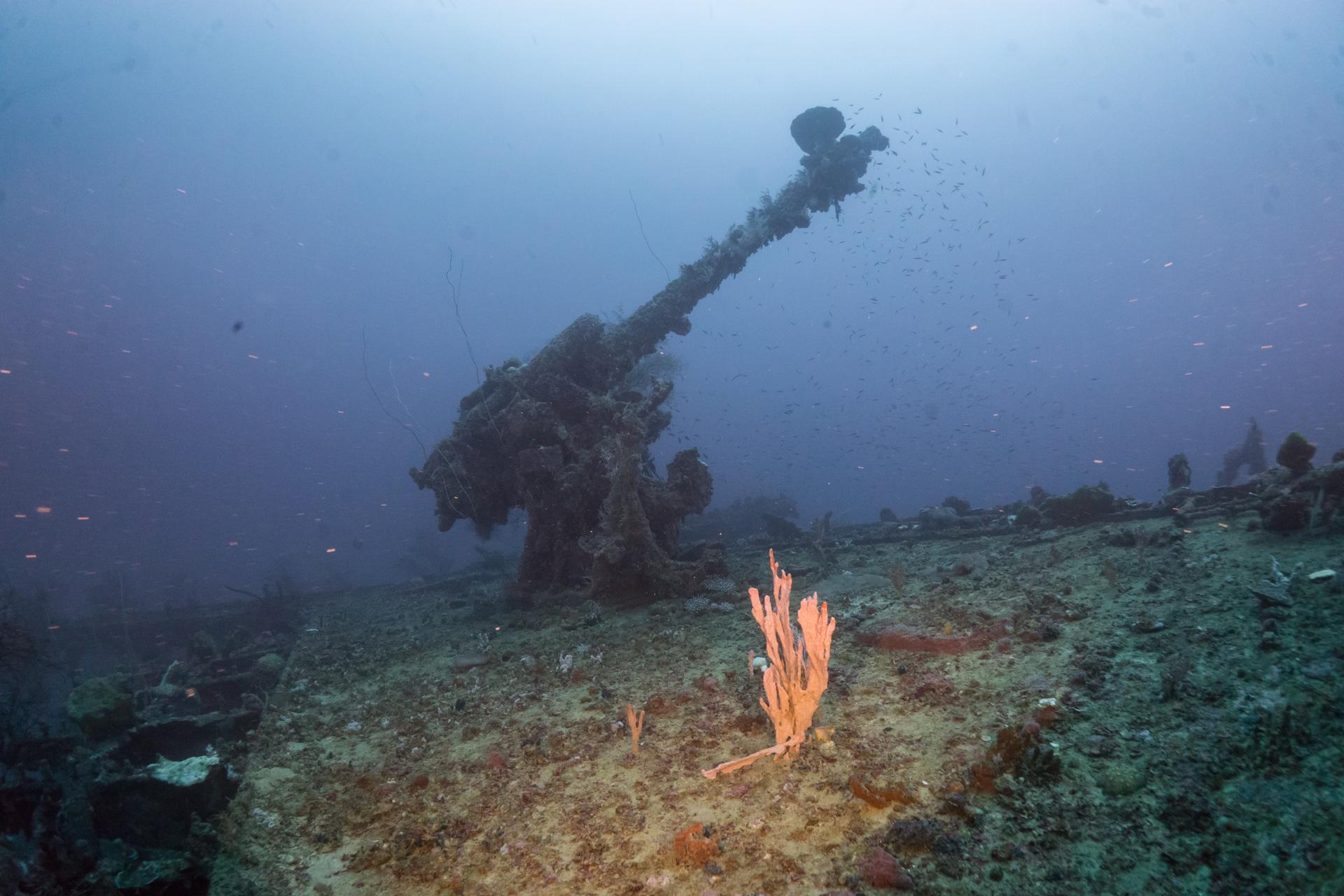
The Aikoku Maru was built as one of Japan's finest passenger-cargo liners and went to war as an armed merchant cruiser instead. In February 1944 she was in Truk with ammunition in her holds and troops aboard when a hit on her forward hold set it off. The explosion destroyed her bow and she sank within a couple of minutes; most of the more than 900 men aboard died with her. She sits upright with her bridge at about 40 metres, which makes her one of the deep Truk dives: the stern gun still angled upward, the aft decks, the bridge and the galley. This guide covers her story, what you will see, the conditions, when to go and how to dive her with the respect she is owed.
Quick answer: Aikoku Maru is a deep wwii shipwreck sitting upright, bow destroyed; war grave in Truk Lagoon. Best season: December to April (dry season) for the calmest seas and best visibility; diveable year-round. Level: Experienced divers trained for decompression diving at 40–50m; any penetration is a technical dive. Depth: Top of the superstructure and bridge about 38–40m; deck roughly 45–50m; seabed about 64m, deeper in the blast area forward. Typical visibility: Often 20m or more in the dry season; light fades quickly at this depth, and the interior is silty.
Facts verified November 2026
Why the Aikoku Maru is special
She was laid down at Mitsui's Tamano yard in 1938 for the Osaka Shosen line's South America service: a passenger-cargo liner of about 10,400 gross tons and roughly 160 metres. She was completed in August 1941 and taken straight into the Imperial Japanese Navy, which armed her as an auxiliary cruiser. Working with the Hokoku Maru she raided Allied shipping in the Pacific and Indian Oceans, and in July 1942 the pair captured the New Zealand freighter Hauraki, which now lies in the same lagoon as the Hoki Maru.
She later served as a submarine tender and then as a transport for troops and munitions. She came into Truk Lagoon on 16 February 1944, the day before the raid, with ammunition in her holds and troops aboard.
On 17 February, the first day of Operation Hailstone, aircraft from the carrier Intrepid hit her with several bombs and set her on fire. In a following attack a torpedo from a TBM Avenger struck her forward and set off the ammunition in her No. 1 hold. The explosion destroyed the bow and brought down the attacking aircraft and its crew. She sank within a couple of minutes. Jacques Cousteau's team filmed her in 1969 without identifying her.
A war grave
The Aikoku Maru took one of the heaviest death tolls of any ship sunk in the raid. A Japanese team recovered the remains of about 400 of them in 1980, and more were recovered in June 2024, and the remains of many others are still in the wreck. A memorial plaque stands on the upper structure at around 38 to 40 metres.
Dive her as the grave she is. Look, don't touch, and take nothing: removing anything from the Truk wrecks is illegal under Chuuk law. If you come across human remains, leave them exactly as they are.
What you'll see on the wreck
The forward part of the ship is gone, so the dive is the bridge and the stern half, which is largely intact:
- The stern gun on the aft deckhouse, its barrel still angled up
- The bridge and upper superstructure, the shallowest part of the wreck at about 40m
- The memorial plaque on the upper structure
- Galley and accommodation areas, with china, dishes and utensils scattered inside
- The blast zone forward, where the hull ends in torn plating
Conditions and who it's for
This is a deep dive by any standard. The top of the superstructure is at roughly 38 to 40 metres, the deck around 45 to 50, and the seabed about 64 metres. Even a short visit to the stern gun means a decompression dive, so the Aikoku Maru is for divers trained and current in decompression diving, with gas planned for the depth. At these depths a helium mix keeps your head clearer; if you plan to go below the deck or inside, ask what gas will be available on your sailing before you book.
If you are certified to 40 metres but not for decompression, be honest with yourself: the top of this wreck sits at the edge of your limits and most of it lies beyond them. Inside, the wreck is silty and has collapsed in places, and the way into the engine room is partly blocked; penetration here is a technical wreck dive. Water is 28 to 30°C all year and current is usually mild, but light fades fast at this depth, so carry a good primary torch even on an outside dive.
When to dive it
Truk Lagoon is diveable year-round. The drier months from about December to April usually bring the calmest seas and the clearest water; June to November is wetter and more variable, and August to November carries the most typhoon risk, although the barrier reef keeps the swell off the wrecks.
Clear water counts for more on a wreck this deep. In the dry season you can often make out the stern and the gun from the line; on a murky day you see what your torch lights, and with only minutes at depth, that matters.
How you dive the Aikoku Maru
Descend the line to the top of the superstructure, pause at the memorial, and plan a short, focused dive on one part of the ship, usually the stern gun and the after decks. Don't try to see the whole ship in one dive. Turn with plenty of gas in hand: the ascent and decompression take much longer than the time you spend on the wreck.
If she is on your trip plan, dive her early in the day, when you are fresh, and keep the following dive shallow.
We sell 8 to 10-night Truk Lagoon liveaboards that board off Weno. The Aikoku Maru is a deep decompression dive, and whether she is on the plan depends on the group's training and on what your sailing offers for deep and technical divers. If she matters to you, tell us your certification and recent deep-diving experience when you enquire, and ask us about gas and decompression support before you book; not every sailing runs technical dives.
Aikoku Maru: common questions
What is the best season to dive Aikoku Maru?
December to April (dry season) for the calmest seas and best visibility; diveable year-round
What experience level do I need for Aikoku Maru?
Experienced divers trained for decompression diving at 40–50m; any penetration is a technical dive
How deep is Aikoku Maru?
Top of the superstructure and bridge about 38–40m; deck roughly 45–50m; seabed about 64m, deeper in the blast area forward
What marine life will I see at Aikoku Maru?
Coral and sponge growth over the superstructure, stern gun and kingposts