Silvertip Bank
A flat-topped seamount 125 kilometres out in the Andaman Sea, where the reef ends and the open ocean begins.
Silvertip Bank is the most-dived of Myanmar's legendary Burma Banks, a cluster of enormous seamounts that rise from 300-metre depths to within 15 metres of the surface, far beyond sight of land. This is frontier diving in the truest sense: a full night's steam from the nearest reef, reachable only by liveaboard, with clear blue water, unpredictable current and the constant sense that anything could cruise in off the blue. Silvertip Bank diving rewards patience and self-sufficiency rather than guarantees, and that is exactly why serious divers keep coming back.
Quick answer: Silvertip Bank is an offshore seamount / open-ocean drift in Myanmar. Best season: December–April (liveaboards run roughly November–early May). Level: Advanced — remote, open-ocean, current-exposed. Depth: Plateau at 15–18 m; slopes and edges to 30–40 m, surrounding water 300 m+. Typical visibility: Typically 20–30 m, up to 40 m on the clearest days.
Facts verified September 2026
What makes Silvertip Bank special
Most dive sites give you a wall, a pinnacle, or a coral garden to work along. Silvertip Bank gives you the top of a mountain. The Burma Banks — Big, Silvertip, Rainbow, Roe, Coral and Heckford — are vast flat-topped seamounts that climb from roughly 300 metres of open Andaman Sea to a plateau just 15 metres below the surface. Silvertip is the shallowest and the closest to the Myanmar mainland, which is why it is the one Burma liveaboards dive most often.
What sets it apart is not a single feature but the sheer remoteness. You are around 125 kilometres offshore, well out of sight of land, in water that regularly opens up to 30 metres of visibility and occasionally more. The plateau is close to a kilometre across, so a dive here feels less like exploring a reef and more like standing on a submerged island in the middle of the ocean, watching the blue for whatever decides to appear.
What you'll see underwater
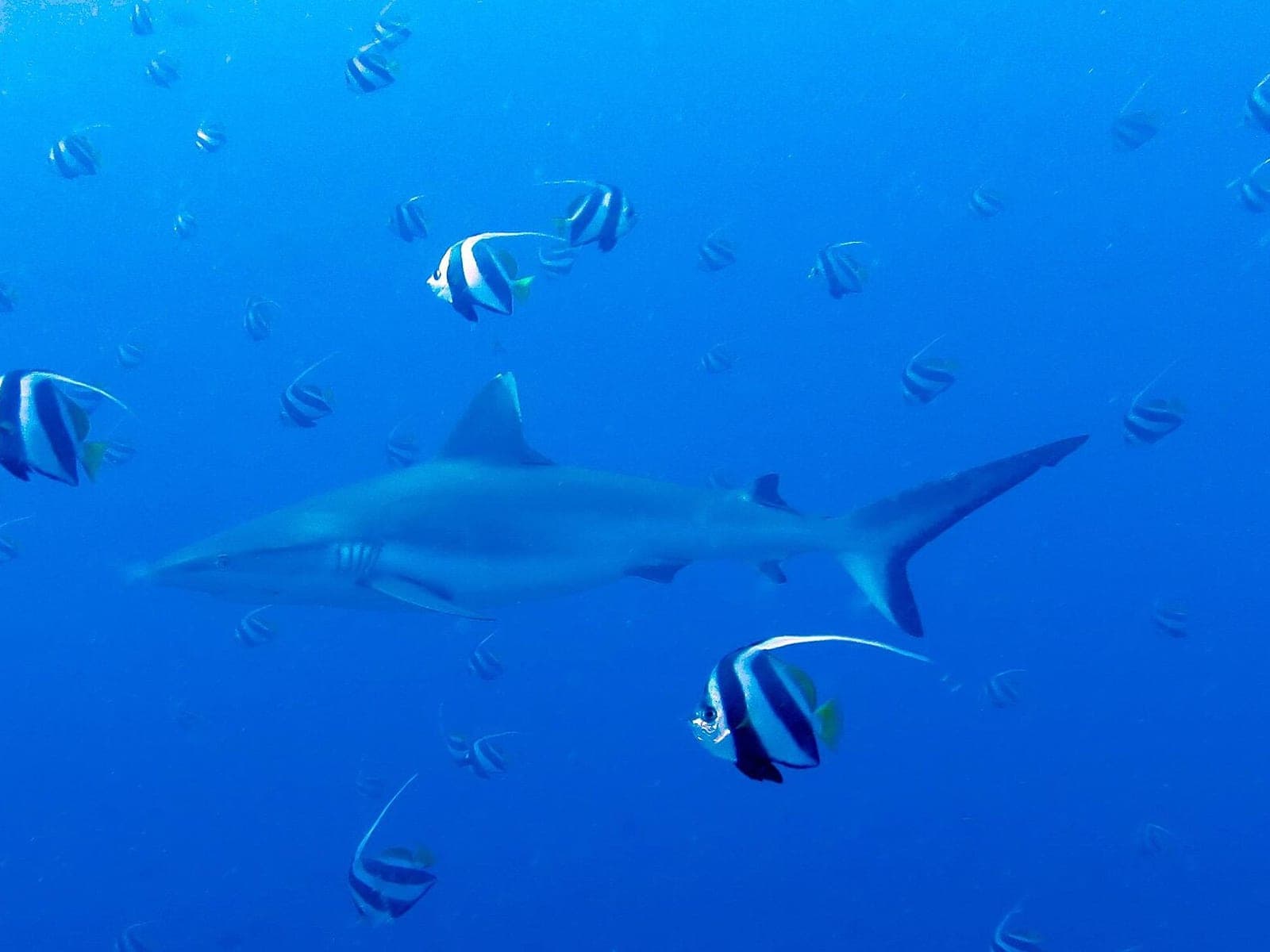
Let's be honest about the sharks first, because the name sets an expectation the site no longer fully meets. Silvertip Bank was once famous for near-guaranteed silvertip encounters, but heavy fishing pressure in the early 2000s hit the population hard. Silvertips are still seen — just far less reliably than the old stories suggest. Nurse sharks remain a steadier presence, and whitetip and blacktip reef sharks patrol the deeper edges.
Beyond the sharks, this is a healthy open-ocean ecosystem. Along the plateau you'll find potato cod and great barracuda cruising, plus moray eels, octopus, bignose unicornfish and big red snappers. The real spectacle is often overhead and out in the blue:
Come with open-ocean eyes rather than a checklist. The best moments here tend to arrive unannounced.
- Schooling pelagics — tuna, bonito, rainbow runners and jacks working the current
- Manta rays and spotted eagle rays, most often later in the season
- The occasional passing whale shark
- Nurse sharks resting on the plateau, with reef sharks along the deeper slopes
- Macro life is limited — this is a big-animal, big-water site, not a critter dive
Conditions and who it's for
This is an advanced dive, and the difficulty is about exposure and self-reliance as much as depth. The plateau itself sits at a comfortable 15 to 18 metres, but the currents are the defining factor: they are variable and genuinely unpredictable, sometimes differing between the surface and the bottom, and they can change during a dive. The upside is that the seamount's shape means there are no violent up- or down-currents, but you still need solid buoyancy, comfort in blue water with no reference, and the discipline to turn a dive when conditions shift.
A surface marker buoy is essential, not optional — you may surface well away from the boat in open ocean, and the crew are tracking you across a big, exposed area. You should be a confident, current-experienced diver with a reliable air consumption and good situational awareness. Nitrox is a real advantage for extending bottom time on the plateau. If you are newly certified or unsure in current, this is a site to build up to rather than start with.
When to dive Silvertip Bank
The Burma Banks are only accessible during the dry northeast-monsoon window, roughly November to early May, which is the only period liveaboards operate this far out. Outside that season the crossing is simply not safe or comfortable.
For the best of it, aim for December through April, when the seas are calmest, skies clearest and the long open-water crossing is at its most benign. The later months — roughly February to May — tend to bring the most frequent manta and the occasional whale shark encounters as the water warms. Because Silvertip sits so far offshore, a settled weather window matters as much as the calendar; a rough forecast can put the Banks out of reach even in peak season, so flexibility pays off.
How you actually dive it
There is no day-boat option and no shortcut. Silvertip Bank is reached only by liveaboard, and getting there means a dedicated blue-water crossing — a full night's steam from North Twin, the nearest reef, and the better part of a day's sailing from Thai ports such as Ranong or Khao Lak. For that reason the Banks are usually built into longer itineraries, commonly seven-to-nine-day trips through the Mergui Archipelago, rather than a quick add-on.
Diving is done from the liveaboard, typically dropping onto the plateau and drifting with whatever current is running, then working back up the seamount to off-gas in the shallows before your safety stop. Briefings here matter more than usual: entry timing, current direction, a clear plan for the blue, and a firm turnaround. Myanmar requires diving permits arranged through the operator, so this is a place you visit on a properly organised expedition, not independently.
Faneca reaches Silvertip Bank on our Myanmar liveaboards through the Mergui Archipelago and out to the Burma Banks, which run only during the November–early May season; because the site sits so far offshore, we build it into longer expeditions and stay honest that a settled weather window, not a wishlist, decides when the Banks are truly on.
Silvertip Bank: common questions
What is the best season to dive Silvertip Bank?
December–April (liveaboards run roughly November–early May)
What experience level do I need for Silvertip Bank?
Advanced — remote, open-ocean, current-exposed
How deep is Silvertip Bank?
Plateau at 15–18 m; slopes and edges to 30–40 m, surrounding water 300 m+
What marine life will I see at Silvertip Bank?
Nurse sharks, occasional silvertip and reef sharks, potato cod, barracuda, tuna, rainbow runners, eagle and manta rays
