Shark Cave
A daylight canyon you can swim through, with sharks resting in the shadows at the far end.
Shark Cave, at the Three Islets in Myanmar's Mergui Archipelago, is one of the Andaman's most characterful dives: three rocky pinnacles split by an undersea canyon and threaded by a 20-metre swim-through where tawny nurse sharks lie stacked in the gloom. It is remote, current-swept and reachable only by liveaboard, which is exactly why it still feels wild. This guide covers the depths, the marine life, the honest conditions and how you actually dive Shark Cave in Myanmar.
Quick answer: Shark Cave is a rock pinnacles, undersea canyon and a ~20 m tunnel swim-through (light overhead) in Myanmar. Best season: Late October to May; best conditions December–April. Level: Advanced — strong currents and an overhead swim-through. Depth: 5–30 m (canyon and swim-through 5–20 m; walls bottom out around 25–30 m). Typical visibility: Variable, ~10–25 m; clearer early season, dropping to 10–15 m during Feb–April plankton blooms.
Facts verified September 2026
What makes Shark Cave special
Most dives sold on the promise of a swim-through hand you a dark, tight squeeze that photographs better than it feels. Shark Cave is the opposite. The signature feature is a canyon between the central islet's rocks that narrows into a tunnel roughly 20 metres long, running clean through from one side of the rock to the other. Because both ends are open and shallow, daylight pours in from both directions, so you move through an illuminated corridor rather than a true cave — you can see the exit almost the whole way.
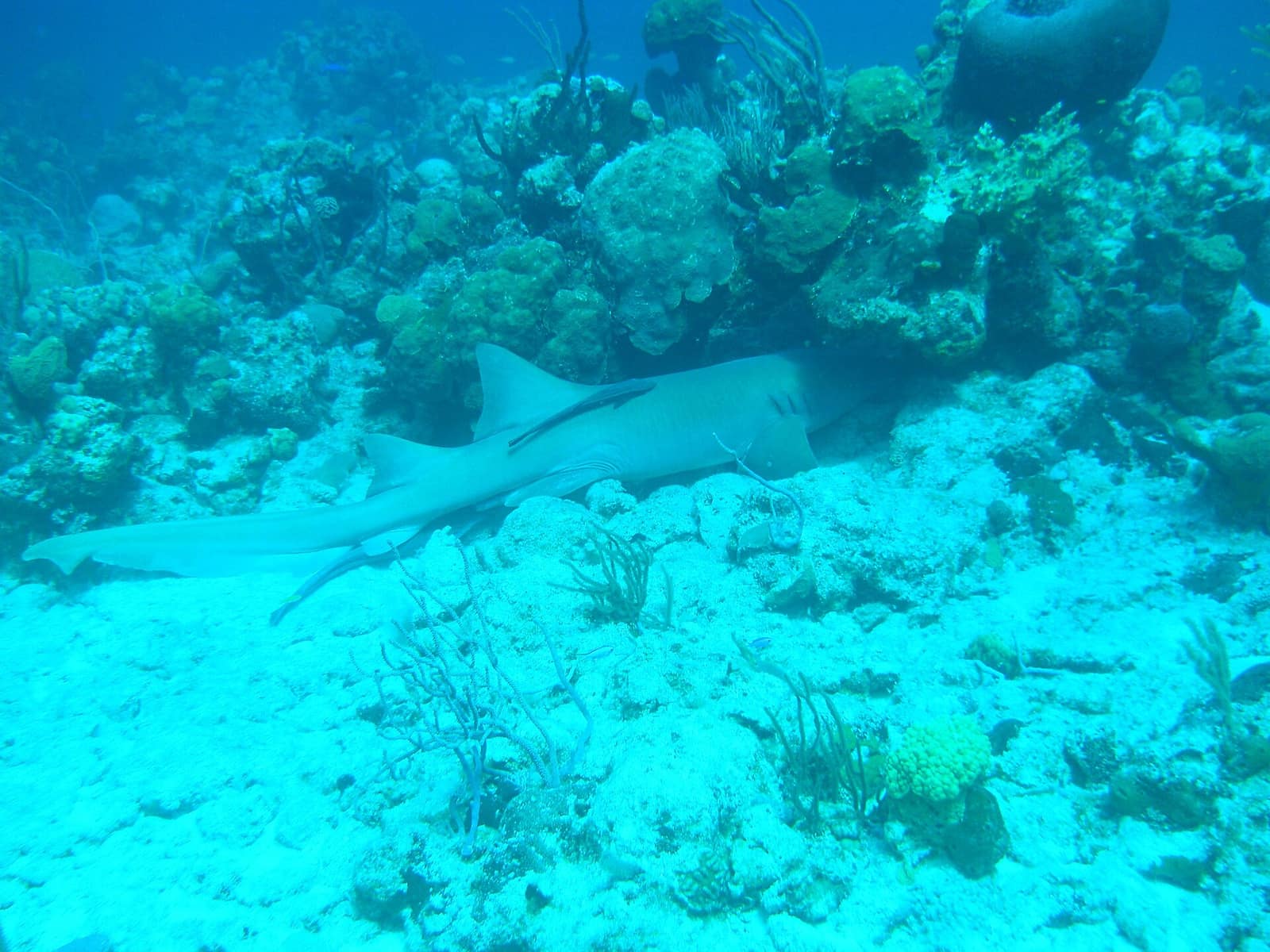
The reason it earned the name is what waits in the shadows. Tawny nurse sharks, some genuinely large, use the tunnel and an adjoining lower recess as a daytime resting spot, lying motionless on the sand and stacked against each other in the cooler dark. Being able to hang quietly a few metres from a pile of resting sharks, in good light, is a rare and memorable thing.
Honest note: the nurse sharks are the draw but not a guarantee. This site's shark numbers have fluctuated over the years, and there are seasons when only a few show, or none on a given dive. Treat them as the highlight if they are home and the rest of the site — the topography, the corals, the macro — as the reason the dive stands on its own regardless.
What you'll see
Shark Cave rewards divers who look at both scales. The big-animal moments come from the sharks and the occasional pelagic passing the outer walls; the quieter riches are in the cracks, the sponge fields and the tunnel ceiling.
Inside and around the swim-through, the overhangs and boulders are worth slowing down for:
- Tawny (nurse) sharks resting in the tunnel and lower recess, plus whitetip reef sharks tucked under boulders
- Moray eels and spiny lobsters wedged into the cracks and overhangs
- A tunnel ceiling crusted in orange cup corals, with yellow encrusting sponges carpeting the floor
- Macro life the archipelago is known for: seahorses, ornate and robust ghost pipefish, harlequin shrimp and frogfish
- Blotched fantail rays and stingrays resting on the sand at the base of the walls
- Schooling snapper, fusiliers and barracuda in midwater, with the chance of larger pelagics cruising past in season
Conditions and who it's for
This is an advanced dive, and it earns the label on two counts. First, current: the water moves roughly northwest to southeast across the islets and can run hard, particularly around the full and new moons. It can push you toward or away from the tunnel mouth, so timing the entry and holding position matters. Second, the overhead: even though the swim-through is short and lit, it is still an environment with rock above you. You need comfortable buoyancy, an awareness of your fins near the silt and sponge, and the discipline to go single-file without stirring the place into a brown-out for the divers behind you.
Visibility is variable and worth setting expectations around. Early in the season the water tends to be clearer with fewer thermoclines. From February into mid-April the plankton that brings the region's manta and whale shark chances also drops visibility to around 10–15 metres. That trade-off is real: the richest water is often the murkiest.
If you are a confident advanced diver comfortable in current and in a light overhead, Shark Cave is a joy. If you are freshly certified or shaky on buoyancy, this is a site to build up to rather than cut your teeth on — and a good guide will route a nervous diver over the top of the canyon rather than through the tunnel.
When to dive it
The Myanmar season is dictated by the monsoon. Diving in the Mergui Archipelago runs roughly from late October to May, and it closes for the southwest monsoon over the northern summer. Shark Cave is only accessible within that window.
Within the season, December to April brings the most settled conditions and the warmest, calmest seas, with water around 27°C. If clearer water and a relaxed dive are your priority, aim for the earlier stretch. If you are willing to trade some visibility for the plankton-fed big-animal season — mantas and the outside chance of a whale shark across the wider itinerary — the February-to-April window skews in your favour. Either way, the shoulder months at each end of the season can be quieter on boats but more exposed to weather.
How you actually dive it
Shark Cave is a liveaboard-only site. It sits deep in the Mergui Archipelago, far from any day-boat range, so you reach it as part of a multi-day trip that typically departs from Kawthaung on the Myanmar–Thailand border (often staged from Ranong in Thailand). Myanmar diving also requires the boat to hold the correct national-park and cruising permits, and to clear immigration formalities — all of which the operator handles, but which is why this is a planned expedition, not a spur-of-the-moment dive.
The dive itself usually begins on the sheltered side of the central islet, dropping down the wall and working toward the canyon at 5–20 metres. Guides read the current before committing to the tunnel, then lead the group through single-file, pausing at the resting sharks before exiting the far side. From there you can explore the outer walls and the connected rocks, keeping an eye on the blue for passing pelagics, and finish in the shallows over the coral and sponge gardens. Because the best of the site is genuinely shallow, air and no-deco time are rarely the limiting factor — the current and the surge are.
Faneca dives Shark Cave on our Myanmar liveaboard itineraries through the Mergui Archipelago, running only within the late-October-to-May season and departing from the Kawthaung/Ranong border with all national-park and cruising permits arranged — so you can focus on the sharks rather than the paperwork.
Shark Cave: common questions
What is the best season to dive Shark Cave?
Late October to May; best conditions December–April
What experience level do I need for Shark Cave?
Advanced — strong currents and an overhead swim-through
How deep is Shark Cave?
5–30 m (canyon and swim-through 5–20 m; walls bottom out around 25–30 m)
What marine life will I see at Shark Cave?
Tawny nurse sharks, whitetip reef sharks, moray eels, lobsters, stingrays, ghost pipefish, harlequin shrimp, schooling snapper and fusiliers; passing pelagics
