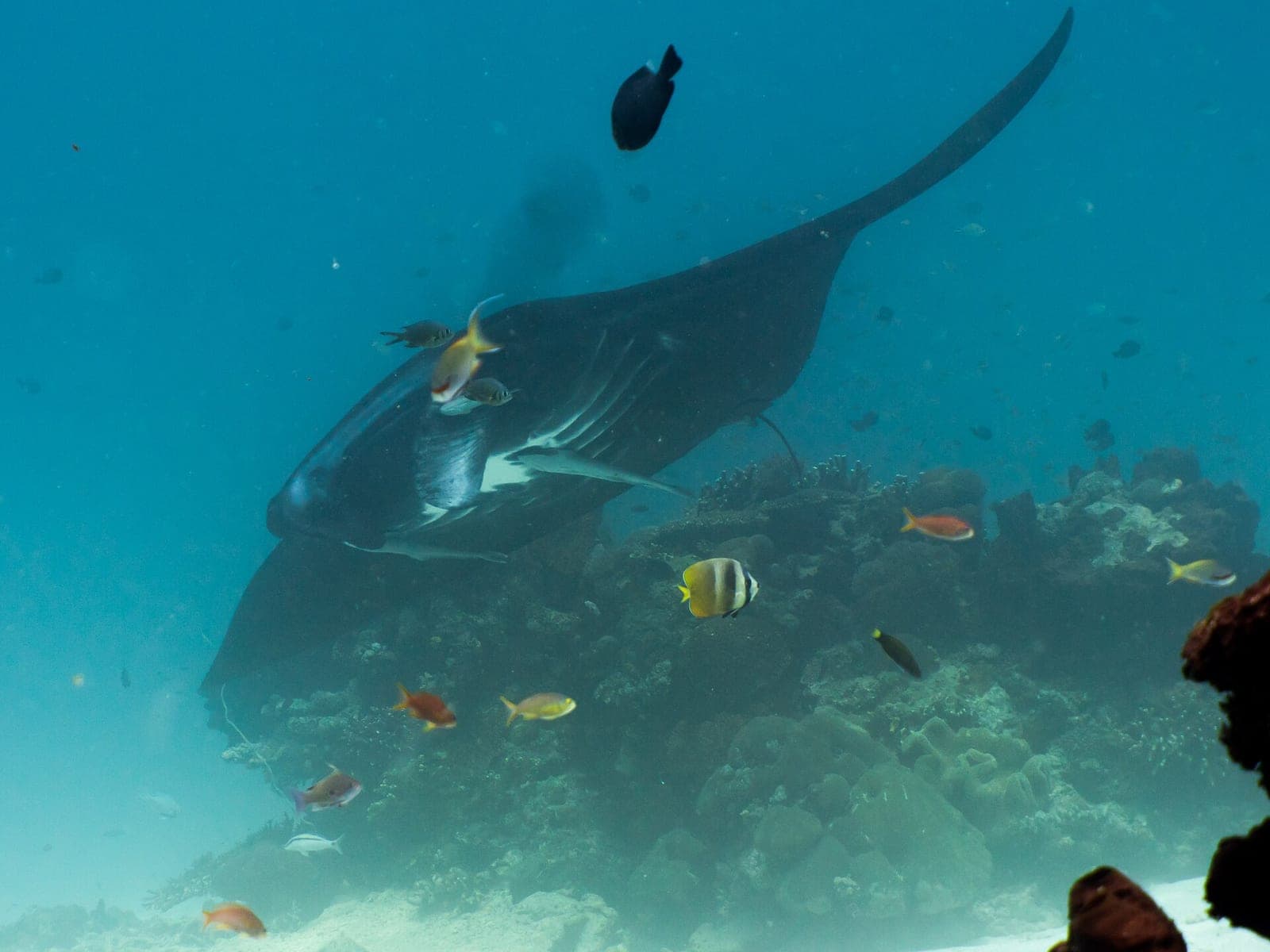
Black Rock
A lone limestone fist rising from open ocean, 188 kilometres from anywhere, where oceanic mantas queue up to be cleaned.
Black Rock is the crown jewel of Myanmar's Mergui Archipelago and, for many, the reason to book a Burma liveaboard at all. This isolated pinnacle in the open Andaman Sea is one of the most reliable oceanic manta ray cleaning stations in Southeast Asia, patrolled by grey reef sharks and visited, in the right months, by whale sharks. It is also exposed, current-swept and genuinely advanced diving. Black Rock rewards divers who can read water and hold their position — and it asks for that respect on every dive.
Quick answer: Black Rock is an exposed offshore pinnacle / rock, drift and negative-entry diving, liveaboard-only in Myanmar. Best season: Late October/November to May; calmest seas and best visibility December–April; mantas and whale sharks most frequent February–May. Level: Advanced — comfortable in strong and possible down-currents, good buoyancy and air management essential. Depth: Reef from 5 m; sloping east side 25–30 m onto rock at 40–45 m; west wall drops sharply past 30 m. Typical visibility: Highly variable, roughly 5 m to 40 m+ depending on plankton and current.
Facts verified September 2026
Why Black Rock is Myanmar's premier dive site
Most of the Mergui Archipelago is a maze of jungle-topped islands and shallow, silty channels. Black Rock is the exception — a bare rock standing alone in open water, roughly 80 metres wide and rising only about ten metres above the surface. That isolation is exactly what makes it special. With nothing else around for miles, it acts as a magnet, an oasis of structure in the blue where big pelagic animals gather to feed, shelter and, crucially, get cleaned.
What sets Black Rock apart from almost anywhere else in the region is its role as an oceanic manta ray cleaning station. Cleaner wrasse set up shop on the rock, and mantas cruise in to hover motionless while the little fish work them over. Of the roughly fifty individual mantas identified in Myanmar's Manta Matcher records, the overwhelming majority were logged here. When it switches on, you can spend a whole dive watching mantas circle a cleaning station a few metres away.
What you'll see underwater
Black Rock is a two-tier dive. The pelagic action happens in the blue and along the rock's flanks; the macro life hides in the cracks and coral once you slow down and look. On a strong day you get both.
The headline residents and visitors include:
- Oceanic manta rays — the main event, most reliable February to May when plankton blooms bring them in to feed and be cleaned
- Grey reef and blacktip reef sharks patrolling the reef edges and drop-offs
- Whale sharks — seasonal and never guaranteed, but Black Rock is among the better bets in Myanmar, chiefly February to May
- Schooling barracuda, tuna and trevally hunting along the current-swept corners
- Macro life for the patient: ornate ghost pipefish, harlequin shrimp, seahorses and a strong cast of nudibranchs in the shallows
Conditions and who it's for — an honest read
This is not a beginner's site, and it would be dishonest to sell it as one. Currents at Black Rock are genuinely unpredictable: they can be flat calm one dive and rip the next, generally tracking northwest to southeast. The real hazard is the down-current at the exposed east and west tips, where water can pour off the deeper edges and pull you down. Push past the shelter of the rock into open flow and getting back can become hard work.
Visibility swings just as widely, anywhere from a murky five metres to a stunning forty-plus, and the murkier plankton-rich days are often the ones the mantas love. You should be comfortable with negative entries, drift diving, holding a reef hook or a good hover in current, and turning a dive early if the water turns against you. Advanced certification, solid air consumption and recent experience matter here. If you are newer, this is a site to build toward across your trip rather than jump into cold.
When to dive Black Rock
The Myanmar liveaboard season runs roughly from late October or November through May, closing for the southwest monsoon. Within that window, December to April brings the calmest seas and the best average visibility — the most comfortable crossing and the most settled diving.
For the marquee encounters, aim later: February to May sees the most frequent manta and whale shark sightings as plankton concentrations peak. It is the classic trade-off — the plankton that can drop visibility is the same plankton that draws the big animals in. Water temperature is mild year-round, around 26°C in December warming to about 28°C by April, so a 3mm suit suits most divers, with a little extra thermal protection welcome on repetitive days.
How you actually dive it
Black Rock is liveaboard-only. There is no day-boat access and no land base nearby — the site sits about 188 kilometres northwest of Kawthaung, deep in the open Andaman Sea. Trips depart from either Ranong in Thailand or Kawthaung in Myanmar, and reaching Black Rock usually means an overnight crossing, often positioning the boat to dive it early before the wind and current build.
Diving Myanmar's waters also means paperwork: the Mergui Archipelago requires foreign-diver permits and marine-park fees that the operator arranges as part of the trip, and immigration is handled at the border. It is a remote, committing destination with no recompression chamber close at hand, so conservative profiles, good insurance and DAN cover are not optional. Because conditions dictate everything, a good crew will brief entry points, exit strategy and the down-current risk in detail, and may run several passes across a day to catch the rock at its best.
Faneca dives Black Rock on our Myanmar liveaboards through the Mergui Archipelago, run seasonally from roughly November to May with the best manta and whale shark odds late in that window. It is a remote, permit-required, advanced trip, so we match divers to it carefully and build up to the exposed sites over the itinerary.
Black Rock: common questions
What is the best season to dive Black Rock?
Late October/November to May; calmest seas and best visibility December–April; mantas and whale sharks most frequent February–May
What experience level do I need for Black Rock?
Advanced — comfortable in strong and possible down-currents, good buoyancy and air management essential
How deep is Black Rock?
Reef from 5 m; sloping east side 25–30 m onto rock at 40–45 m; west wall drops sharply past 30 m
What marine life will I see at Black Rock?
Oceanic manta rays (cleaning station), grey reef and blacktip sharks, seasonal whale sharks, barracuda, tuna, trevally, plus macro (ghost pipefish, harlequin shrimp, nudibranchs)
