Shark Bank
A lone granite tower in open blue water off Mahe, patrolled by eagle rays, big stingrays and, in season, whale sharks.
Shark Bank is the dive that separates Seychelles' gentle house reefs from its serious open-water sites. Rising alone from a sandy floor around 35 metres, this current-swept granite pinnacle sits between Mahe and Silhouette with nothing around it but blue, which is exactly why the big animals show up. Diving Shark Bank means committing to depth, reading the current honestly, and being rewarded with squadrons of eagle rays, resting whitetips, cruising jacks and the seasonal chance of a whale shark passing through. It is one of the most memorable dives in the inner Seychelles, and one of the most demanding.
Quick answer: Shark Bank is a deep granite pinnacle / seamount, day-boat drift and reference dive in Seychelles. Best season: April-May and October-November, the calm inter-monsoon windows; whale shark odds best around August-November. Level: Advanced (AOW or equivalent, with solid buoyancy and deep-dive experience). Depth: Averages 25-30 m over the top, dropping to 35-40 m at the sand; a genuine deep dive. Typical visibility: Typically 15-30 m, best on the clear inter-monsoon days, reduced during plankton blooms.
Facts verified September 2026
What makes Shark Bank special
Most inner-Seychelles diving happens on sheltered granite reefs a few minutes from the beach. Shark Bank is the opposite. It is a submerged tower standing alone in open water, its summit still well below the surface and its base fading into sand near 40 metres. Because it is the only structure for a long way in any direction, it works like a magnet: everything that swims in that stretch of the Indian Ocean uses it as a cleaning station, a hunting ground and a rest stop.
The rock itself is classic Seychelles granite, split into boulders and gullies and softened by a coat of orange cup coral and small purple soft corals that glow when you light them. But nobody dives Shark Bank for the coral. You dive it for the animals it concentrates, and for the feeling of hanging on an exposed pinnacle with big pelagics materialising out of the blue. As a Seychelles liveaboard and day-boat highlight, it earns its reputation.
What you'll see
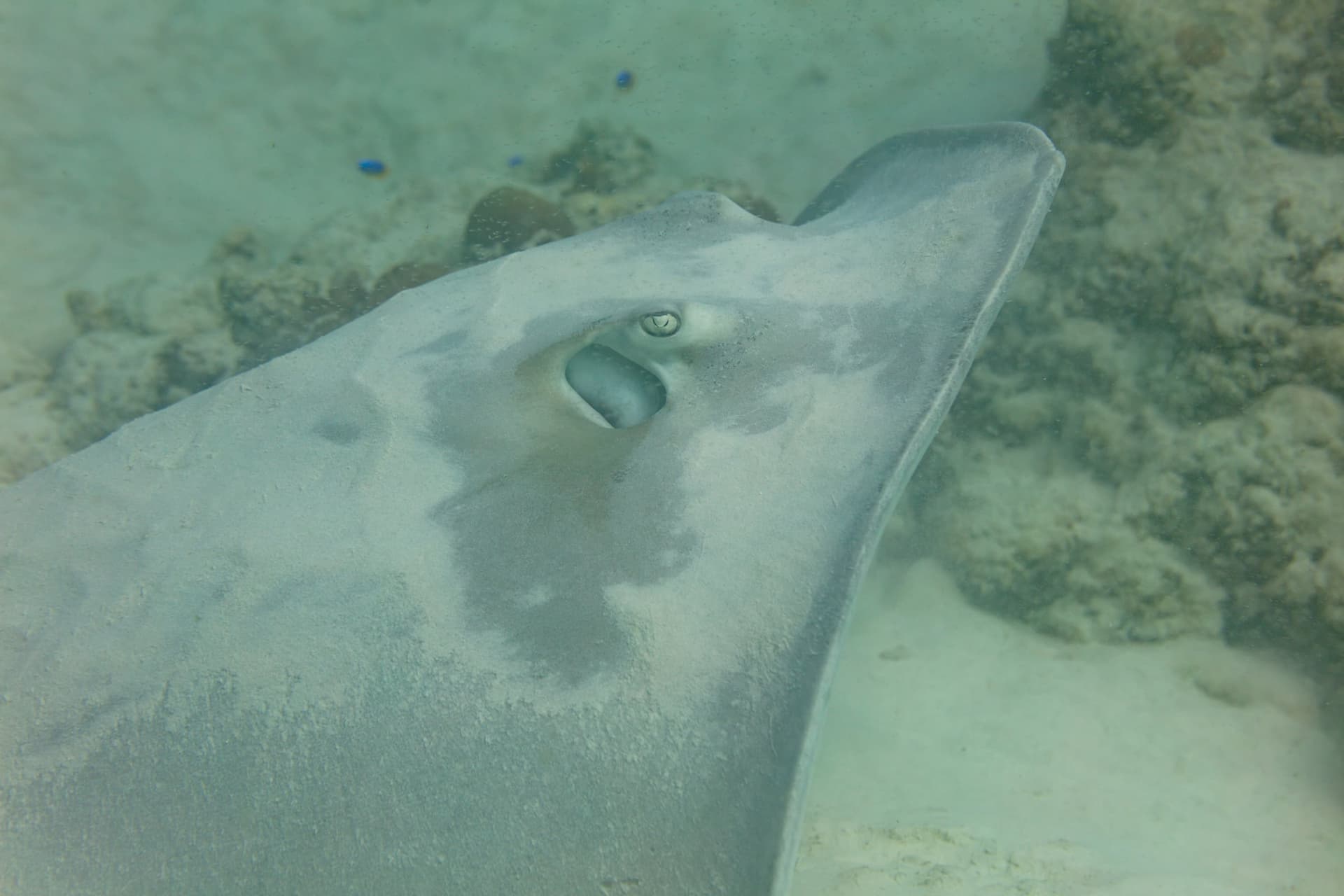
Shark Bank is named for its regulars, and the roll call here is genuinely large-animal. The stingrays alone are worth the dive: big marbled and honeycomb rays, some over a metre and a half across, lie parked in the sand and glide along the base like slow grey aircraft.
Above and around them, expect motion. Eagle rays cruise the pinnacle singly and in loose groups, whitetip reef sharks rest in the gullies, and schools of barracuda and bigeye jacks stack up in the current. Add the supporting cast and it becomes a genuinely busy dive.
- Eagle rays patrolling the pinnacle, often several on a good day
- Large marbled and honeycomb stingrays resting in the sand
- Whitetip reef sharks tucked into ledges and gullies
- Dense schools of barracuda, jacks and fusiliers riding the current
- Napoleon (humphead) wrasse, groupers, tuna and hawksbill turtles
- Seasonal whale sharks and the occasional nurse shark passing through
Conditions and who it's for
Be honest with yourself before booking this one. Shark Bank is an advanced dive, and the two reasons are depth and current. You will spend the dive between roughly 25 and 40 metres, so gas planning, no-stop time and buoyancy all matter more than they do on a shallow reef. This is not a site for a first post-course dive or for anyone shaky on air consumption at depth.
The current is the bigger variable. Sources that call it mild are describing a good day; on a running tide this exposed pinnacle can be swept hard, with no lee to hide in. Expect a negative or fast descent straight to the rock, expect to work, and be ready to use it as a drift if it is honking. A reef hook is not standard here, so good trim and the discipline to stay low against the granite are your tools. If the skipper reads the current as too strong, a good operation will move you to a sheltered site instead, and that is the right call.
In return for the demands, this is one of the most rewarding dives in the Seychelles for confident AOW divers who want big-animal action rather than macro or easy scenery.
When to dive it
Seychelles diving is shaped by two monsoons. The southeast monsoon (roughly May to September) brings wind and chop that can make the crossing to an exposed site like Shark Bank rough and cut visibility. The northwest monsoon (November to March) is warmer and calmer but can carry plankton that softens the water clarity.
The sweet spots are the inter-monsoon transitions, April-May and October-November, when the sea flattens, visibility opens toward 30 metres and access to open-water pinnacles is most reliable. If your priority is whale sharks, weight your trip toward the August-to-November window when the plankton blooms draw them into Seychelles waters; sightings are never guaranteed, but that is when the odds are best. Water sits between about 27 and 30C year-round, so a 3 mm suit is plenty.
How you actually dive it
Shark Bank is reached by boat from Mahe, a short run of well under an hour out into open water, and it is dived almost entirely as a day trip from the main island rather than as a fixed liveaboard mooring. Because there is no shallow reef to finish on, briefings matter: you drop onto the pinnacle, work your way around and up as your gas and no-stop time allow, and make your safety stop in blue water, often drifting, with the boat tracking your bubbles or SMB.
Send a delayed SMB before you leave the rock so the skipper can find you in open water, and carry a torch to bring out the orange and purple coral colour that flat daylight washes away. Because of the depth, a computer, conservative planning and honest buddy checks are non-negotiable. Dive it early in the day and early in a trip when you are fresh, and treat the run itself as part of the adventure.
Faneca dives Shark Bank on our Seychelles trips as part of the inner-island day diving off Mahe, weather and current permitting, since this is an exposed open-water pinnacle rather than a sheltered house reef; time your trip for the calm April-May or October-November windows for the best access, and toward late in the year if you are chasing the seasonal whale sharks.
Shark Bank: common questions
What is the best season to dive Shark Bank?
April-May and October-November, the calm inter-monsoon windows; whale shark odds best around August-November
What experience level do I need for Shark Bank?
Advanced (AOW or equivalent, with solid buoyancy and deep-dive experience)
How deep is Shark Bank?
Averages 25-30 m over the top, dropping to 35-40 m at the sand; a genuine deep dive
What marine life will I see at Shark Bank?
Eagle rays, large marbled and honeycomb stingrays, whitetip reef sharks, barracuda and jack schools, Napoleon wrasse, tuna, turtles; seasonal whale sharks and occasional nurse sharks
