Aldabra Passes
The tidal channels of Aldabra Atoll deliver one of the wildest drift dives in the Indian Ocean — a liveaboard-only ride on the flooding tide, shoulder to shoulder with green turtles, giant groupers and reef sharks.
Diving the Aldabra Passes is less a dive site than an event you time to the moon. Aldabra is the second-largest raised coral atoll on Earth, a UNESCO World Heritage Site marooned roughly 1,120 km southwest of Mahé, and its enormous lagoon breathes through a handful of tidal channels, of which Grande Passe (Main Channel) is the one dived on scuba. Twice a day the ocean pours in and drains out through those gaps; in Main Channel you drop in with a Seychelles Islands Foundation diver and let the flow carry you. This is remote, advanced, permit-controlled diving in the Seychelles Outer Islands, and it rewards the effort like almost nowhere else.
Quick answer: Aldabra Passes is a tidal channel drift dive, run on the incoming tide — liveaboard-only expedition diving in Seychelles. Best season: Roughly November to April, the season Aldabra visits are planned around; manta feeding peaks in the southeast monsoon. Level: Advanced — a genuine high-flow drift that demands solid buoyancy and drift experience. Depth: 10–25 m in the passes; the outer reef walls drop well beyond recreational limits. Typical visibility: 20–30 m and up on the clean flooding tide; greener and hazier when lagoon water flushes out.
Facts verified September 2026
What makes the Aldabra Passes special
Aldabra is a place that barely lets people in, and that is exactly why it dives the way it does. The atoll measures 34 km by 13 km and wraps around a lagoon of nearly 200 square kilometres that empties to roughly two-thirds dry sand and seagrass at low water. All of that volume has to move somewhere, and it moves through the passes. With a tidal range around 2.7 m — exceptionally large for an atoll — the channels turn into rivers in the sea, and the flooding tide becomes your engine.
Diving the Aldabra Passes means riding that inbound flow off the ocean and into the protected lagoon, threading between coral heads while the whole reef feeds around you. Because the atoll sits inside one of the planet's most intact marine reserves — home to some 100,000 Aldabra giant tortoises above the waterline and one of the Western Indian Ocean's largest green turtle nesting populations below it — the animals here simply do not fear divers. Turtles hold their line as you pass. Groupers watch from their ledges. That unhurried, unhunted quality is the thing you remember.
What you'll see
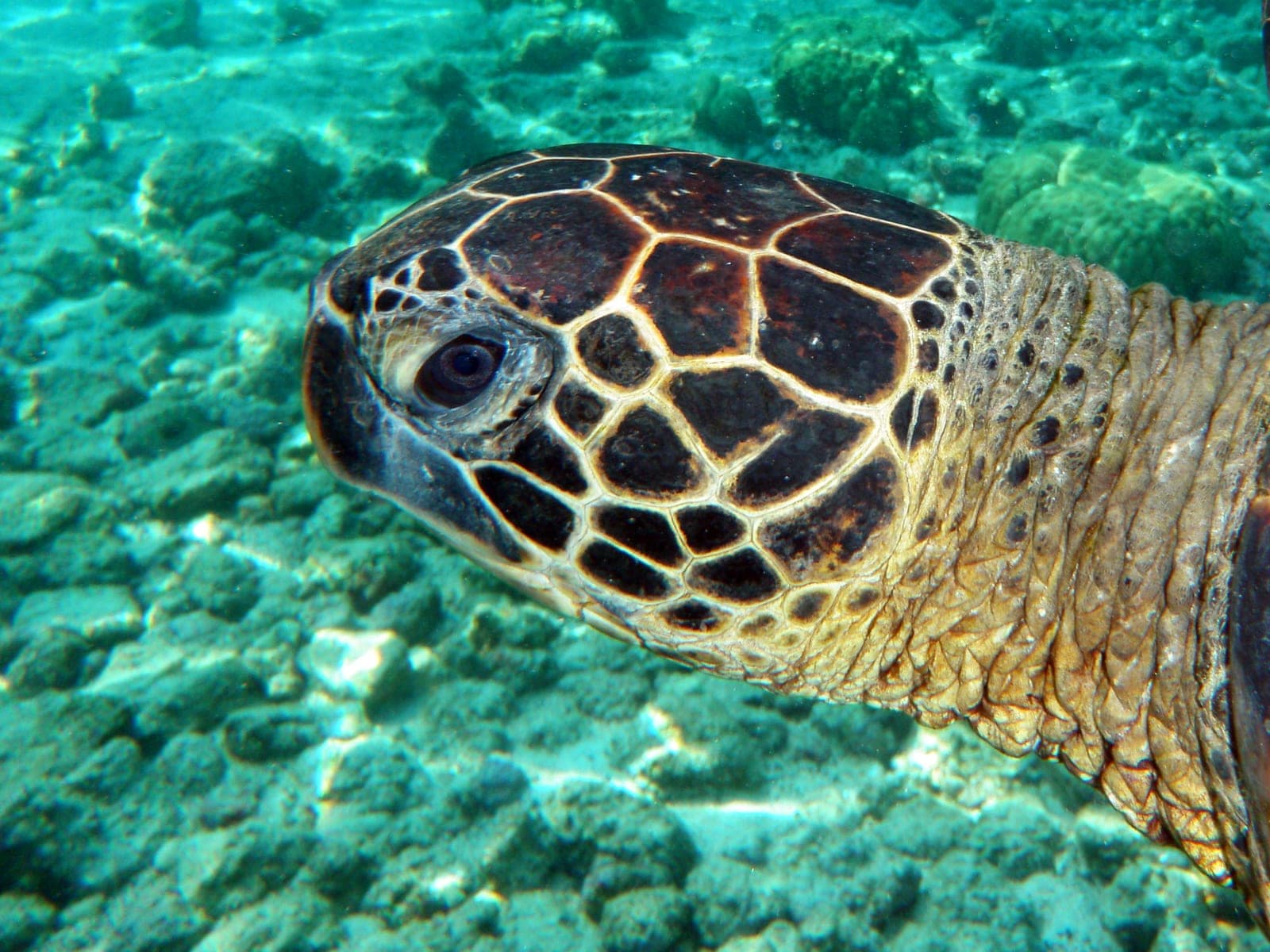
The passes are highways, and on a good flood the traffic is constant. Green turtles are the signature — you may lose count on a single dive — and they share the channel with some of the biggest groupers you will ever see up close, cruising Napoleon wrasse, and dense, wheeling schools of barracuda and jacks. Reef sharks patrol the current lines, and the deeper edges bring in the fast pelagic crowd.
On any given drift, keep an eye out for:
- Green turtles in numbers, often feeding on seagrass or resting in the channel
- Giant groupers and inquisitive Napoleon (humphead) wrasse holding station in the flow
- Grey reef and whitetip reef sharks working the current; tawny nurse sharks resting on the sand
- Eagle rays gliding the edges, and reef manta rays feeding seasonally along the west and north coasts
- Schooling barracuda, giant trevally, jacks and dogtooth tuna, with giant morays tucked into the coral
Conditions and who it's for — honestly
This is not a first-week-of-your-course dive, and no honest guide would pretend otherwise. The currents that make the passes spectacular also make them serious: the flow is faster than you can swim, and the water accelerates and eddies as the lagoon fills and empties. The rules are strict: Advanced Open Water minimum, a Seychelles Islands Foundation staff diver with every group, no dives on spring tides, no night or baited dives, and the other channels are drift-snorkel only. The margin for casual mistakes is thin.
You should come with genuine drift experience, confident buoyancy, and the discipline to stay with your guide and group. A reef hook, an SMB and a loud surface signal are standard kit. Advanced certification and a comfortable air consumption go a long way. Visibility swings with the tide: the clean ocean water on the flood can open to 30 m and beyond, while lagoon water flushing back out turns the passes green and hazy. Sea surface temperatures are warm year-round, typically in the high-20s Celsius, so exposure protection is about comfort and abrasion, not cold.
When to dive it
Aldabra's diving calendar is dictated by the monsoons and by how comfortable the long ocean crossing is, not by the reef itself. The northwest monsoon months, broadly November to April, give the flattest seas for reaching the atoll and the most settled conditions in the passes, which is why expedition itineraries cluster there.
The southeast monsoon (roughly May to September) brings stronger, more consistent winds and rougher passages, but it is also when reef manta rays feed most reliably along Aldabra's western and northern coasts, so there is a genuine trade-off between sea state and specific encounters. Either way, the real constraint is access: this is a short, tightly held season on a handful of boats, and dates fill far ahead.
How you actually dive it
There is no shortcut to Aldabra. The atoll has no airstrip, no jetty and no day-boat operation — reaching the passes means a multi-day liveaboard expedition across the Outer Islands, often via Assumption, Cosmoledo and Astove, from a departure point a very long way to the northeast. You dive from tenders launched off the mother ship, and every pass dive is planned around the tide table: the crew reads the flood, drops you at the ocean mouth of the channel, and you ride through while they follow your bubbles and SMBs.
Access is also a paperwork reality. Aldabra is a strictly protected UNESCO reserve managed by the Seychelles Islands Foundation, and diving here requires prior permits and adherence to reserve rules — numbers are limited and conservation comes first. On a good expedition that structure is invisible to you; it is handled long before you step onto the boat, and it is part of why the reef is still this pristine.
Faneca dives the Aldabra Passes on our Seychelles Outer Islands liveaboard expeditions through the Aldabra group, which run only in the calmer November-to-April season and on strictly permitted, small-group itineraries — so these trips are limited and best booked well in advance.
Aldabra Passes: common questions
What is the best season to dive Aldabra Passes?
Roughly November to April, the season Aldabra visits are planned around; manta feeding peaks in the southeast monsoon
What experience level do I need for Aldabra Passes?
Advanced — a genuine high-flow drift that demands solid buoyancy and drift experience
How deep is Aldabra Passes?
10–25 m in the passes; the outer reef walls drop well beyond recreational limits
What marine life will I see at Aldabra Passes?
Green turtles, giant groupers, grey and whitetip reef sharks, eagle rays, Napoleon wrasse, barracuda and jack schools, dogtooth tuna; reef mantas seasonally
