Cosmoledo Atoll
The Seychelles' healthiest coral, ruled by potato groupers and reef sharks, 1,000 km from anywhere.
Cosmoledo Atoll is genuine frontier diving. Sitting roughly 1,029 km southwest of Mahé in the Seychelles outer islands, it is a vast, raised coral atoll where only a handful of sites have ever been named and many more remain unmapped. Diving Cosmoledo means committing to a real expedition: liveaboard-only, weather-dependent, and reachable for just a few weeks each year. What you get in return is some of the healthiest hard coral cover found anywhere in the Seychelles, tidal channels alive with fish, and the very real chance of potato bass, dogtooth tuna and passing sharks on almost every dive. This is a Seychelles liveaboard destination for divers who want reef the way it used to be.
Quick answer: Cosmoledo Atoll is a reef, channel drift, gentle wall/slope, plus strong macro in Seychelles. Best season: Roughly November to April; May–October is closed by the southeast monsoon. Level: Intermediate to advanced — remote, self-sufficient, some current. Depth: Mostly 5–30 m; the slope drops gradually toward 50 m and beyond. Typical visibility: Good, commonly up to ~30 m in season.
Facts verified September 2026
What makes Cosmoledo special
Cosmoledo is a raised coral atoll about 17 km east–west and 12.5 km north–south, ringed by 19 low islands enclosing a lagoon and reef flats of some 145 km². It sits in the Aldabra Group, the most isolated corner of the Seychelles, and that isolation is the whole story. Almost nobody dives here. There is no resort strip, no fleet of day boats, no queue at the mooring — just an eco-camp, the occasional liveaboard, and reef that has been left almost entirely alone.
The payoff is coral. The northwest of the atoll in particular carries what is widely regarded as the highest hard-coral cover in the Seychelles: dense, structurally complex, and strikingly healthy in an ocean where so many reefs have bleached and thinned. You are diving a working, fish-heavy ecosystem rather than a pretty remnant of one, and that changes how every dive feels.
What you'll see
Cosmoledo is a big-fish reef with a serious macro side. The tidal channels between the islands funnel current, and current pulls in predators and bait. Expect the reef bosses — heavy potato groupers (potato bass) — holding station on the coral, with dogtooth tuna and trevally cruising the blue and hunting when the tide runs. Sharks are a regular part of the picture rather than a lucky break.
On the smaller end, this is one of the better macro destinations in the outer islands, with an unusually rich moray population — around 15 species, including big giant morays — plus batfish, barracuda and dense, swirling schools of snapper that will happily wrap around you.
Commonly encountered:
Potato groupers (potato bass) and other large groupers
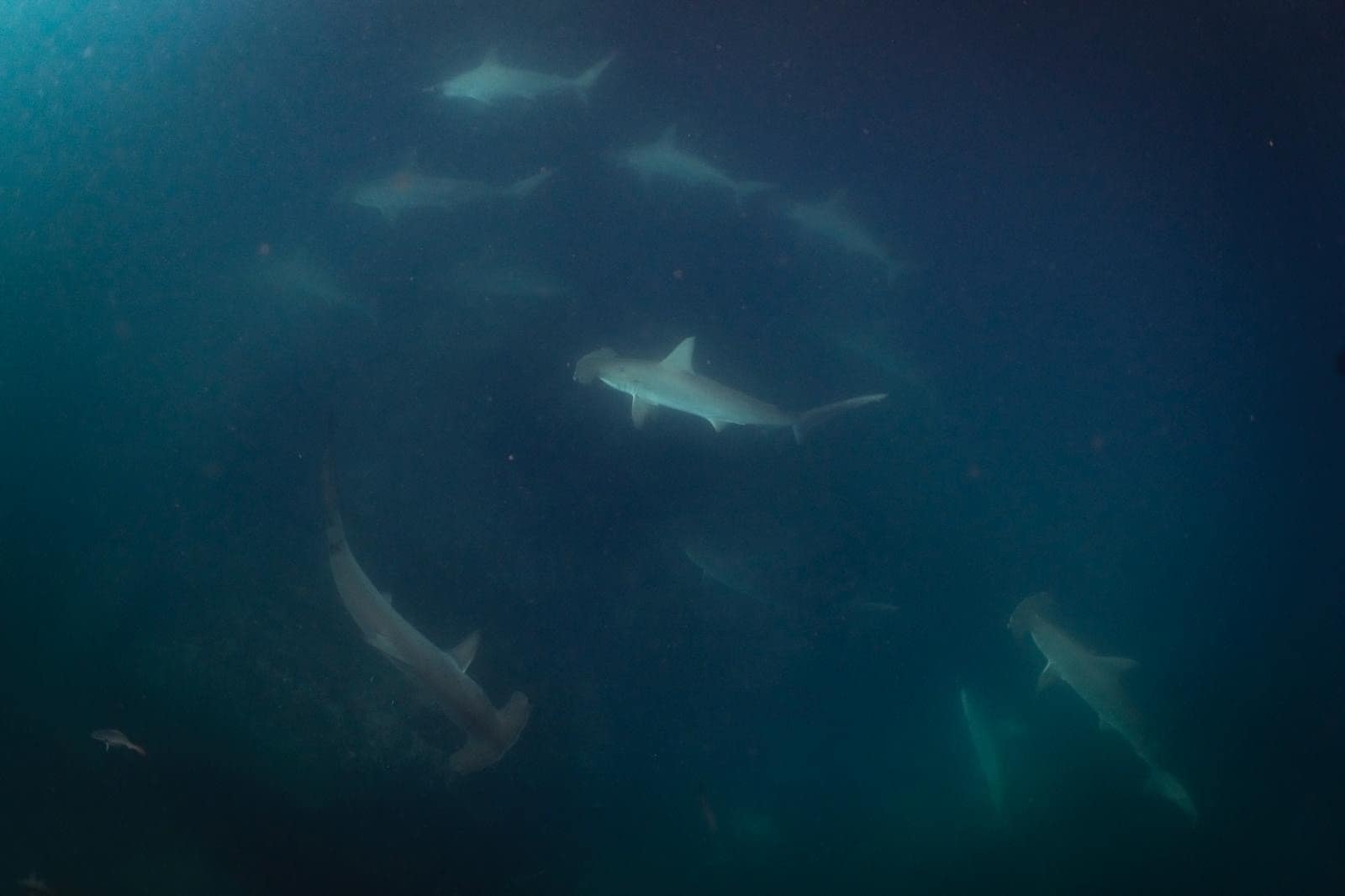
Grey reef, silvertip and nurse sharks; occasional scalloped hammerheads in deeper water
Dogtooth tuna, giant trevally and other jacks on the hunt
Green and hawksbill turtles, plus eagle rays
Giant morays and up to ~15 moray species
Big schools of bluelined, humpback and bohar snapper, batfish and barracuda
Conditions and who it's for
Be honest with yourself about this one. Cosmoledo is not a beginner site and not a place to log your first ocean dives. The topography is less dramatic than the sheer walls elsewhere in the region — the sea floor slopes away gradually toward 50 m before steepening — so the challenge is less about depth and more about remoteness and water movement. Tidal current through the channels can range from a pleasant push to something that demands good buoyancy, a reef hook mindset and comfort drifting.
The bigger factor is where you are. You are around 1,000 km from Mahé with no recompression chamber nearby and long evacuation times. That reality rewards conservative profiles, good gas management and divers who are genuinely self-sufficient. If you are a comfortable intermediate with some current and drift experience — say 50-plus logged dives and solid Advanced-level skills — you will have the time of your life. If you are still building confidence, dive elsewhere in the Seychelles first and come back for this.
When to dive it
Access is dictated by weather, not by preference. The outer-atoll routes to Cosmoledo and Aldabra run in the calmer northwest monsoon, roughly November to April; from May to October the southeast monsoon blows too hard for the crossing. Even then it is swell-dependent: groups have been turned back from Cosmoledo in June with four-metre swells running, so nothing is guaranteed until the boat actually reaches the atoll.
In season, conditions are worth the patience. Water sits at its warmest, around 29°C, and visibility is commonly good — up to roughly 30 m. Book with flexibility built in, treat the itinerary as a plan rather than a promise, and go with an operator who will make the honest call about whether the crossing is safe.
How you actually dive it
Because of the atoll's sheer size and its distance from anywhere, Cosmoledo is effectively a liveaboard destination. A boat lets you cross open water to the atoll, sleep on site and dive the channels and outer reef across several days — which is the only sensible way to explore somewhere with so few charted sites and so much still unmapped. There is a land-based eco-camp on the atoll, but for divers the liveaboard is the practical route in.
Expect expedition-style diving: RIB tenders off the mother ship, tide-timed entries on the channels, and a lot of exploratory feel. As part of the Aldabra Group, the wider area carries strict protections and permit requirements, so you dive it through a licensed operator working an authorised itinerary. Come prepared to be flexible, self-reliant and genuinely present — this is one of the last places in the Indian Ocean that still feels undived.
Faneca reaches Cosmoledo on our Seychelles outer-atoll liveaboards through the Aldabra Group, and we run these expeditions only in the calmer season, roughly November to April — spaces are genuinely limited and the itinerary always bends to the weather, so plan well ahead and travel with flexibility.
Cosmoledo Atoll: common questions
What is the best season to dive Cosmoledo Atoll?
Roughly November to April; May–October is closed by the southeast monsoon
What experience level do I need for Cosmoledo Atoll?
Intermediate to advanced — remote, self-sufficient, some current
How deep is Cosmoledo Atoll?
Mostly 5–30 m; the slope drops gradually toward 50 m and beyond
What marine life will I see at Cosmoledo Atoll?
Potato groupers, dogtooth tuna, trevally, grey reef/silvertip/nurse sharks, occasional scalloped hammerheads, turtles, eagle rays, 15 moray species, big snapper schools
