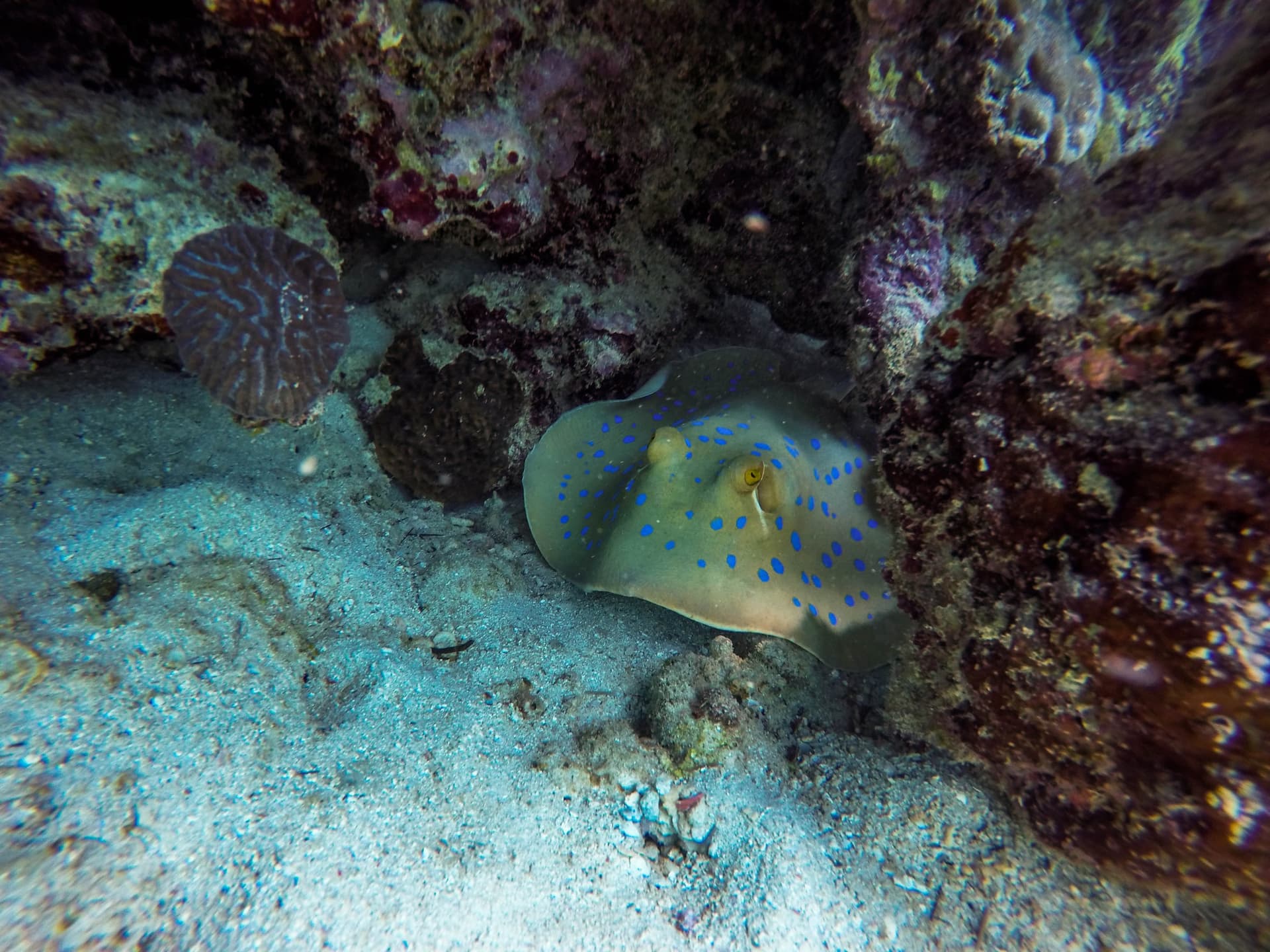
Sha'ab Ammar
A horseshoe of reef in an empty sea, where the walls fall into blue and the hammerheads come to you.
Sha'ab Ammar is one of the northern Saudi Red Sea's standout wall dives — a large horseshoe-shaped reef whose north and south flanks drop steeply into open water. Diving Sha'ab Ammar means hanging in the blue while scalloped hammerheads patrol the current line and grey reef sharks work the drop-off, all above hard coral that looks the way most of the Red Sea did a generation ago. It is remote, permit-controlled and reachable only by liveaboard, which is exactly why it still feels untouched.
Quick answer: Sha'ab Ammar is a wall and blue-water dive along a horseshoe reef, run as drifts off the north and south points in Saudi Arabia. Best season: October to April for cooler water and the best hammerhead odds; the region dives as a warm-season itinerary through summer too. Level: Advanced — comfort on steep walls and in blue water is essential. Depth: Reef top at 5-12m; walls plunge well past recreational limits, with the shark action typically at 18-35m. Typical visibility: Typically 20-30m, often 40m-plus on clear days.
Facts verified September 2026
What makes Sha'ab Ammar special
Most divers picture the Red Sea as Egypt — the well-trodden reefs of the north and the deep south of Marsa Alam. Sha'ab Ammar sits in a different world. This is the Saudi side, a coastline that has only recently opened to visiting divers and where a reef like this one can go days without seeing another boat. The horseshoe shape is the whole story: two long walls curving away from a sheltered lagoon, each one meeting the open sea at a point where current, structure and deep water collide. That is precisely the geography sharks favour, and it is why this reef has built a quiet reputation as a hammerhead site.
The other thing that stays with you is the coral. Because the pressure of mass tourism has never reached here, the hard coral is genuinely healthy — plating and branching colonies stacked across the shallows and down the wall, the kind of intact reef that has become rare elsewhere. You come for the sharks, but the reef itself is a reminder of what these waters can be when they are left alone.
What you'll see diving Sha'ab Ammar
The headline act is the scalloped hammerhead. In the cooler months they gather off the reef's points, sometimes as loose singles cruising the edge of visibility, sometimes in schools that materialise out of the blue and hang in the current before drifting off. They are skittish animals, so encounters reward patience and calm — stay off the reef, keep your bubbles quiet, and let them decide how close to come.
Grey reef sharks are the more reliable residents, patrolling the drop-off and often circling in on the exposed corners. Around them the reef is busy: barracuda and jacks in tight schools, tuna cutting through, turtles grazing the coral, and the usual dense Red Sea cast of anthias, snapper and reef fish blanketing the wall. Keep one eye on the blue throughout — in water this clear, the best sightings often start as a shadow at the limit of your vision.
Conditions and who it's for: an honest look
This is an advanced dive, and it is worth being straight about why. The walls drop past recreational depths, the shark action sits in the 18-35m band, and much of the diving is done as a drift in open water with no reef beneath you for reference. Current on the points can be moderate to strong and can push you out into the blue quickly. You should be confident with buoyancy, comfortable doing a mid-water safety stop with nothing to hold, and happy diving a computer conservatively so you are not chasing depth every time a shark appears deeper.
Just as important is the access. The Saudi Red Sea is an emerging, permit-based frontier — you cannot simply turn up. Diving here is arranged through licensed liveaboard operators who hold the necessary permits, and the season, routing and even which reefs are visited depend on those authorisations and on weather. Infrastructure is thin by Egyptian standards, so a degree of expedition-style flexibility is part of the deal. Nitrox is a real advantage on a site like this, letting you extend your time in the shark zone with more margin.
When to dive it
The prime window is October to April. Through those cooler months the water sits around 24-26°C, visibility is at its best, and the hammerhead odds are highest — the schooling behaviour on the northern Saudi reefs is strongly tied to the cooler season. Grey reef sharks and the reef life are there year-round.
The region also runs as a warm-season itinerary, with water climbing toward 29-30°C in summer and calm, glassy conditions. Diving is good then too, but if hammerheads are the reason you are making the trip, plan for the cooler half of the year and accept that sharks are wild animals — no reef guarantees them on any given day.
How you actually dive it
Sha'ab Ammar is dived from a liveaboard, which typically uses the sheltered inside of the horseshoe as an overnight anchorage and runs tenders out to the points. The classic plan is a negative or prompt entry near a corner, a drop to your working depth along the wall, and then time spent facing into the current watching the blue while the reef slides past on one shoulder. As your no-stop time or gas runs down, you ease up onto the reef top and finish among the coral, sending a delayed SMB before your safety stop so the tender can track you if you have drifted.
Brief carefully with your guide before you splash: agree a maximum depth, a turn point, and what to do if the group gets separated in current. Early-morning dives, when the light is low and the reef is quiet, tend to give the best shark encounters. Move slowly, minimise your profile against the reef, and resist the urge to swim at any shark you see — the divers who stay still and calm are the ones the hammerheads come to look at.
Faneca dives Sha'ab Ammar as part of our Saudi Arabia Red Sea liveaboard expeditions, which run with licensed, permit-holding operators on this still-emerging coast — best booked for the cooler October-to-April hammerhead season, and suited to advanced divers comfortable on walls and in blue water.
Sha'ab Ammar: common questions
What is the best season to dive Sha'ab Ammar?
October to April for cooler water and the best hammerhead odds; the region dives as a warm-season itinerary through summer too
What experience level do I need for Sha'ab Ammar?
Advanced — comfort on steep walls and in blue water is essential
How deep is Sha'ab Ammar?
Reef top at 5-12m; walls plunge well past recreational limits, with the shark action typically at 18-35m
What marine life will I see at Sha'ab Ammar?
Scalloped hammerheads, grey reef sharks, barracuda and jack schools, tuna, turtles, and dense hard coral
