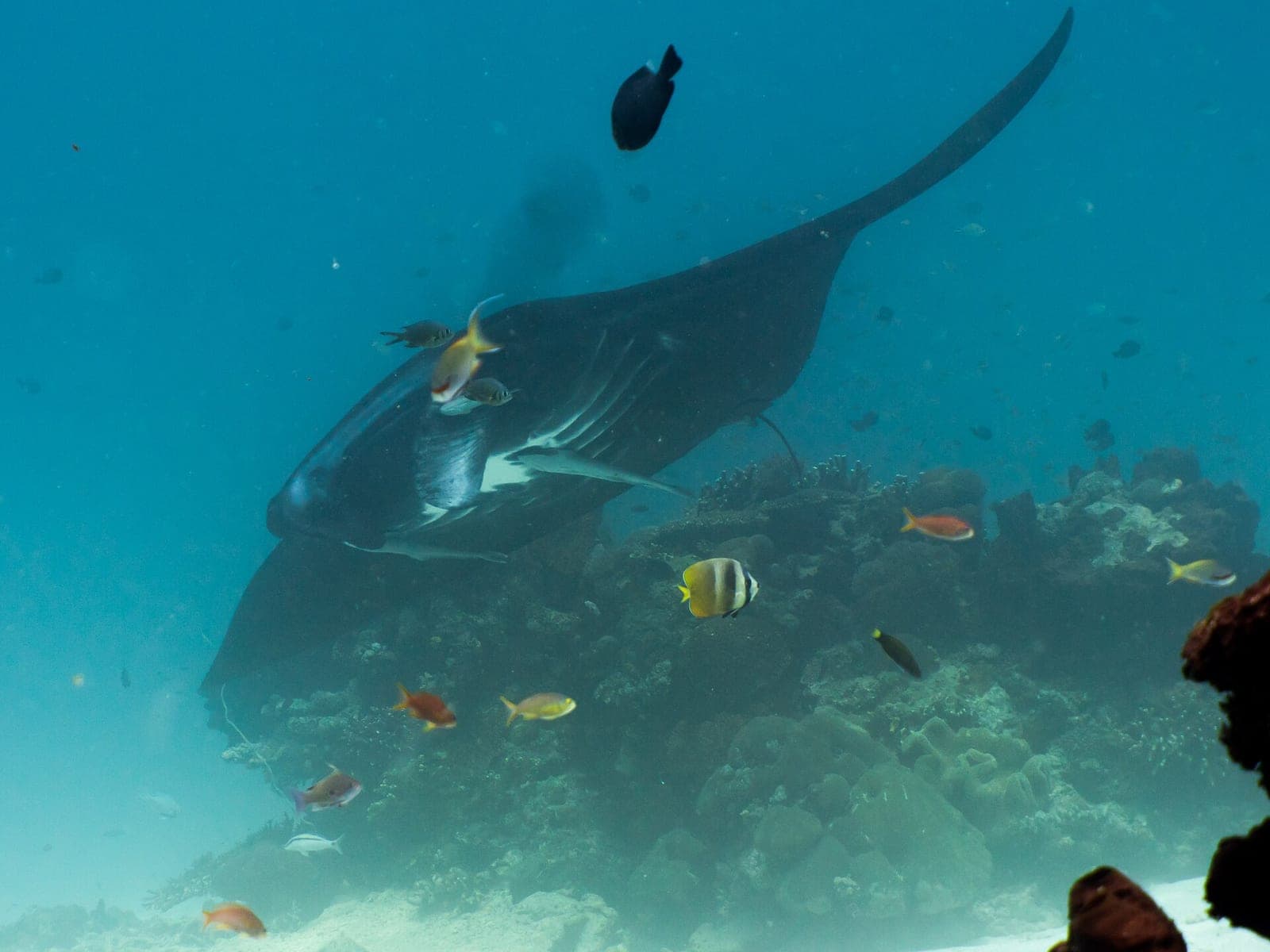
Roca Partida
A speck of rock in the open Pacific where the big animals come to you.
Some dive sites earn their reputation slowly. Roca Partida earns it in the first thirty seconds. You roll off the skiff into deep blue water, drop past a wall crusted white with guano and life, and before you have even checked your gauges a school of jacks folds around you like weather. This is the smallest and most remote of the Revillagigedo islands, and diving Roca Partida is as close as the sport gets to standing on a single rock in the middle of the ocean while the ocean parades past. There is no lagoon, no shelter, no easy version of it. There is just the pinnacle, the current, and whatever the blue decides to send you.
Quick answer: Roca Partida is an oceanic pinnacle / wall, dived as a blue-water drift in Socorro (Revillagigedo). Best season: November to May/June; sharks peak early season, whale sharks Nov–Dec & late spring, humpbacks Jan–Mar. Level: Advanced — comfort in current, blue water and surge is essential. Depth: Working depths 18–30 m; walls plunge past 50 m to an abyss over a mile deep. Typical visibility: Typically 20–30 m, often exceeding 30 m in clear blue water.
Facts verified September 2026
Why Roca Partida is the dive everyone remembers
Roca Partida means "split rock," and that is exactly what breaks the surface: two low, guano-whitened knuckles of ancient volcano, barely large enough to stand on, marooned 235 miles from the nearest port. What you see above water is almost nothing. What sits below is one of the most concentrated pelagic aggregations on the planet.
The rock is the visible tip of a sheer volcanic pinnacle. Its walls drop vertically to a plateau around 50 metres, then keep going — past a thousand feet, eventually to more than a mile of open Pacific beneath your fins. Because it is the only structure for miles, it works like a magnet and a cleaning station and a rest stop all at once. Currents wrap around it and stack food against its corners, and the animals know it. This is why Roca Partida consistently ranks among the best big-animal dive sites in the world, and why serious divers plan whole Socorro liveaboard trips around getting a few dives here.
What you'll see
The headline act at Roca Partida is quantity and size in equal measure. You are diving in true blue water against a single wall, so encounters tend to arrive out of nowhere and stay close.
Expect a rotating cast rather than a fixed one — every dive is different, and that unpredictability is the point:
- Giant oceanic (Pacific) manta rays, often curious and happy to hang in your bubbles
- Schooling scalloped hammerheads holding in the current off the corners
- Galápagos, silvertip and silky sharks patrolling the blue
- Whitetip reef sharks stacked in "cuddle puddles" along the ledges — sometimes dozens to a shelf
- Whale sharks, most reliably in late autumn and again toward late spring
- Dense schools of jacks, yellowfin tuna and wahoo, with the occasional marlin
- Humpback whales through the archipelago in winter — frequently heard singing underwater, occasionally seen
Conditions and who it's for — an honest read
This is not a beginner site, and it does not pretend to be. Roca Partida sits fully exposed in the open Pacific, so surface conditions can be lumpy and the current ranges from a pleasant push to genuinely strong. The saving grace is that one side of the rock is usually sheltered, and experienced guides read the weather and time the entries so you drop where the current is workable rather than punishing.
The real skill demands are blue-water awareness — holding a level, keeping the group and the rock in sight when there is no reef to reference — and managing surge near the surface, which can get sporty on the safety stop against the wall. You want solid buoyancy, comfort with negative entries, and enough dives that a shark cruising past does not rattle your air consumption. Advanced certification and recent experience are the sensible baseline. Handled with respect, it is exhilarating rather than intimidating; taken lightly, it is the kind of site that reminds you the ocean is in charge.
When to dive Roca Partida
The Revillagigedo dive season runs roughly November to May, occasionally into June, dictated by when the seas are calm enough to reach the rock at all. Outside that window the crossing and the exposed conditions simply close the site.
Within the season there are trade-offs worth knowing. Early on, November into the new year, water is warmest (around 26–28°C) and whale shark odds are good. January through March brings cooler water (roughly 21–24°C) but the shark action intensifies and it is prime time for migrating humpbacks singing through your dives. Spring warms again and can deliver a second whale shark push. There is no bad month here — only different flavours of very good — so choose by whether you are chasing whale sharks, hammerhead numbers or whale song.
How you actually dive it
Roca Partida is liveaboard-only, and that is not a marketing line — there is no land base within reach, no day-boat option, nothing but open water for 200-plus miles. You reach it on a multi-day expedition out of Cabo San Lucas, and the site is dived from skiffs off the mother vessel.
The typical plan is a negative entry to punch through any surface current, a drop down the sheltered wall, and then a slow patrol of the ledges and corners where the animals concentrate — the whitetip shelves low, the hammerheads and mantas out in the blue. Guides position the group so the current does the work, drifting you along the face rather than fighting it. Because the rock is small, you often circle features you recognise, but the pelagic traffic changes constantly. Keep one eye on the wall for orientation and the other on the blue, because that is where the whale shark materialises.
Faneca dives Roca Partida aboard the Rocio del Mar on our Socorro (Revillagigedo) expeditions — and because the rock sits 200-plus miles offshore with no land base, a liveaboard is the only way to experience it, giving you the multiple dives it takes to strike gold.
Roca Partida: common questions
What is the best season to dive Roca Partida?
November to May/June; sharks peak early season, whale sharks Nov–Dec & late spring, humpbacks Jan–Mar
What experience level do I need for Roca Partida?
Advanced — comfort in current, blue water and surge is essential
How deep is Roca Partida?
Working depths 18–30 m; walls plunge past 50 m to an abyss over a mile deep
What marine life will I see at Roca Partida?
Giant oceanic mantas, scalloped hammerheads, Galápagos, silvertip, silky & whitetip reef sharks, whale sharks, tuna, wahoo, jacks; humpback whales in winter
