Punta Vicente Roca
Cold, green water under an old volcano, and the best odds in the Galápagos of meeting a sunfish.
Punta Vicente Roca is where a Galápagos liveaboard turns west and the water turns cold. Tucked under the slopes of Volcán Ecuador on the north-west tip of Isabela, it is a wall dive fed by deep upwelling, and it is the site most often named as the best place in the islands to see sunfish. It is also where sea lions, penguins and marine iguanas share the same stretch of rock. This guide covers what makes Punta Vicente Roca worth the cold, what you are likely to see, who it suits, when to go and how the dive actually runs.
Quick answer: Punta Vicente Roca is a wall and drift dive along the flank of an eroded volcanic cone, with a sea cave and coves in Galápagos. Best season: Year-round; the cool season (roughly June–November) is colder but widely reported to give better sunfish odds. Level: Advanced: cold water, possible strong current and a deep first dive. Depth: Shallow ledges to about 30 m on a typical dive; the wall continues to around 50 m. Typical visibility: Variable and often green with plankton; around 5–10 m on poor days, clearer when the upwelling eases.
Facts verified September 2026
What makes Punta Vicente Roca special
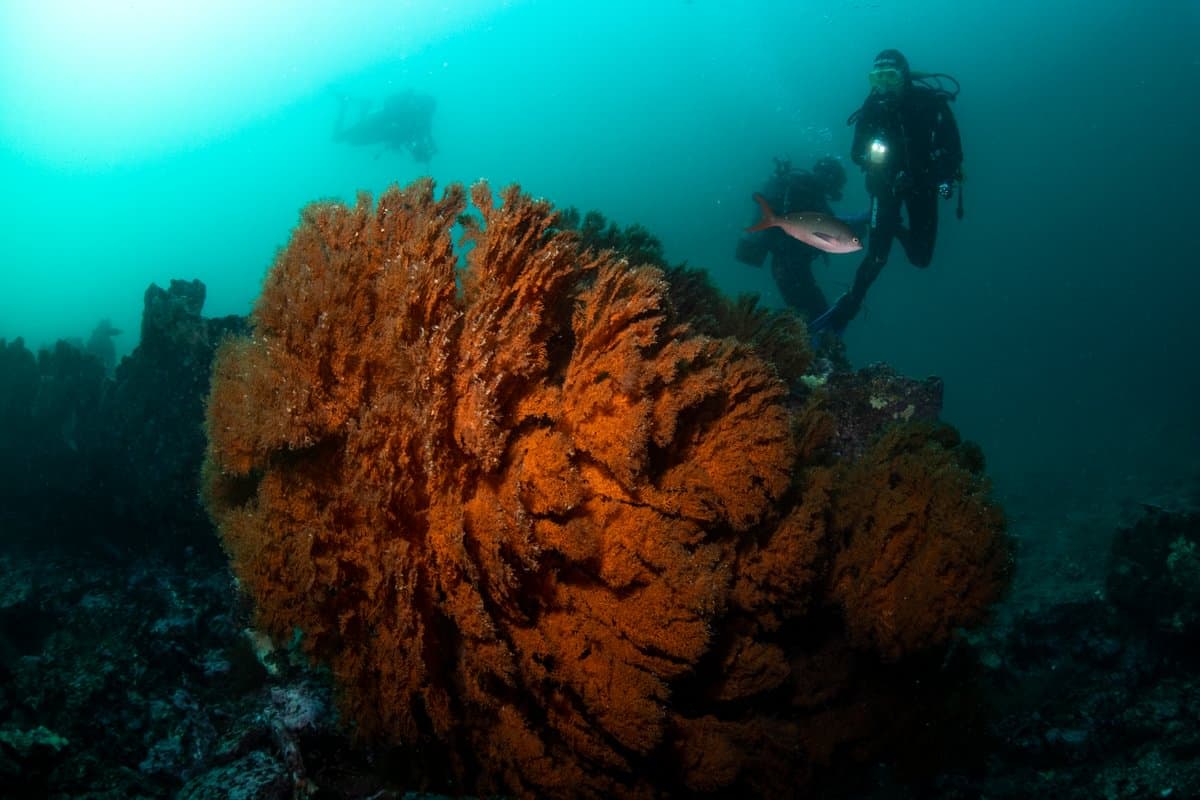
Punta Vicente Roca sits at the north-west corner of Isabela, on the outer slopes of Volcán Ecuador. What is left above water is the eroded remains of an old volcanic cone: sheer cliffs, two coves on either side of the point and a sea cave cut into the rock. Below the surface the coastline becomes a wall of crevices and narrow ledges, covered in sponges and small corals, that drops past 30 metres towards roughly 50.
The reason to dive it is the water. The west of Isabela lies in the path of the Cromwell Current, a cold, nutrient-rich flow that wells up against the islands from the deep. That upwelling makes the western Galápagos colder and greener than the central islands, and it supports a different cast of animals. Sunfish come up from deep water to the wall, sea lions and penguins hunt the shallows, and marine iguanas graze algae on the rocks. Few sites anywhere put a sunfish and a penguin on the same dive.
What you'll see
Sunfish are the reason most divers want this site, but they are never a sure thing: several divers on the same boat can come back with completely different stories. The wall itself rewards slow, close looking, and the shallows are rarely quiet.
- Sunfish (mola), usually seen off the wall in deeper, darker water, often around 25–30 m. Genetic samples taken from nine sunfish here in 2011 all proved to be the southern or bump-head sunfish (Mola alexandrini, then called Mola ramsayi), so not every 'mola' at this site is Mola mola
- Galápagos bullhead shark, a small, slow bottom-dweller found only in the Galápagos and off Peru; mostly active at night, so seeing one resting on the bottom by day is a bonus
- Red-lipped batfish, frogfish and seahorses on the ledges and sandy patches, worth looking for between the big-animal moments
- Galápagos sea lions and Galápagos penguins hunting through schools of black-striped salema in the shallows
- Marine iguanas feeding on the rocks and, at times, underwater close to shore
- Green turtles, barracuda schools, stingrays, eagle rays and mobulas; orcas, which are known to prey on sunfish, pass through occasionally but are rarely seen by divers
Conditions and who it's for
Plan for cold. Even in a normal year the west of Isabela is among the coldest diving in the Galápagos: expect anything from the high teens to the low twenties °C, with readings in the mid-teens reported on strong upwelling days. Divers arriving from Wolf and Darwin feel the drop immediately. A 7 mm wetsuit with a hood and gloves is the sensible minimum, and many divers who feel the cold bring a drysuit or an extra layer for the western days.
Current is variable. Some days the wall is close to slack; on others it runs hard, with surge in the shallows, and guides will shorten or call a dive if conditions turn. Visibility is usually reduced by the same plankton that feeds everything else, so you need to be comfortable in green water. Because the sunfish are found deep, the first dive often goes to around 30 metres in cold, dim water, which uses gas and no-stop time faster than you might expect. This is an advanced dive: come with an Advanced Open Water certification or equivalent, recent experience in cold water and current, and good buoyancy on a wall.
When to dive it
Punta Vicente Roca can be dived year-round, and sunfish are recorded here in every season. The cool season, roughly June to November, brings the strongest upwelling, the coldest and greenest water, and what many guides describe as the best odds of sunfish. If the sunfish is your main reason for the trip, that is the window to aim for, and you should pack for it.
The warm season, roughly December to May, is milder on the western sites and visibility can be better, but the sunfish are less predictable. Whatever the month, this is a site where the weather and the upwelling decide more than the calendar does, so treat any sighting as luck rather than a promise.
How you actually dive it
In practice Punta Vicente Roca is a liveaboard site. It lies far from the inhabited ports, and the expedition cruise ships that stop here offer snorkelling and panga rides rather than scuba. Dive liveaboards usually visit it on the western leg of a Wolf and Darwin itinerary, paired with Cabo Douglas on Fernandina, and often give it a full day of dives, or split the day with Cabo Douglas.
A typical first dive starts with a negative entry beside the wall and a direct descent to look for sunfish in the deeper water. After that, the group works back along the wall towards the shallows and the cave, finishing with sea lions, turtles and, with luck, penguins during the safety stop. Later dives often stay shallower and closer to the coves. Carry a surface marker buoy and deploy it before you surface: snorkellers and pangas use the same coves and the cave entrance. When a sunfish appears, stay still and let it come to you rather than swimming out after it; they spook easily and leave quickly when chased.
Between dives: the coastline
Landing is not permitted at Punta Vicente Roca, so the coast is seen from the water, usually on a panga ride between dives. The western islands hold almost the whole population of Galápagos penguins, about 95 per cent of them on Fernandina and the west coast of Isabela, and they share these cliffs with flightless cormorants, blue-footed and Nazca boobies, sea lions and marine iguanas.
The site lies inside the Galápagos Marine Reserve, and all diving is with a naturalist guide authorised by the Galápagos National Park. The park asks visitors to keep at least two metres from wildlife, even when an animal approaches. Sea lions will often close that gap themselves; enjoy it, keep your hands to yourself, and never touch, feed or follow an animal.
Faneca dives Punta Vicente Roca on our Galápagos weeks, usually on the western leg of the week after Wolf and Darwin, paired with the Fernandina sites. It is cold, often green and conditions-dependent, so we are honest at booking about the thermal protection you will need and what the sunfish odds look like for your month.
Punta Vicente Roca: common questions
What is the best season to dive Punta Vicente Roca?
Year-round; the cool season (roughly June–November) is colder but widely reported to give better sunfish odds
What experience level do I need for Punta Vicente Roca?
Advanced: cold water, possible strong current and a deep first dive
How deep is Punta Vicente Roca?
Shallow ledges to about 30 m on a typical dive; the wall continues to around 50 m
What marine life will I see at Punta Vicente Roca?
Sunfish (mola), Galápagos bullhead shark, red-lipped batfish, seahorses, sea lions, Galápagos penguins, marine iguanas, green turtles, salema schools