Police Island
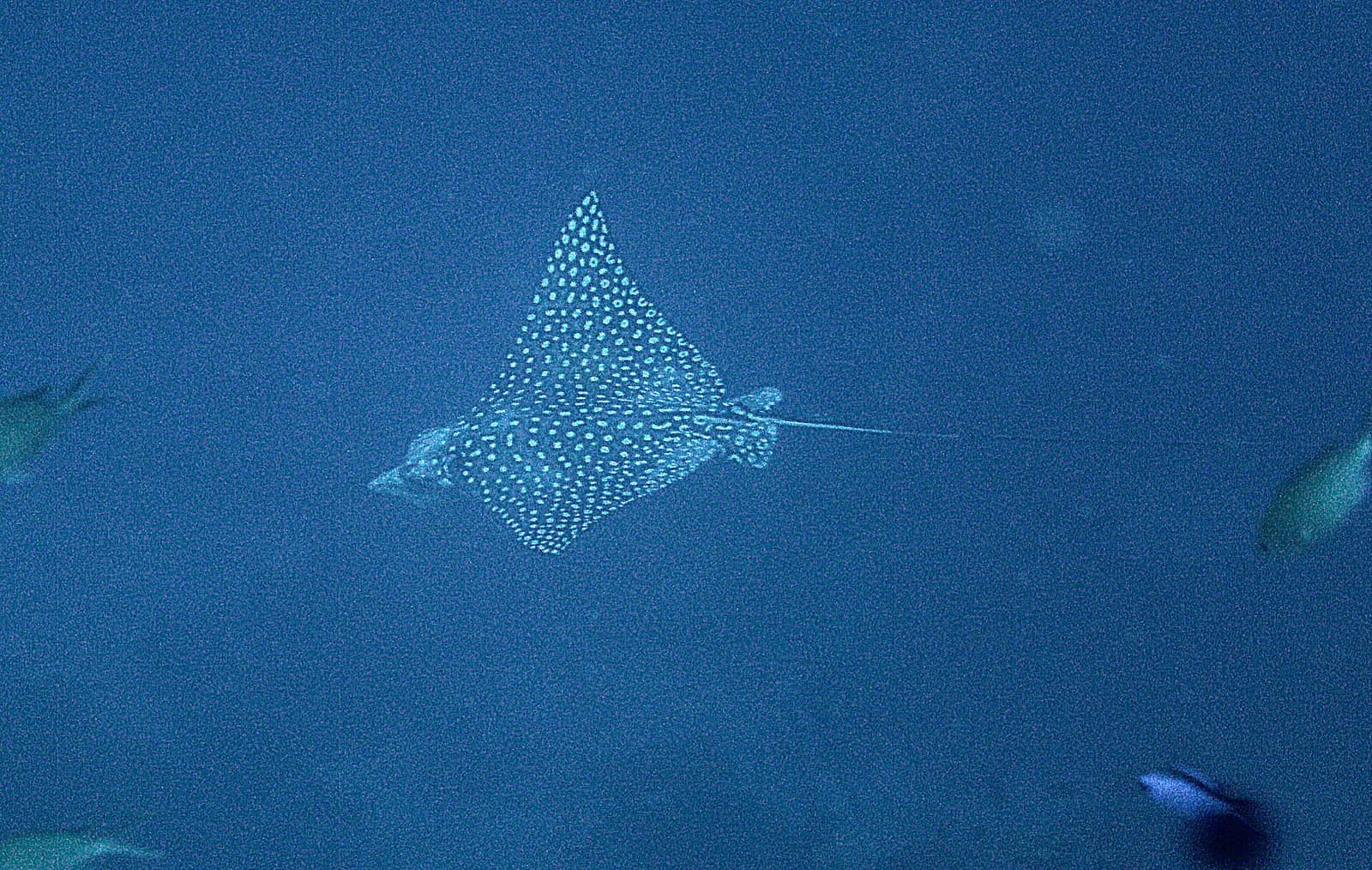
A shallow, sun-drenched coral garden threaded with swim-throughs, where turtles sleep in the crevices and stingrays tuck under the rock ledges.
Police Island is one of the gentler, more colourful dives in Oman's Daymaniyat Islands Nature Reserve, and a favourite for good reason. It asks little of you technically, yet it delivers the full Daymaniyat cast: green and hawksbill turtles, honeycomb morays wedged into the coral, stingrays resting in the sand, and fish schools thick enough to blur the reef behind them. If you want a relaxed, life-packed dive that still has a couple of narrow swim-throughs to keep it interesting, Police Island diving is exactly that. It is a day-boat site out of Muscat rather than a liveaboard one, which makes it easy to reach and easy to love.
Quick answer: Police Island is a day-boat reef dive: coral garden, boulders and swim-throughs in Oman. Best season: October–May for the calmest, clearest diving; whale shark chances peak Sept–Nov. Level: Open Water and up; comfortable for newer divers, with buoyancy control needed in the swim-throughs. Depth: Roughly 5–18 m, with swim-throughs around 16 m; the site rarely exceeds 25 m. Typical visibility: Typically 15–25 m, sometimes 30 m.
Facts verified September 2026
What makes Police Island special
The Daymaniyat Islands are a cluster of nine small, uninhabited islands protected as Oman's first marine reserve, and the diving here is the best in the north of the country. Coral covers a remarkable share of the reef, and because the whole area is a no-take sanctuary, the fish life is unusually dense and unbothered by divers.
Police Island earns its place in that line-up by being approachable. Where some Daymaniyat sites are walls and deeper drop-offs, this is a shallow, boulder-strewn coral garden lit up by Arabian sun. Two narrow swim-throughs cut off the main reef structure are the signature feature, short passages you can glide through while a ray sits on the sand below or a turtle lifts off from its ledge. It is the kind of dive where the reward is not a single big-animal moment but the steady accumulation of small, close encounters.
What you'll see
The reserve holds hundreds of marine species, and Police Island shows off a generous slice of them. Turtles are the headline: green turtles feed in the shallows and hawksbills, which nest across the Daymaniyats in large numbers, are seen resting under overhangs and coral ledges. Sightings here are reliable rather than lucky.
Look carefully into the coral and rock and you will find honeycomb morays, their yellow-and-black patterning unmistakable, often sharing a hole with cleaner shrimp. Stingrays rest in the sand and inside the swim-throughs. Above the reef, schools of fusiliers, snapper and jacks move in shifting curtains, and the hard-coral boulders host the usual busy cast of butterflyfish, parrotfish and anthias.
- Green and hawksbill turtles, feeding and resting on the reef
- Honeycomb morays tucked into coral and rock crevices
- Stingrays on the sand and inside the swim-throughs
- Dense schools of fusiliers, snapper, jacks and barracuda
- Occasional leopard sharks and resting nurse sharks
- Seasonal whale sharks passing through the wider reserve (roughly Sept–Nov)
Conditions and who it's for
This is an easy dive, and honestly so. Depths are modest, the site rarely pushes past 25 m, and currents in the Daymaniyats are generally light. That makes Police Island well suited to newer divers, refresher dives and anyone who wants an unhurried, photograph-everything pace.
The one thing to respect is buoyancy. The swim-throughs are narrow, and sea urchins sit on the floor and walls, so you want to hold your trim and keep your fins off the reef rather than kicking through. If your buoyancy is still settling, stay outside the passages and enjoy the coral garden over the top; you lose nothing of the marine life. Visibility is usually a comfortable 15–25 m and can open up to around 30 m on the clearest days.
When to dive it
Northern Oman dives on a seasonal rhythm. Boats run to the Daymaniyats across much of the year, but the most settled, clearest conditions run from roughly October to May, which is prime time for a relaxed site like this. Water is bath-warm through the summer, and a 3 mm suit is plenty.
Visibility often improves in the cooler months, when less plankton means cleaner water, so there is a genuine trade-off between warm-and-calm and clear-and-cool. If whale sharks are on your wish list, aim for the September–November window when they move through the reserve. One planning note that catches people out: landing on the islands themselves is closed during the turtle-nesting season, but the diving continues, so this does not affect your day on Police Island.
How you actually dive it
Police Island is a day-boat dive, not a liveaboard one. You leave from a Muscat marina in the morning by speedboat, and the Daymaniyats are only around 45 minutes to an hour offshore, so you are in the water without a long crossing. Most operators run a two-tank morning trip, and Police Island pairs naturally with a second nearby Daymaniyat site.
The reserve is properly protected, so a daily permit is required and no-take rules are strictly enforced: nothing comes off the reef, and touching or standing on coral is out. Morning departures tend to bring the calmest seas and the best light, which suits this sun-lit coral garden perfectly. Plan on a giant-stride or back-roll entry from the speedboat and a straightforward drift-free tour of the reef and its swim-throughs.
Faneca dives Police Island on our Oman diving trips as part of Daymaniyat Islands day trips run by speedboat from Muscat rather than by liveaboard, since the islands sit close enough to shore that day-boats are how the reserve is dived; we target the settled October–May window and handle the marine-reserve permits for you.
Police Island: common questions
What is the best season to dive Police Island?
October–May for the calmest, clearest diving; whale shark chances peak Sept–Nov
What experience level do I need for Police Island?
Open Water and up; comfortable for newer divers, with buoyancy control needed in the swim-throughs
How deep is Police Island?
Roughly 5–18 m, with swim-throughs around 16 m; the site rarely exceeds 25 m
What marine life will I see at Police Island?
Green and hawksbill turtles, honeycomb morays, stingrays, dense reef-fish schools, occasional leopard/nurse sharks and seasonal whale sharks
