North Twin
A tree-topped island at the far edge of the map, where granite pinnacles fall into blue water thick with sharks and rays.
North Twin is one of the Mergui Archipelago's genuine big-fish sites — a remote cluster of granite pinnacles and plateaus off Myanmar's Andaman coast where the current runs, the walls drop past 40 metres, and the blue water fills with grey reef sharks, eagle rays and rainbow runners. This is liveaboard-only diving, days from anywhere, and it rewards divers who are comfortable in current and depth. If you want the Mergui at its wildest, North Twin diving delivers exactly that.
Quick answer: North Twin is a liveaboard-only pinnacle, plateau and boulder-reef diving in Myanmar. Best season: January to April, with the wider window running November to May. Level: Advanced — depth, current and remoteness demand experience. Depth: 3 m over the pinnacle tops to beyond 40 m on the plateau. Typical visibility: Usually excellent, commonly 20–40 m.
Facts verified September 2026
What makes North Twin diving special
North Twin is the smaller, tree-topped sister of South Twin, sitting roughly 20 kilometres to its north near the seaward edge of the Mergui Archipelago. That position matters. Out here you are exposed to open Andaman water, and the marine life reflects it — this is one of the archipelago's true pelagic sites, not a sheltered fringing reef.
The topography is classic Mergui: enormous granite boulders, the same rounded grey megaliths you see in Thailand's Similan Islands, stacked into pinnacles and spread across sloping plateaus. The headline feature is South Pinnacle off the island's south-west tip, rising to within about 3 metres of the surface and dropping to around 35 metres. A kilometre to the north-west, the North Twin Plateau is a series of sloping rocky ridges that fall beyond 40 metres in places. Between the structure and the current, this is proper blue-water diving where you hang off the rock and watch the open ocean deliver.
What you'll see
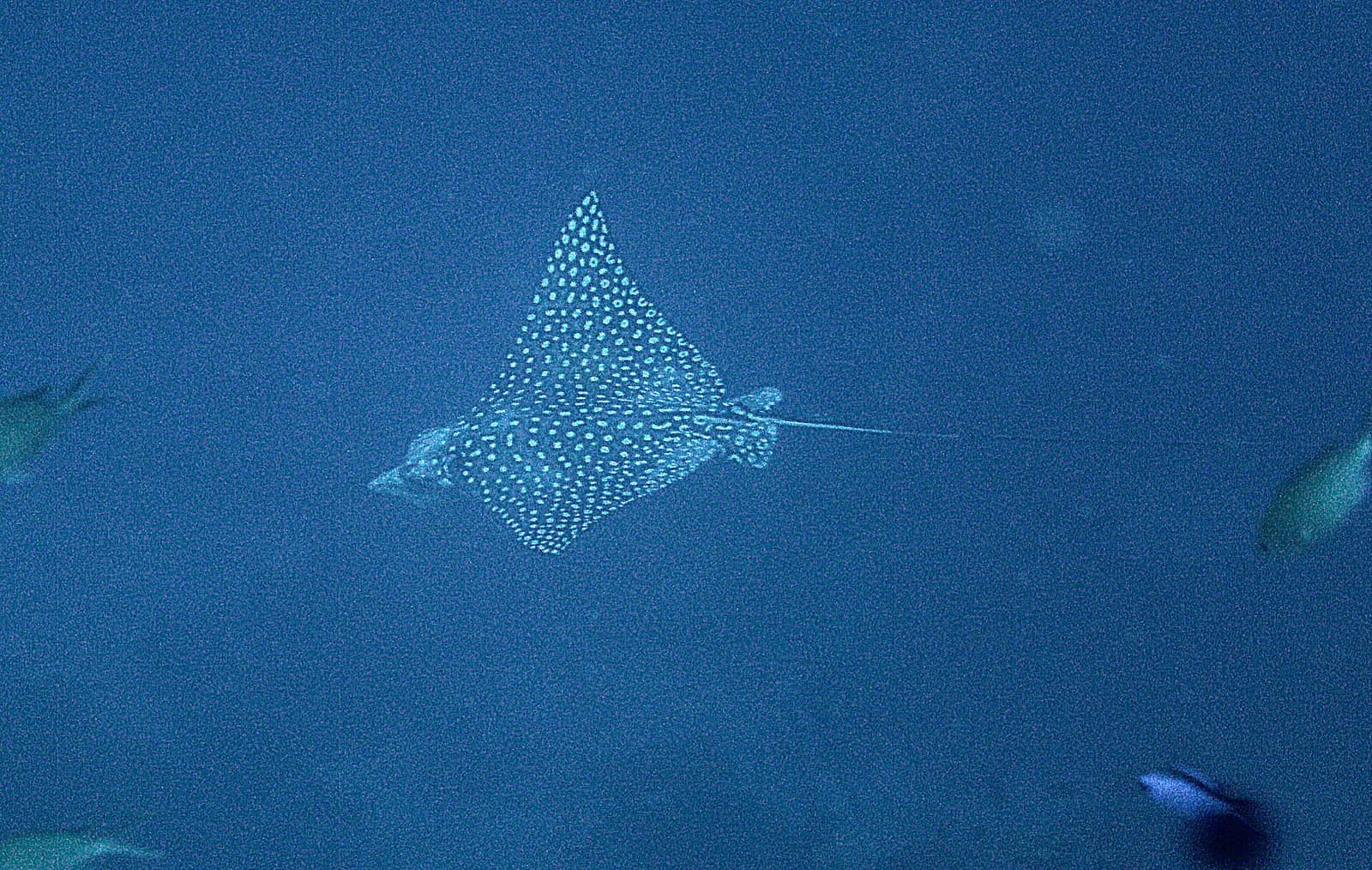
North Twin is a shark and ray site first and foremost. The pinnacles act as gathering points and cleaning stations, and on a good day the traffic in the blue is the whole reason you came. Bull sharks (known locally as Zambezi sharks) are the occasional heavyweight; grey reef and whitetip reef sharks are more reliable. Leopard sharks rest on the sand patches, which is notable — North Twin is one of the few Myanmar sites where you can count on seeing them.
The reef itself carries the supporting cast, with boulders draped in soft corals, orange fan corals sprouting from the deeper crevices, and encrusting sponges holding smaller life.
- Sharks: grey reef, whitetip reef, leopard, and occasional bull (Zambezi) sharks; nurse sharks on the plateau
- Rays: eagle rays in the blue, plus occasional manta rays at the cleaning stations
- Pelagics: rainbow runners, barracuda and jacks along the current lines
- Reef life: teira batfish, malabar groupers, sweetlips, angelfish, scorpionfish and nudibranchs
Conditions and who it's for
Be honest with yourself about this one. North Twin is an advanced site, and the reasons are stacked: the best action is deep, the current can be strong and unpredictable on the exposed pinnacles, and you are diving from a liveaboard days from the nearest recompression facility. None of that should scare off an experienced diver, but it should rule the site out for anyone still building their first dozens of dives.
What you get in return is water that is usually beautifully clear — visibility commonly runs 20 to 40 metres — and warm, sitting around 27 to 29 degrees through the main season. Good buoyancy, comfort with negative entries and reef hooks in current, and solid air consumption at depth are the skills that make North Twin enjoyable rather than stressful. Nitrox is worth having for the deeper plateau profiles. If you dive it well, it is one of the most rewarding sites in the Mergui.
When to dive it
The Mergui Archipelago has a short, weather-defined season. Liveaboards run roughly from November to May, but the sweet spot for North Twin is January to April, when the seas are calmest, the skies clearest and visibility is at its best. Water temperatures sit warm and comfortable across this window.
If big-fish encounters are your priority, the later part of the season into February and beyond tends to bring the highest frequency of the larger pelagics through the region. Outside the window the south-west monsoon shuts the archipelago down — the boats simply don't run, and an exposed outer site like North Twin would be unworkable anyway.
How you actually dive it
There is no shore access and no day-boat option here — North Twin is reached only by liveaboard, and it is a genuinely remote stop deep in the Mergui itinerary. Trips stage out of Ranong in Thailand with border clearance into Kawthaung, Myanmar, and the archipelago's permit system adds a per-diver fee (typically in the region of US$200–250, paid in cash in clean US dollars) covering border, diving and entry charges. Your operator handles the logistics, but budget for it and bring the cash in good condition.
On site, expect briefings built around the current. Dives are often negative entries straight down onto the pinnacle, working the up-current side to watch the blue, then drifting the boulders and plateau on the way back up. Keep an eye on depth and gas — the temptation to chase a shark deeper is real. A surface marker buoy is essential given the exposed water and the possibility of drifting off the structure.
Faneca reaches North Twin on our Myanmar liveaboards through the Mergui Archipelago, sailing the outer sites during the January-to-April window when conditions are at their best; because the region is remote and permit-controlled, these are pre-planned seasonal departures rather than trips you can book on short notice.
North Twin: common questions
What is the best season to dive North Twin?
January to April, with the wider window running November to May
What experience level do I need for North Twin?
Advanced — depth, current and remoteness demand experience
How deep is North Twin?
3 m over the pinnacle tops to beyond 40 m on the plateau
What marine life will I see at North Twin?
Grey reef, whitetip, leopard and occasional bull sharks; eagle rays, rainbow runners, barracuda, batfish, groupers
