Kicker Rock (León Dormido)
Two sheer halves of a drowned volcanic cone, a channel between them, and sharks working the gap.
Kicker Rock, León Dormido to Ecuadorians, is the dive most people do from San Cristóbal and the one they talk about afterwards. It is a volcanic tuff cone that the sea has split in two, rising roughly 150 metres out of open water off the island's west coast, with a narrow channel between the halves where Galápagos sharks, eagle rays and turtles pass through and, on a good day, hammerheads show at the ends. This guide covers what you will see, the current and cool water to be ready for, when to go, and how to fit the rock around a Galápagos liveaboard week.
Quick answer: Kicker Rock (León Dormido) is a channel and wall dives around a split volcanic tuff cone in Galápagos. Best season: Year-round; June–November for more big animals, December–May for warmer, calmer water. Level: Intermediate: certified divers, recent current experience recommended. Depth: Typical dives 15–25 m; channel floor around 20 m; walls drop to ~40 m. Typical visibility: Typically 10–15 m; from under 5 m to 20 m+ depending on swell and season.
Facts verified September 2026
What makes Kicker Rock special
León Dormido is the eroded remnant of a tuff cone, a volcanic vent built from compacted ash. The sea has cut it into two near-vertical blocks that stand roughly 150 metres above the water (published figures vary slightly), separated by a narrow channel. Seen from one side the outline looks like a sleeping lion, which gives the Spanish name; from another it looks like a boot, which gives the English one. There is no landing. It is a marine visitor site inside the Galápagos Marine Reserve, reached only by boat and visited only with a licensed guide.
Underwater the walls keep going. Currents running past the rock push nutrient-rich water up its faces, which feeds the barnacle-covered ledges, the schools of fish and, in turn, the sharks. The channel concentrates all of it: it is a natural corridor where animals pass within sight of divers holding station beside the wall, and that is why this one site gives so many San Cristóbal visitors their first proper shark dive.
What you'll see
Kicker Rock is a sharks-and-rays dive first, with a solid supporting cast. What turns up on a given day depends on current, water temperature and luck, and no honest operator guarantees any of it.
- Galápagos sharks, the most dependable of the big animals, often patrolling the channel and its entrances
- White-tip reef sharks resting on ledges and on the sandy channel floor
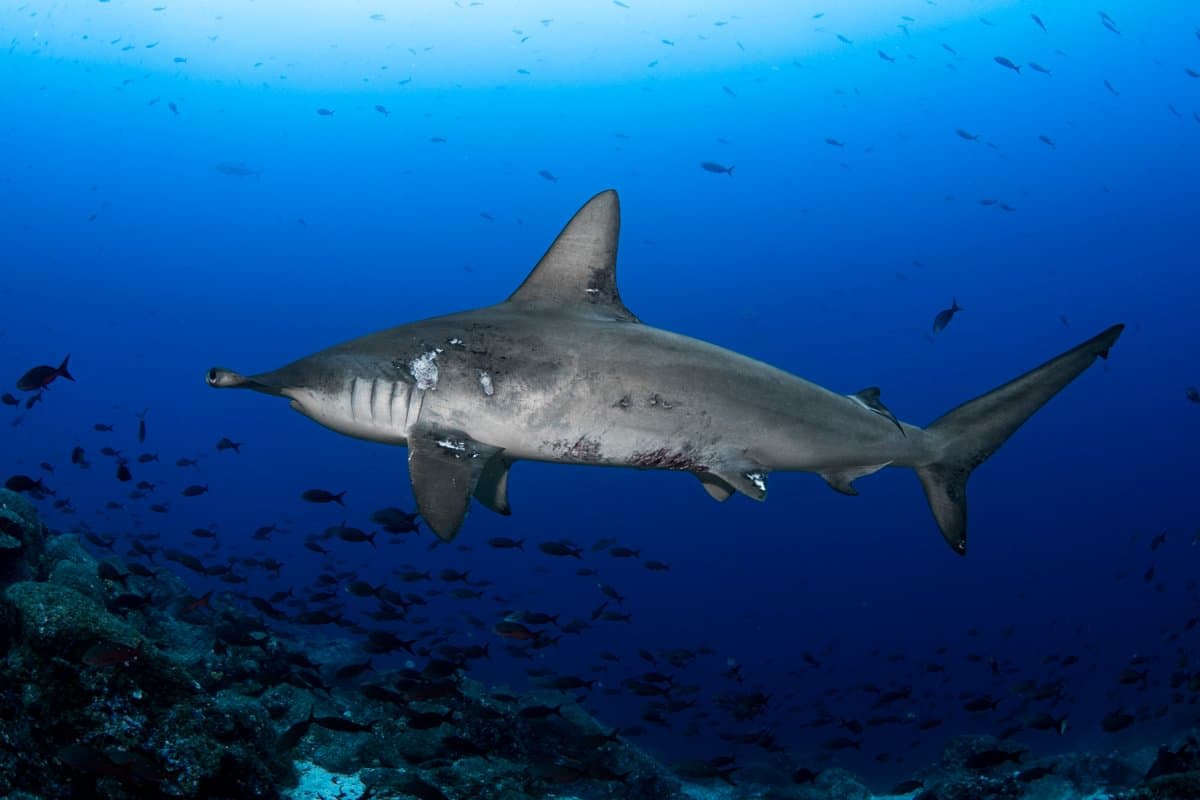
- Scalloped hammerheads, sometimes seen off the deeper ends of the channel or the outer walls: a real possibility, not a fixture
- Spotted eagle rays and golden cownose rays, often moving through the channel in loose groups
- Green sea turtles and Galápagos sea lions, the sea lions mostly in the shallower water
- Schooling barracuda and jacks, with king angelfish, yellowtail surgeonfish and creolefish along the walls
- With luck, a manta ray or another passing pelagic, more likely in the cooler months
Conditions and who it's for
Kicker Rock is open ocean, not a sheltered bay. Current is often moderate and can be strong, particularly in the cool season, and swell surging against the walls can lift sand off the bottom and cut visibility. Visibility is usually somewhere around 10 to 15 metres, occasionally better and sometimes a lot worse. The walls give you a constant visual reference, which makes it more forgiving than a blue-water site, but there is little shelter once the current picks up in the channel.
Day operators on San Cristóbal take certified divers here with fairly modest minimums, so you may share the boat with people who have only a handful of logged dives. We would still call it an intermediate dive. You should be comfortable descending promptly beside a wall, holding depth without using the rock, and staying with your guide in moving water; Advanced Open Water and some recent current diving make the day far more enjoyable. Water is roughly 18–24°C from June to November, colder in an upwelling or below a thermocline, and around 21–26°C from December to May. A 5 mm suit with a hood is a sensible minimum for most of the year, and 7 mm is not overkill in the cool months.
When to dive it
This is a year-round site, and the resident sharks, rays and sea lions are around in every month. The seasons change the character of the dive rather than switch it on and off. From roughly June to November the Humboldt Current brings cooler, nutrient-rich water: more plankton, more fish and better odds of hammerheads and other big animals, but also colder water, greener visibility and often stronger current and rougher seas.
From December to May the water warms, the sea is usually calmer and visibility tends to improve, which makes for a more relaxed dive and longer, more comfortable snorkelling for a non-diving partner. If hammerheads are the priority, aim for the cool season and accept the conditions. If you want an easier first taste of Galápagos diving, the warm months suit better. Either way, keep a spare day in hand, because sea state can change plans at short notice.
How you actually dive it
Kicker Rock sits off the west coast of San Cristóbal, north-east of the harbour at Puerto Baquerizo Moreno, and the ride out usually takes about an hour to an hour and a half depending on the boat and the sea. Day trips leave in the morning and normally include two dives with a surface interval on board; snorkellers often share the boat in their own group with their own guide. Some operators run a short skills check close to the coast first, especially if your last dive was a while ago.
A typical first dive drops down beside one of the walls to around 20 metres, then works through the channel between the two rocks, watching the entrances for sharks before exiting the far side. The second is usually a wall dive along the outside of the rock, close to the face, where the bottom is often out of sight below you. Most of the diving happens between about 15 and 25 metres, although the walls continue to around 40. Descend with the group, keep the wall on one shoulder, watch your gas and no-decompression time in the cold, and let the animals pass rather than swimming out after them.
Galápagos National Park rules apply in the water as well as on land: dive only with an authorised operator and a licensed guide, keep at least 2 metres from wildlife (and don't reach for a sea lion that closes the gap itself), no flash photography of animals, no feeding, and nothing taken. On the ride out, look up as well: blue-footed and Nazca boobies and frigatebirds use the cliffs.
Fitting it around a liveaboard week
Kicker Rock is easy to combine with a Galápagos liveaboard, because so many dive trips start and finish in San Cristóbal. It is not a fixed dive on most liveaboard itineraries, though. Boats leaving San Cristóbal usually make their first check dive close to the harbour, the National Park sets the order of sites, and the week is built around the far north. Some cruises visit or pass the rock at the start or end of a trip, but if Kicker Rock matters to you, don't count on diving it from the yacht.
The dependable way is a day trip from Puerto Baquerizo Moreno, and the best slot is before you embark. Arrive a day or two early, dive the rock, and you also get a warm-up in cool Galápagos water before the bigger current sites. Afterwards is possible but tighter: the standard guidance is to wait at least 18 hours after multiple days of diving before flying, and many divers allow 24, which means extra nights on the island before the flight back to the mainland.
Kicker Rock isn't a guaranteed dive on our liveaboard weeks, but our 7-night trips start and end in San Cristóbal, so the rock fits neatly into a day trip from Puerto Baquerizo Moreno before you embark. We can help you plan the extra night ashore and line the day up with your flights.
Kicker Rock (León Dormido): common questions
What is the best season to dive Kicker Rock (León Dormido)?
Year-round; June–November for more big animals, December–May for warmer, calmer water
What experience level do I need for Kicker Rock (León Dormido)?
Intermediate: certified divers, recent current experience recommended
How deep is Kicker Rock (León Dormido)?
Typical dives 15–25 m; channel floor around 20 m; walls drop to ~40 m
What marine life will I see at Kicker Rock (León Dormido)?
Galápagos & white-tip reef sharks, occasional scalloped hammerheads, spotted eagle & golden cownose rays, green turtles, sea lions, barracuda