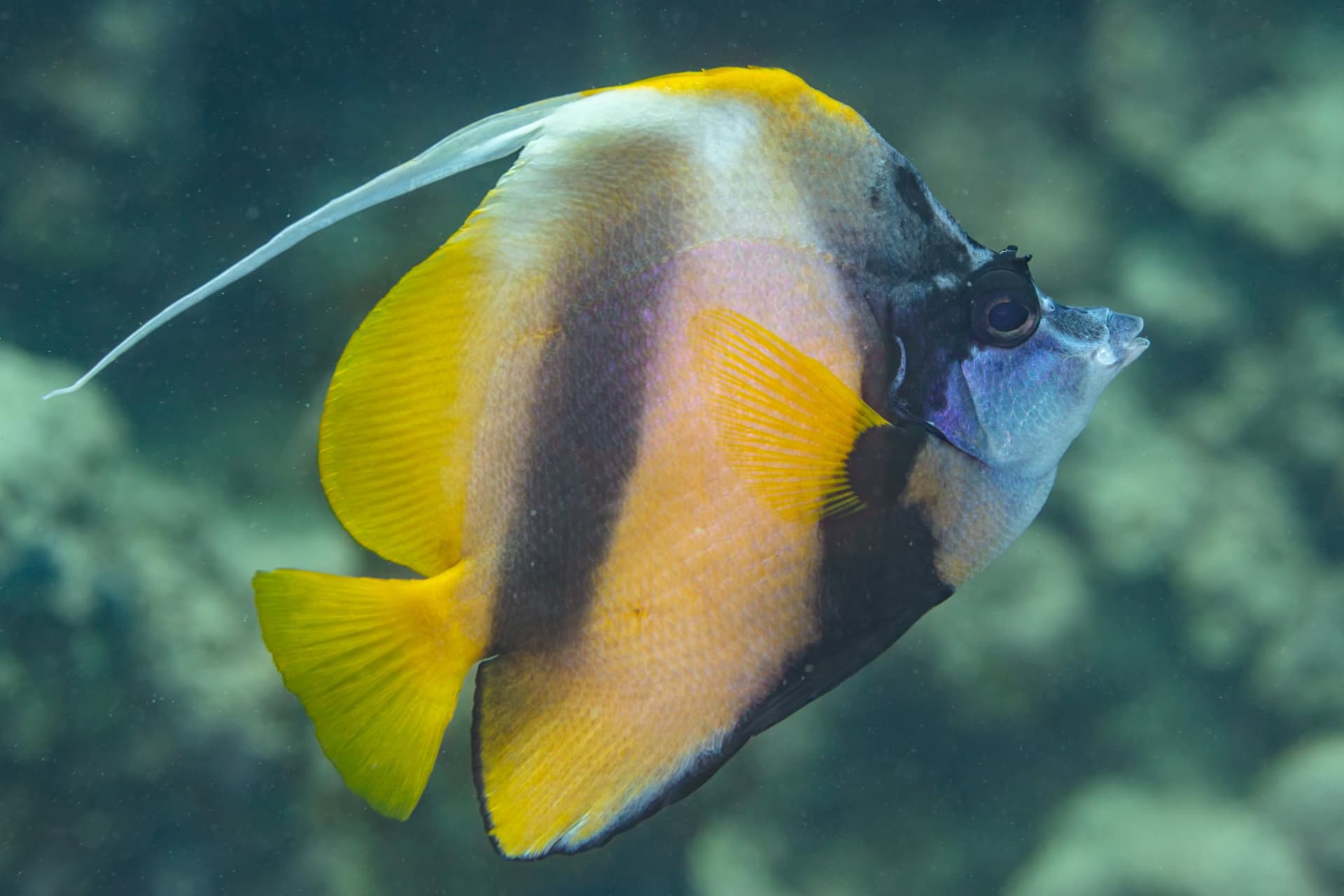
Danak Island
A vegetation-crowned islet in the far southern Farasan Banks, ringed by an unspoiled plateau that falls into open blue.
Danak Island diving is Saudi Arabia at its most remote and least trafficked. This is a frontier corner of the southern Red Sea, reached only by liveaboard, where a gently sloping northern plateau of hard and soft coral gives way to blue water patrolled by trevally, reef sharks and the occasional bigger visitor. There is no jetty, no dive shop, no crowd. You dive it because a boat brought you here on a permit-controlled expedition, and because reefs this untouched are getting harder to find anywhere in the world.
Quick answer: Danak Island is a liveaboard-only wall and plateau; drift and blue-water pelagic diving in Saudi Arabia. Best season: October/November to May. Level: Advanced — AOW or equivalent, comfort at 30 m+, ideally 30–50+ logged dives. Depth: 20–35 m; the northern plateau bases out around 25 m before the slope drops into blue. Typical visibility: Frequently 25–30 m+, often exceptional over the sandy plateau.
Facts verified September 2026
What makes Danak Island special
Danak sits deep in the Farasan Banks, a 350-mile scatter of reefs, atolls and low islands stretching down Saudi Arabia's southern coast. It is one of the least-dived regions of the entire Red Sea, and Danak is a fair distance even within it — you clear Al Lith, run out past Sha'ab Ammar, and keep going south until a green-topped islet rises out of the haze. That remoteness is the whole point. There is no shore access and no infrastructure, so the reef has been left to simply grow.
The island itself is densely vegetated and used by nesting seabirds, while turtles haul out onto its sandy fringe to lay. Underwater, the signature feature is the northern plateau: a broad coral shelf that bottoms out around 25 metres before the terrain falls away into open blue. That combination — a healthy, gently sloping reef flat with a pelagic drop on its outer edge — is what makes Danak such a satisfying dive. You get coral-garden detail and big-water potential on the same tank.
What you'll see diving Danak Island
The plateau is the star. Expect dense hard-coral heads interspersed with soft corals and alcyonarians, sea fans and gorgonians catching the current on the edges, and sponges tucked into the structure. Because this reef sees so few divers, the coral cover reads as genuinely unspoiled rather than merely good.
Reef life is thick — anthias, snapper, fusiliers and the usual Red Sea supporting cast — and giant trevally hunt the plateau lip. Turtles are a regular sight here, often unbothered by divers. Push your attention out into the blue off the drop and that is where the pelagic story develops: reef sharks cruise the banks, and across the wider Farasan Banks silky sharks, grey reef sharks and, with luck, hammerheads and even whale sharks move through in season. Danak is not a guaranteed shark site, but it is a place where you keep one eye on the blue for good reason.
Conditions and who Danak is for
This is advanced, remote diving and it should be treated as such. Working depths run 20 to 35 metres, currents on the exposed banks can be variable and occasionally strong, and the nearest recompression facility is a very long way off. Operators typically ask for Advanced Open Water or equivalent, solid comfort at 30 metres, and a meaningful logbook — commonly 30 to 50-plus dives, with deep and drift experience valued. Good buoyancy and gas management matter more here than at any resort reef.
Just as important is the frontier reality. Saudi Arabia's Red Sea is an emerging, permit-based destination that only opened to recreational diving in recent years, and the Farasan Banks in particular is protected and access-controlled. You dive Danak as part of an organised, permitted liveaboard expedition — not on a whim, and not independently. Weather and sea state in this exposed southern region can reshape a schedule, so flexibility is part of the deal.
When to dive Danak Island
The window is roughly October or November through May, the cooler half of the year, when the southern Red Sea is at its most diveable. Summer here is punishingly hot and generally avoided. Even in season the water stays warm, so most divers are comfortable in a 3mm suit, and visibility over the pale sand of the plateau is often superb — frequently 25 to 30 metres and beyond.
Shark and pelagic action tends to be a seasonal lottery rather than a promise, which is honest to say of anywhere in the Banks. Come for the reef and the remoteness first; treat the big animals as the bonus this frontier occasionally delivers.
How you actually dive Danak Island
Everything runs from the liveaboard. Trips depart Al Lith, itself an internal transfer of a couple of hours south from Jeddah, and it is a long open-water run out to the southern Banks — Danak is often a highlight day deep into the itinerary rather than a first-morning check dive. You will dive from tenders, dropping onto the plateau and working the coral before easing out toward the edge where the pelagics hold.
Plan conservative profiles given the depth, distance from help and the pace of a multi-dive day, and build in a proper safety stop with something in reserve. Nitrox is worth having for the repetitive 25-to-30-metre profiles this region invites. Because sites are chosen day-by-day around wind and swell, take the guides' briefings seriously — they read this water far better than any printed dive plan can.
Faneca dives Danak on our Saudi Arabia Red Sea liveaboards through the Farasan Banks — an expedition-style, permit-controlled route that only runs in the cooler October-to-May window and asks for genuine experience (Advanced certification and a solid logbook), so talk to us early about dates, permits and whether your diving is ready for it.
Danak Island: common questions
What is the best season to dive Danak Island?
October/November to May
What experience level do I need for Danak Island?
Advanced — AOW or equivalent, comfort at 30 m+, ideally 30–50+ logged dives
How deep is Danak Island?
20–35 m; the northern plateau bases out around 25 m before the slope drops into blue
What marine life will I see at Danak Island?
Gorgonians, soft corals and sponges, giant trevally, turtles, reef sharks; silky and grey reef sharks and occasional hammerheads or whale sharks in the wider banks
