Cabo Marshall
A drift along the volcanic flank of Isabela, where oceanic mantas rise onto a shallow plateau to be cleaned.
Cabo Marshall is the Galápagos dive most people book for mantas. It sits on the north-east coast of Isabela, below the slopes of Wolf volcano and close to the equator, and it is a different kind of dive from the shark walls of Wolf and Darwin. Here the action is shallower: a rocky plateau at around 12 metres where giant oceanic mantas come in to be cleaned, edged by a wall that drops away into deep water. This guide covers what makes the site worth the sail, what you are likely to see, the conditions, the season question, and how the dive actually runs.
Quick answer: Cabo Marshall is a drift dive along a volcanic wall and shallow plateau in Galápagos. Best season: Mantas possible year-round; most liveaboards schedule it in the warm season, roughly December–May. Level: Advanced, with recent current experience. Depth: Plateau at ~12 m; most of the dive 10–20 m; the wall drops past 40 m. Typical visibility: 6–20 m, often lower in plankton-rich water.
Facts verified September 2026
What makes Cabo Marshall special
Cabo Marshall is a stretch of Isabela's coastline rather than a single rock. Old lava flows run down from Wolf volcano into the sea and form a steep, broken wall, stacked with square blocks of basalt and tufts of black coral. Partway down the wall there is a plateau at roughly 12 metres, and that ledge is the reason the site is famous. Cleaner fish work the rocks there, and giant oceanic mantas come up onto it and hang over the stations, sometimes returning to the same spot again and again during a dive.
Some guides call it Manta City, and on a good day the name fits. What also sets it apart is the setting. You are diving the flank of a young island whose volcanoes are still active, in green, plankton-rich water that feeds the whole food chain. It is a nutrient dive, not a clear-water reef dive, and it rewards divers who are happy to hang in the current and wait.
What you'll see
Mantas are the headline, but they are wild animals on their own schedule, and no guide can promise them on a given dive. The site is busy even when they stay away.
- Giant oceanic mantas, often cruising over the plateau and the cleaning stations, sometimes passing close to divers who stay still
- Mobula rays in small groups, often just below the surface, plus eagle rays and marbled rays on the bottom
- Huge, dense schools of black-striped salema, a schooling fish endemic to the Galápagos region, that can swallow a whole group of divers
- Barracuda in tight schools, Pacific creolefish, yellowtail surgeonfish and parrotfish along the wall
- White-tip reef sharks resting on ledges, Galápagos sharks off the wall and, with luck, a scalloped hammerhead in the blue
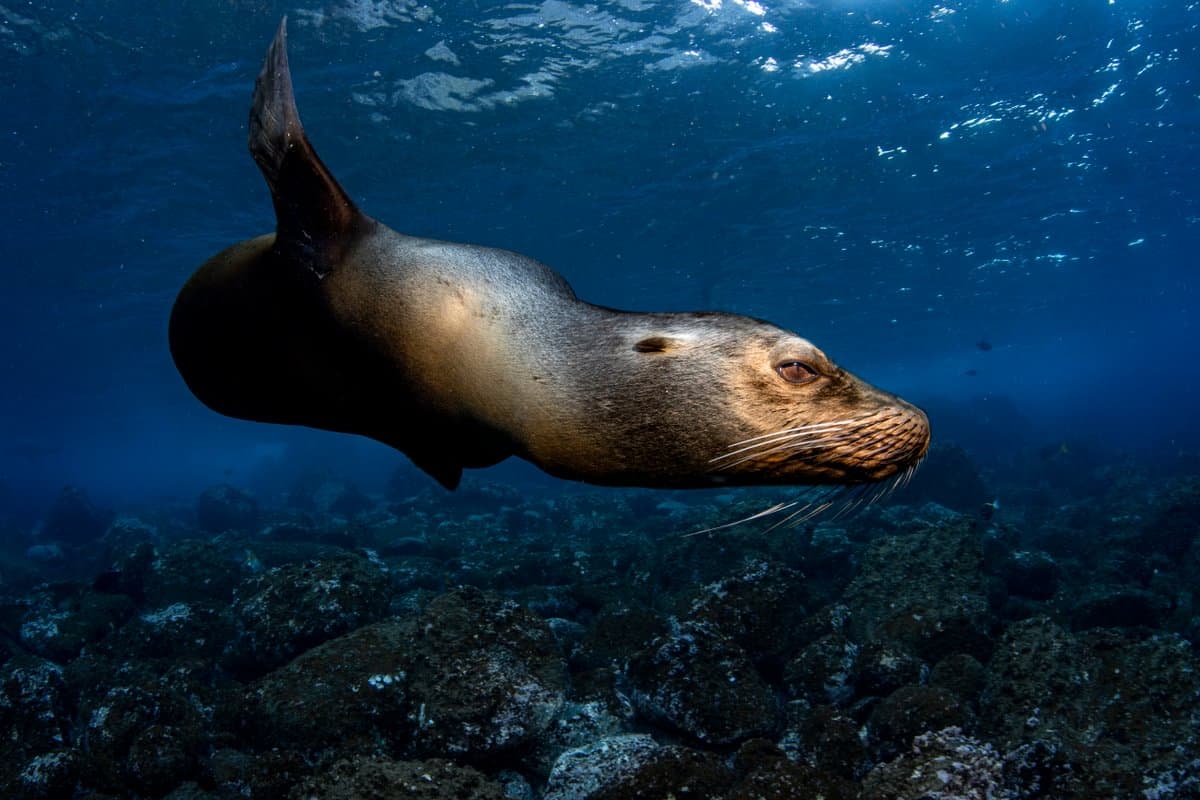
- Galápagos sea lions near the shore, green turtles, moray eels and long-nosed hawkfish in the black coral
Conditions and who it's for
Cabo Marshall is a drift dive, and the current runs along the coast at anything from moderate to strong. It is usually gentler than Wolf or Darwin, but it can change direction or pick up with the tide, and there is often swell at the surface near the shore. You need to be comfortable with a negative entry, with holding position low on the rocks without grabbing living things, and with ascending in open water away from the wall.
Visibility is the other honest point. The plankton that brings the mantas also clouds the water, and 6–20 metres is a fair expectation, with occasional dives much lower than that. Water temperature varies by season: roughly 22–27°C in the warm months, cooler from June to November, often around 18–23°C, and thermoclines can be colder still. A 7 mm wetsuit with a hood is the sensible choice for most people. This is a site for advanced divers with recent current experience, and the liveaboards that run it set their own minimum logged-dive requirements.
When to dive it
Mantas are seen at Cabo Marshall throughout the year, but sources and guides disagree on the best months. Many liveaboard itineraries plan the site in the warm season, roughly December to May, when the sea is generally calmer and the water warmer. In the cooler months, several boats switch that day to Cabo Douglas on Fernandina and Punta Vicente Roca on Isabela, which suit the season's marine iguanas and mola. Some divers report excellent manta encounters in the cool season too, when plankton levels rise.
The practical answer is that the season decides whether Cabo Marshall is on your trip at all more than it decides what you will see once you are there. If mantas are a priority, check that your departure includes the site, and treat it as a likely encounter rather than a guaranteed one.
How you actually dive it
There are no land visits at Cabo Marshall and day boats do not normally reach it from the inhabited islands, so you dive it from a liveaboard, usually on the western leg of the week when the boat is near Isabela. The panga drops the group close to the shore, and you descend together straight onto the plateau to get below the surface swell quickly.
From there the dive drifts along the coast with the current. The plan is usually to stay on or just above the plateau, where the cleaning stations are, rather than going deep: there is little extra to see on the deeper wall and it costs you bottom time. Your guide reads the current on the day and picks the line along the shoreline. As everywhere in the Galápagos National Park, you dive with a park-licensed naturalist dive guide at all times, and you surface together for pick-up by the panga.
Diving with mantas the right way
The best encounters happen to the divers who do least. Settle low on the plateau beside a cleaning station, keep your breathing slow and your fins still, and let the manta choose how close it comes. Chasing one, swimming over it or blocking its path above the station drives it off, and it can drive it off for the whole group.
The park rules back this up. Keep at least 2 metres from wildlife even when an animal approaches you, never touch or feed anything, and do not use flash or strobes on wildlife: the national park does not permit flash photography of animals, so plan to shoot with natural light. Do not hold or stand on the black coral either. It is protected in the reserve and takes a very long time to grow.
Faneca dives Cabo Marshall on our 7-night route from San Cristóbal, which takes in Isabela and Fernandina as well as Wolf and Darwin. The exact sites depend on season, weather and park rules, so if mantas matter to you, we check at booking whether your departure is planned to include Cabo Marshall.
Cabo Marshall: common questions
What is the best season to dive Cabo Marshall?
Mantas possible year-round; most liveaboards schedule it in the warm season, roughly December–May
What experience level do I need for Cabo Marshall?
Advanced, with recent current experience
How deep is Cabo Marshall?
Plateau at ~12 m; most of the dive 10–20 m; the wall drops past 40 m
What marine life will I see at Cabo Marshall?
Giant oceanic mantas, mobula rays, black-striped salema, barracuda, white-tip reef and Galápagos sharks, sea lions, turtles