Cabo Douglas
The one place in the Galápagos where you dive with a lizard at lunch.
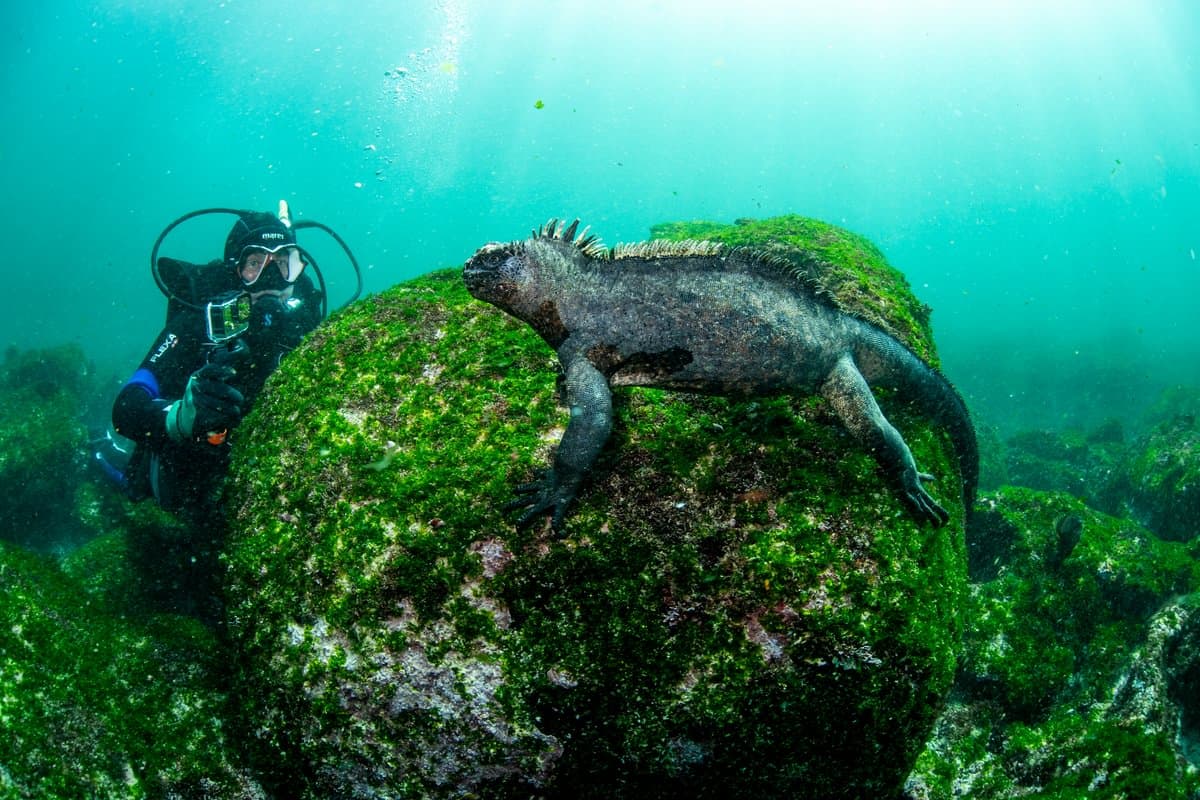
Cabo Douglas is where you go to watch a lizard eat underwater. On the exposed north-west coast of Fernandina, the westernmost island in the Galápagos, big male marine iguanas push off the black lava around the middle of the day and graze algae from rocks a few metres down. The same cold, upwelling water that grows that algae also brings sea lions, fur seals, flightless cormorants and the odd penguin into the shallows. It is a shallow, cold and often surgy dive, reachable only by liveaboard, and it shows you behaviour that exists nowhere else on the planet. Here is what it is really like and how to get the best from it.
Quick answer: Cabo Douglas is a shallow lava reef and wall dive along a rocky shoreline in Galápagos. Best season: Year-round for iguanas; the cool season (roughly June–November) brings the coldest, richest water. Level: Intermediate: easy depths, but cold water and surge need good buoyancy. Depth: Iguanas mostly in 2–10 m; the rocky wall continues below 20 m. Typical visibility: Variable and often limited in the shallows; usually a little better away from the rocks.
Facts verified September 2026
What makes Cabo Douglas special
The marine iguana is the only lizard in the world that forages in the sea, and the Galápagos is the only place it lives. Most iguanas feed on algae exposed in the intertidal zone at low tide. Only the largest males go further, swimming out and diving to graze the subtidal rocks. On Fernandina, where the iguanas are big and spiny, researchers found that the divers are usually males of more than about 3.5 kg. Cabo Douglas puts you right where those animals feed.
The reason they are here is the water. Fernandina and western Isabela sit in the path of the Cromwell Current, a cold, nutrient-rich flow that wells up against the islands from below. That upwelling feeds the red and green algae the iguanas eat, and the same productivity supports the birds and mammals that make the western islands feel so different from the rest of the archipelago. Fernandina has no town or harbour, and diving here is only possible from a liveaboard.
What you'll see
The iguanas are the reason you come, but Cabo Douglas is a busy shoreline in general. Researchers have used it to study both of the archipelago's pinnipeds, and the north-west coast here is a feeding area for each. Expect plenty of company in the shallows.
- Marine iguanas grazing algae off the rocks, often in a few metres of water, clinging on with long claws while the surge moves around them
- Galápagos sea lions, which feed by day as well as by night and are often curious about divers
- Galápagos fur seals, which outnumber sea lions on this stretch of coast but feed mostly at night, so by day you are more likely to see them resting ashore
- Flightless cormorants, which live only on Fernandina and northern and western Isabela and hunt on the bottom close to shore
- Galápagos penguins, whose main colonies are on Fernandina and Isabela, sometimes darting through after small fish
- Green turtles, reef fish and, on the deeper wall, black coral, overhangs and with luck red-lipped batfish, seahorses and the occasional mola
Conditions and who it's for
Cabo Douglas is not a deep or technical dive, but it is not a soft one either. The coast faces the open ocean, and close to the rocks, exactly where the iguanas feed, the swell and surge can be strong. You need buoyancy good enough to hold position a couple of metres off a rock face while the water pushes you back and forth, without grabbing anything or landing on the algae. Current away from the shore is usually mild, though divers do report days when it runs.
The water is cold. Figures from operators and divers commonly sit between about 17 and 23°C, and when the upwelling is strong it can drop lower still, with some reports into the low teens. A 7 mm wetsuit with a hood is a sensible starting point, and many divers on the western route use a semi-dry or drysuit. Visibility is variable: the shallows are rich in plankton and stirred up by surge, so expect it to be limited near the rocks and a little better further out. Galápagos liveaboards that run the western route generally ask for an advanced certification and current experience, mostly because of the other sites in the same week.
When to dive it
Iguanas live and feed here all year, so there is no wrong month for the main event. The cool season, roughly June to November, brings the coldest and most nutrient-rich water to the western islands, along with the best odds of mola in the area. The warm season, roughly December to May, is generally calmer on the surface and a little kinder on temperature. Some boats only route through Fernandina in part of the year, so check that the week you are looking at includes the western islands.
Time of day matters more than month. Iguanas need to warm up in the sun before they can feed, and the large males usually go into the water around the middle of the day, from late morning into the early afternoon, then haul out again to rewarm. A dive close to midday gives the best chance of finding several feeding at once. Very early dives can find most of them still basking on the lava. Strong El Niño years are the one big exception: warm water kills off the algae, iguanas starve and the largest animals suffer first, so it can take a few years for numbers of big feeding males to recover.
Watching iguanas responsibly
Underwater, a feeding iguana is often so focused on the rock that it lets divers come close. That is exactly when restraint counts. Galápagos National Park rules require you to stay at least 2 metres from wildlife, even if the animal approaches you, and never to touch or feed it. Your guide is a park-licensed naturalist and will hold the group to that.
An iguana in the sea is cooling down all the time and has to get back to the rocks and the sun to rewarm, so never block its way up or back to shore, and do not follow one that is heading in. Keep below and slightly off to the side rather than hanging over it, stay off the algae-covered rocks, and keep fins well clear of the surface when sea lions or cormorants are around. The park rules also say no flash photography of wildlife, so listen to the briefing on what that means for lights and strobes on the day. Natural light works well in this depth range anyway.
How you actually dive it
On weeks that include the western islands, boats usually reach Fernandina after a long overnight crossing from the far north, and Cabo Douglas is often paired with Punta Vicente Roca on nearby Isabela. You go in from a tender close to the shoreline, descend along the rocky slope and then work the shallows where the iguanas are feeding, usually between about 2 and 10 metres. If time and air allow, the guide may drop you down the wall for turtles, black coral and the smaller critters before you come back up the slope.
Pick-up can be lively. With swell running against the lava, tenders often wait a little way off the rocks, so expect a short surface swim to the boat. Watch your air in the cold, carry a surface marker and stay with your guide, because the surge zone is no place to drift away from the group. Treat the whole dive as a slow one: fewer kicks, more watching, and let the animals decide how close the encounter gets.
Faneca dives Cabo Douglas on weeks that include the western islands, usually after the overnight crossing south from Wolf. Routes depend on weather and park permits, so we tell you at booking whether the week you choose is planned to reach Fernandina.
Cabo Douglas: common questions
What is the best season to dive Cabo Douglas?
Year-round for iguanas; the cool season (roughly June–November) brings the coldest, richest water
What experience level do I need for Cabo Douglas?
Intermediate: easy depths, but cold water and surge need good buoyancy
How deep is Cabo Douglas?
Iguanas mostly in 2–10 m; the rocky wall continues below 20 m
What marine life will I see at Cabo Douglas?
Feeding marine iguanas, Galápagos sea lions and fur seals, flightless cormorants, Galápagos penguins, green turtles, reef fish; with luck mola, red-lipped batfish and seahorses