Liveaboard Cabins for Couples: Which Boats Have Real Double Beds and Exactly Which Cabin to Book
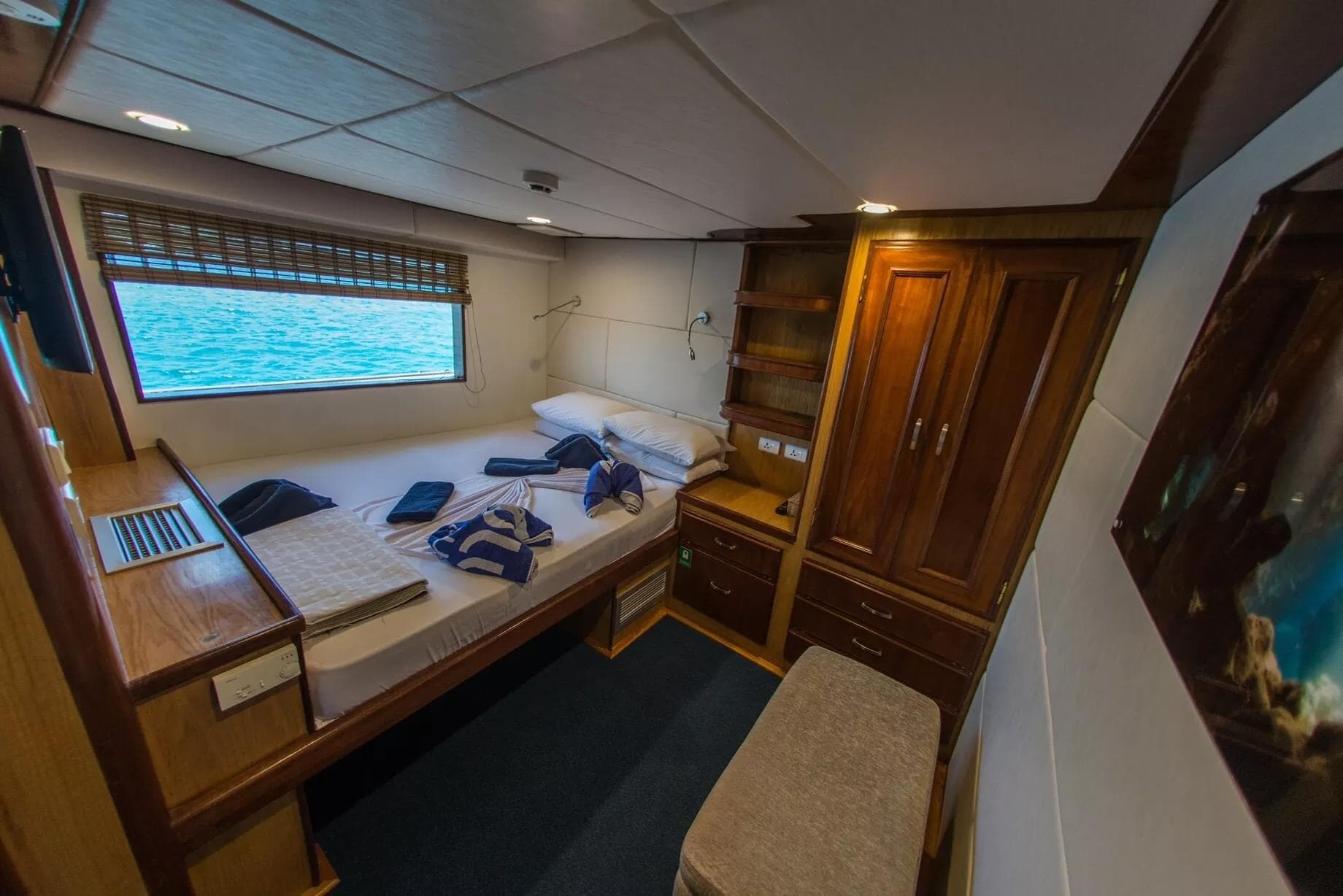
Here is the thing every liveaboard booking page hides from you: the word "double" is doing a staggering amount of dishonest work. When you're shopping liveaboard cabins for couples, that little bed icon can mean an actual queen you'll both sleep across — or two narrow singles shoved together with a seam down the middle and a mattress gap that swallows your arm at 3 a.m. Aggregators list the boat, the price, and a stock photo. They almost never tell you which one you're actually getting. So this guide does the thing they won't: name the real cabin traps, then tell you exactly which cabin to request — and why the answer changes from boat to boat.
This is not a nitrox-and-camera-table post. It's about sleep, privacy, and whether the two of you actually enjoy the week or spend it bracing against a bulkhead. Get the cabin right and everything else — the diving, the sunset-deck beers, the whole reason you booked a boat instead of a resort — gets better.
Why "liveaboard cabins for couples" is a category, not a checkbox
A solo diver can sleep in a bunk over a stranger and not care. A couple cannot un-know that their dive trip is happening in a cabin the size of a walk-in closet, on two mattresses that don't touch, next to an engine room that throbs all night. The variables that barely register for a single traveler — bed configuration, ensuite versus shared head, deck position, distance from the engine — are the entire experience for two people sharing one small room for a week.
And here's the moat: because bed setups vary by individual vessel — not by fleet, not by "cabin class," but by the specific boat and sometimes the specific cabin — you genuinely cannot know what you're getting from a listing alone. Two boats can both advertise a "Deluxe Double" and deliver completely different rooms. The only reliable move is to have someone confirm the exact cabin for your exact dates. More on that at the end — but keep it in mind as you read, because every trap below is solved by one confirmation email.
If you want the full taxonomy of what each cabin name technically means, we break it down in liveaboard cabin types explained. This post is the couples-specific overlay on top of it.
Trap #1: the "double" that's really two singles
This is the single most common disappointment, and it's the reason this post exists.
A liveaboard double cabin can be built two ways:
- A genuine double, queen, or king mattress — one bed, one surface, you sleep together the way you do at home.
- Two twin berths side by side, sometimes pushed together to simulate a double, sometimes with a permanent gap, sometimes in the classic one-bunk-over-the-other layout that isn't a double at all.
The listing photo is frequently the best cabin on the boat, or a render, or another vessel in the fleet entirely. "Double" on a booking engine is a category flag, not a promise about the mattress.
I've watched couples board expecting a king and find two singles with a bolster wedged in the crack. Nobody lied to them exactly — the boat "has doubles." It just wasn't that double. The fix costs one question, asked before you pay.
What to actually confirm: is this one continuous mattress, or two singles? If two, do they lock together, and is there a topper that bridges the seam? On many boats the honest answer is "two singles, no topper" — and for some couples that's a dealbreaker worth knowing on day zero instead of day one.
Trap #2: ensuite vs. shared head — the privacy line
For solo travelers, a shared bathroom down the passage is a minor inconvenience. For couples it's a different trip entirely.
A private ensuite cabin means your toilet and shower are inside your room. You rinse off after a dusk dive, you don't queue in a wet corridor in a towel, you have actual privacy for a week. Shared-head boats — common on older or budget vessels — route several cabins to one or two communal bathrooms. It's serviceable. It is not romantic, and it magnifies every other small friction of small-space living.
If ensuite matters to you — it does for most couples — don't assume it. Plenty of lower-deck and budget cabins on otherwise-lovely boats share facilities. Confirm the cabin itself has its own head, not that "the boat has ensuite cabins," which stays true even if the one you're being sold doesn't.
This is one of the sharpest lines in the whole liveaboard vs. resort diving tradeoff: a resort room is always a private ensuite with a floor that doesn't move. A boat trades some of that comfort for waking up already on the dive site. Knowing exactly what your cabin gives back is how you make that trade with eyes open.
Trap #3: deck position — where noise, motion, and price collide
This is the variable couples underrate the most, and it's the one that quietly decides how well you sleep.
Boats are stacked, and where your cabin sits changes everything:
| Deck position | Noise & motion | Light | Price | Couples verdict |
|---|---|---|---|---|
| Lower deck / waterline | Most engine hum, generator noise, water-line slap; you feel motion more | Little or none (portholes at best) | Cheapest | Fine on a budget; light sleepers suffer |
| Main deck, mid-ship | Quieter, well-damped motion | Often has windows | Mid-to-high | The sweet spot |
| Upper deck | Quietest from the engine, brightest | Large windows, best views | Priciest | Lovely, but higher = more sway in swell |
| Forward (any deck) | Pitches hardest into oncoming swell; anchor-chain noise | Varies | Varies | Avoid if either of you gets seasick |
| Beside the engine room | Loudest on the boat, constant | Varies | Sometimes discounted | Skip unless you sleep through anything |
The pattern: lower and cheaper trades sleep quality for money. Waterline cabins get more engine noise, more hum, and more felt motion because you're near the boat's pivot line and close to the machinery. Main- and upper-deck cabins are quieter and brighter and cost more. Forward cabins — anywhere on the boat — pitch the hardest when you're steaming into swell, and they're first to hear the anchor chain run out at dawn. Anything sharing a wall with the engine room is the loudest bunk aboard.
There's no universally right answer here — it's your money against your sleep. But for two people who actually want to rest, the math leans hard toward paying up a deck.
The couples sweet spot: what to request, every time
Strip away the marketing and the ideal couples cabin is remarkably consistent:
- A true double — one continuous mattress, confirmed, not two singles with a seam.
- A private ensuite — your own head and shower inside the cabin.
- Mid-ship, on the main or upper deck — the calmest, quietest, best-damped part of the boat.
- Not forward, not against the engine room — the two positions that wreck sleep for light sleepers and anyone prone to seasickness.
That combination — true double, ensuite, mid-ship, main or upper deck — is the quietest, most private, most comfortable sleep the boat can offer two people. It usually isn't the cheapest cabin, and it usually isn't the flashy top suite either; it's the well-positioned middle. On many boats it's a "Deluxe" or "Suite" tier; on others the mid-ship main-deck cabin is simply standard. That inconsistency is exactly why you confirm rather than assume.
If you're planning this as a honeymoon or a milestone trip, the cabin choice is most of the "romance" a liveaboard actually delivers — we go deeper on the celebration side in honeymoon liveaboard trips for couples.
What to actually say when you book
Here's the script. Copy it, adapt it, send it before you put money down on any cabin:
- "Is cabin X a single continuous double/king mattress, or two twin beds? If two, do they join, and is there a topper over the seam?"
- "Does this specific cabin have its own private ensuite head and shower?"
- "Which deck is it on, and where along the boat — forward, mid-ship, or aft?"
- "How close is it to the engine room or generator?"
- "For our dates, is this exact cabin the one we'll be assigned, or is assignment done at check-in?"
That last question matters more than people expect. On some boats you book a category and get assigned a specific cabin only when you board — meaning two couples who paid the same can end up in very different rooms. If cabin assignment is flexible, that's your opening to request the good one early.
The answers genuinely differ by boat. A modern Maldives boat might give you a wall of window on the upper deck with a real king; an older classic-hull boat in the Raja Ampat fleet might run mostly twins with a couple of true doubles you have to specifically claim. The Maldives fleet skews newer and more couple-friendly on average; remoter destinations sometimes run older boats where the good double is a scarce, book-early cabin. Same question, different answers — which is the whole point.
Why you should just let someone confirm it
You can absolutely email a boat directly and run the script yourself. But the honest reality of this market is that cabin details live in operators' heads and internal notes, not on the polished booking page — and the answer for your dates depends on what's already sold. That's the gap a good agency closes.
We hold cabins the boring, useful way: we look at what's genuinely available for your dates on our live departures calendar, confirm the actual bed configuration and deck position with the operator, and only then put a 72-hour hold on the specific cabin — the real double, the ensuite, the mid-ship one — so you're not paying to find out. No booking engine does that. It's the difference between "the boat has doubles" and "cabin 4, main deck, mid-ship, confirmed king, ensuite, held for you until Thursday."
Tell us how you two sleep — light sleeper, seasick-prone, want the window, want the quietest cabin on the boat — and we'll match the room to it. Start with a note on the concierge page; if you're still choosing a destination entirely, say so in the brief and we'll narrow that down first. Either way the goal is the same: you book knowing exactly which mattress you're sleeping on, not hoping.
Get the cabin right and the liveaboard does what a resort never can — puts you both to sleep and wakes you up already on the dive site. That's the whole promise, and it lives or dies on one confirmed cabin.
Related Guides
- Liveaboard cabin types explained — the full taxonomy behind every cabin name on the booking page
- Honeymoon liveaboard trips for couples — the celebration-and-romance layer on top of the right cabin
- Liveaboard vs. resort diving — the comfort-for-access trade, honestly weighed
- Maldives liveaboard diving — a newer, more couple-friendly fleet on average
- Raja Ampat liveaboard diving — remote reefs where the good double is worth claiming early
Related Articles
The Complete Liveaboard Packing Guide
What to bring, what to leave behind, and the gear essentials that experienced liveaboard divers swear by.
First-Time Liveaboard: What to Expect Day by Day
Never done a liveaboard? Here's the inside scoop on the schedule, the meals, the diving, and the delightful chaos.