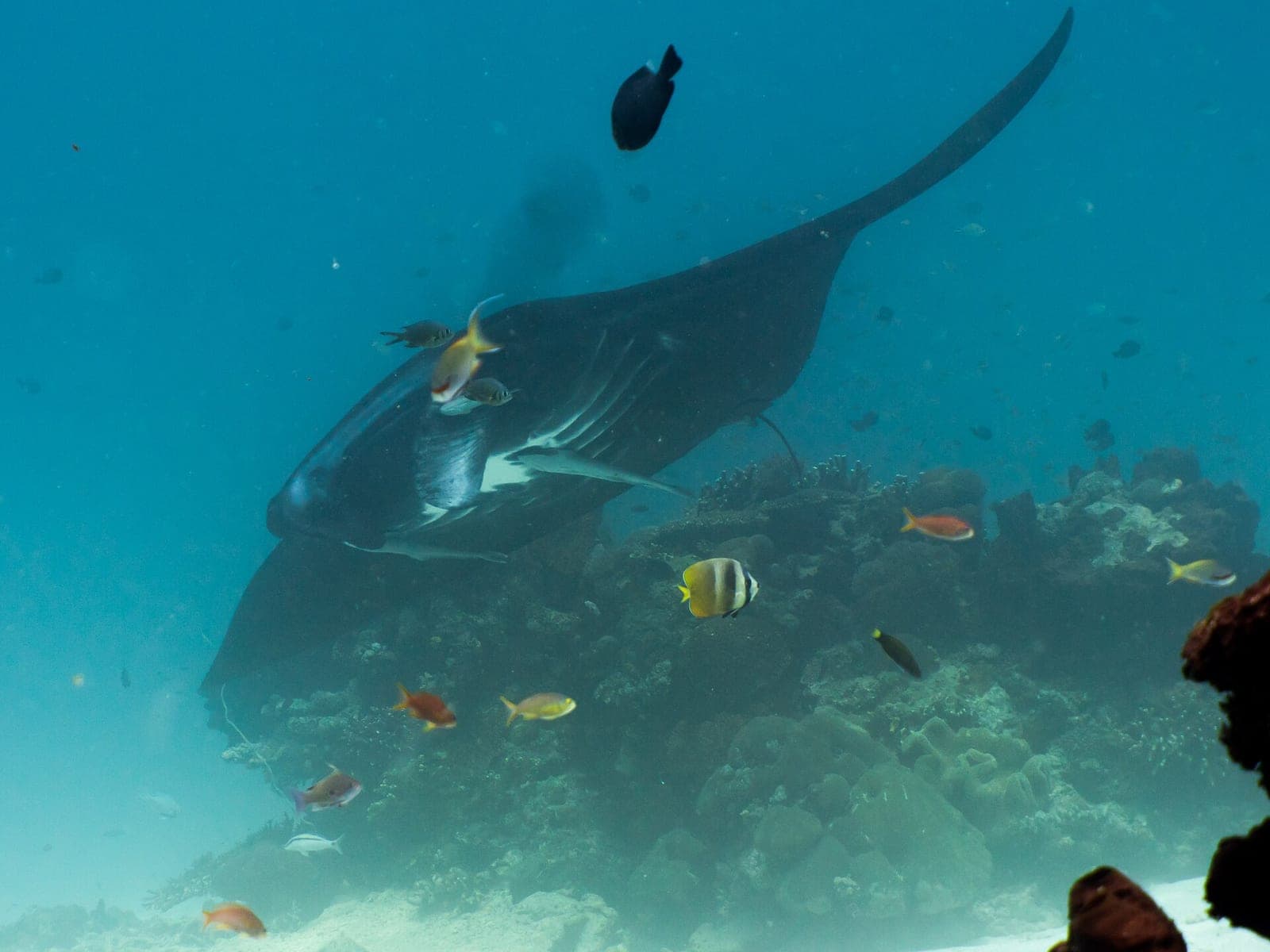
Manta Sandy
A shallow sand channel in the Dampier Strait where reef mantas queue up to be cleaned — and you get a front-row seat if you can hold still.
Manta Sandy is the dive most people book Raja Ampat for and few forget. It is not a wall, not a pinnacle, and not remotely dramatic to look at: a pale sandy plateau at 16 metres, a scatter of coral bommies, and a line of rocks laid in the sand that you are not allowed to cross. What makes it one of the most dependable manta dives on the planet is what happens above that sand. Reef mantas circle in to hover over the bommies while cleaner wrasse pick them over, and on a good day in season you sit quietly and watch a dozen of them stack up in the current. This is diving as patient wildlife-watching, and it rewards the diver who does the least.
Quick answer: Manta Sandy is a sandy-channel cleaning station (not a wall or drift) — hold-and-watch diving in Raja Ampat. Best season: October–April (NW monsoon); peak December–March, with November–February calmest and clearest. Level: All levels — good buoyancy and comfort holding position on the sand matter more than logged dives. Depth: Cleaning station at ~16 m; max around 18 m; entry near the top of the sand bank a metre below the surface. Typical visibility: Typically 20–30 m, often excellent.
Facts verified September 2026
Why Manta Sandy is special
Most manta encounters are luck. Manta Sandy is closer to an appointment. The site is a natural cleaning station: a sheltered sandy corridor between two reefs where cleaner wrasse set up shop on the coral bommies, and reef mantas come in to hover, mouth open, wings barely moving, while the little fish work over their gills and skin. Because the mantas return to the same bommies day after day, the odds here are as good as manta diving gets in Raja Ampat.
The other thing that sets it apart is how close it lets you be without chasing anything. You do not swim after the mantas. You settle on the sand behind a marked line and let them come to you, and they routinely do — passing overhead within a couple of metres, unbothered, as long as the group stays calm. Raja Ampat also hosts an unusually high proportion of black, or melanistic, reef mantas, so a good session often includes both the classic grey-and-white animals and the near-solid-black ones gliding through together.
What you'll see
The stars are reef mantas (Mobula alfredi), typically two to three metres across, and in the right conditions you may see a good number of them working the station at once. Larger oceanic mantas turn up occasionally but are the exception here — do not book the trip on that promise.
The supporting cast is worth your attention between fly-bys, especially on the sand itself:
- Cleaner wrasse — the whole reason the mantas show up; watch them service the gills
- Black (melanistic) reef mantas mixed in with the standard morphs
- Cobia and golden trevally shadowing the mantas
- Bumphead parrotfish and passing turtles over the reef edges
- Seamoth (Pegasus) and other small critters shuffling across the sand — a reason to scan before you kneel
Conditions and who it's for
Manta Sandy is one of the more forgiving signature dives in Raja Ampat. It is shallow — you spend the dive around 16 metres — and the current is usually mild to medium, nothing like the ripping flow at pinnacle sites such as Blue Magic or Cape Kri. Visibility is commonly 20 to 30 metres.
That said, easy depth does not mean careless diving. The whole point is to hold a stable position on the sand without silting the place out or drifting into a manta's path, and that takes real buoyancy control. Newer divers do this site all the time and love it, but if your trim is shaky, practise settling neatly on a sandy bottom before you get here. When the current is running you may need a negative or prompt entry to get down and behind the line quickly, so listen to your guide's briefing on entry timing.
When to dive it
Manta activity at Manta Sandy tracks the northwest monsoon, roughly October through April, which is also the main Raja Ampat liveaboard season. The reliable window is around December to March, with November through February usually offering the calmest water, the best visibility, and mantas at the cleaning station in numbers.
Outside that window mantas still appear, but sightings thin out and become less predictable. If a strong, repeatable manta encounter is the reason you are coming to Raja Ampat, plan for the heart of the season rather than the shoulders.
How you actually dive it
You are usually dropped near the top of the sand bank, a metre or so under the surface, and follow the slope down to the flat bottom at about 16 metres where the cleaning bommies sit. Debris, rocks and coral have been arranged into a line in the sand — every diver must stay behind it. This is not a suggestion; it keeps the group out of the mantas' approach lanes so the animals keep coming.
Before you kneel, scan the sand for camouflaged critters, then settle low, keep your bubbles as controlled as you can, and go still. Do not swim toward the mantas, do not chase, and never touch or try to position yourself over one — the rule is strictly no touching, chasing or harassing. If a manta tracks toward you, hold your line and let it pass; mimicking their slow, unhurried movement reads as non-threatening. Manta Sandy is also protected by a ranger station that caps the site at 20 people (divers and snorkellers combined) via a booking system and enforces a no-go zone for boats over the cleaning area, so your operator books a slot rather than just showing up.
Faneca dives Manta Sandy on our Raja Ampat liveaboard itineraries aboard the Blue Pearl and Dancing Wind, which cruise the Dampier Strait in the October–April manta season; because the site runs on a ranger booking system with a hard cap of 20 people, we schedule it around the tides and the day's slot rather than promising it on demand.
Manta Sandy: common questions
What is the best season to dive Manta Sandy?
October–April (NW monsoon); peak December–March, with November–February calmest and clearest
What experience level do I need for Manta Sandy?
All levels — good buoyancy and comfort holding position on the sand matter more than logged dives
How deep is Manta Sandy?
Cleaning station at ~16 m; max around 18 m; entry near the top of the sand bank a metre below the surface
What marine life will I see at Manta Sandy?
Reef mantas (including black/melanistic morphs), occasional oceanic mantas, cleaner wrasse, cobia, golden trevally, bumphead parrotfish, turtles, seamoth (Pegasus) on the sand
